


Black
-

Takashi Murakami TM/KK Jellyfish Eyes Black 2 Lithograph Print by Takashi Murakami TM/KK
Jellyfish Eyes Black 2 Lithograph Print by Takashi Murakami TM/KK Hand-Pulled Print on Wove Fine Art Paper Limited Edition Graffiti Street Pop Artwork. 2004 Signed & Numbered Limited Edition of 300 Artwork Size 19.75x19.75. Comes Framed in 2 Frame Styles, Modern Blck Frame Size 22x22, Beige Matte Frame Size 28.75x28.75 Jellyfish Eyes Black 2 by Takashi Murakami – Floating Optics in Street Pop Art & Graffiti Artwork Takashi Murakami’s 2004 lithograph Jellyfish Eyes Black 2 stands as a vibrant continuation of his exploration into recurring motifs of vision, surveillance, and playful abstraction. Measuring 19.75 x 19.75 inches, the print is part of a signed and numbered limited edition of 300, released under the TM/KK imprint. Executed on fine wove art paper, the composition features a constellation of color-saturated, stylized eyes that hover and merge across a velvety black field. The piece is available in two distinct presentation options—modern black frame at 22 x 22 inches, and an elegantly soft beige matte frame at 28.75 x 28.75 inches—each emphasizing the spatial fluidity of Murakami’s floating forms. In the context of Street Pop Art & Graffiti Artwork, this piece emerges as both a study in surface aesthetics and a philosophical meditation on perception and presence. Murakami’s Animated Language of Form The visual structure of Jellyfish Eyes Black 2 builds upon the iconography of its predecessor, deploying a series of floating eyeball-like entities that fuse pop animation with organic drift. Set against a deep black background, the circular forms appear to pulse and glow, shifting subtly in tone and layering. Each figure is constructed with concentric rings of bold color—lime greens, blush pinks, scarlets, turquoise, ochres—punctuated with lashes, droplets, and slight distortions. The connective tissue that flows between the eyes resembles both mycelium and neural pathways, suggesting a symbiotic or collective intelligence. Within the lexicon of Street Pop Art & Graffiti Artwork, this mapping of interlinked optics translates as a metaphor for social networks, media vision, and collective consciousness. Murakami’s abstraction is not random; it is tightly ordered chaos, echoing both Japanese folklore and cybernetic futurism. Optical Play and the Superflat Aesthetic True to Murakami’s Superflat manifesto, Jellyfish Eyes Black 2 rejects the illusion of spatial depth while simultaneously creating tension and layering. The eyes are rendered in a graphic, poster-like style, referencing both commercial design and the techniques of Japanese anime and manga. The lithographic medium allows for pristine color reproduction, retaining Murakami’s digital sharpness and uniform flatness. This results in a visual experience where each element competes equally for attention, much like signage in urban space or characters in graffiti murals. The framing options further influence viewer reception—one suggesting sleek modernity and the other a nostalgic museum-grade presentation. Both emphasize the contrast between high-end collectibility and subcultural rawness. Eyes as Agents of Identity and Control In Jellyfish Eyes Black 2, the floating eyes are both whimsical and menacing. They call to mind not only the innocence of animated characters but the omnipresence of surveillance and digital observation. Murakami leverages the symbol of the eye to reflect the watching, documenting, self-aware nature of modern identity. The multiplicity of eyes within the same space speaks to fragmentation, overload, and an inability to escape the gaze—whether from others, institutions, or ourselves. In the realm of Street Pop Art & Graffiti Artwork, eyes often appear as markers of territory, vision, and spiritual assertion. Here, they become avatars of psychological atmosphere. Takashi Murakami’s Enduring Influence in Global Pop Visual Culture Takashi Murakami continues to serve as one of the most influential artists at the intersection of commercial design, conceptual painting, and urban culture. His approach unites Japanese Edo traditions with the immediacy of contemporary visual storytelling. Jellyfish Eyes Black 2 is emblematic of this approach—deceptively simple, richly layered, and hauntingly joyous. It occupies a space where traditional craftsmanship meets hyper-modern aesthetics, and where personal mythologies intermingle with digital consumer culture. The piece is not merely collectible—it is a portal into a stylized cosmos of symbolic resonance, humor, and introspection, rendered in flawless print form for the language of the street and the gallery alike.
$2,250.00
-

Takashi Murakami TM/KK Jellyfish Eyes Black 1 Lithograph Print by Takashi Murakami TM/KK
Jellyfish Eyes Black 1 Lithograph Print by Takashi Murakami TM/KK Hand-Pulled Print on Wove Fine Art Paper Limited Edition Graffiti Street Pop Artwork. 2004 Signed & Numbered Limited Edition of 300 Artwork Size 19.75x19.75 Jellyfish Eyes Black 1 by Takashi Murakami – A Psychedelic Icon of Street Pop Art & Graffiti Artwork Jellyfish Eyes Black 1 is a 2004 signed and numbered limited edition lithograph by renowned Japanese contemporary artist Takashi Murakami, measuring 19.75 x 19.75 inches. Issued in an edition of 300, the print features a cluster of floating, stylized eyes with jellyfish-like appendages, hovering across a black background with vibrant, pulsating color. The concentric orbs and whimsical lashes form an enigmatic composition that is both playful and surreal, drawing viewers into Murakami’s immersive visual universe. This work exemplifies Murakami’s ability to merge traditional Japanese aesthetics with global pop culture, injecting high-energy iconography into the realms of Street Pop Art & Graffiti Artwork. Neo-Pop Formalism Meets Subcultural Visual Language The hypnotic design of Jellyfish Eyes Black 1 showcases Murakami’s deep engagement with visual repetition and pop surrealism. Each eye radiates concentric bands of neon pink, electric blue, acid green, and gold—colors more commonly associated with commercial animation, toy design, and graffiti murals than traditional lithography. The black background intensifies the floating sensation of these biomorphic forms, transforming the space into a dreamlike field of suspended consciousness. Murakami’s roots in Nihonga painting and Edo-period compositions are evident in the fluid arrangement and balance, while the synthetic palette and digital smoothness embrace the commercialized intensity of pop iconography. In Street Pop Art & Graffiti Artwork, this blend of classical order with radical form asserts Murakami’s place as both historian and provocateur. Eyes, Surveillance, and the Otaku Psyche The eyes that populate Jellyfish Eyes Black 1 are not passive. They gaze back with unsettling presence, creating a dynamic tension between observer and observed. The motif reflects Murakami’s frequent exploration of otaku culture, surveillance capitalism, and the consumer gaze. These eyes are playful, even cute, but also obsessive, invasive, and endlessly watching. Some appear innocent; others twitch with layered concentric pupils and pupil-like satellites. This multiplicity mirrors the fragmentation of identity in digital and urban life. As seen across the broader scope of Street Pop Art & Graffiti Artwork, these eyes function as pop sigils—icons that entertain, disturb, and invite deeper inspection. Takashi Murakami and the Legacy of Superflat in Street Art Takashi Murakami’s impact on both fine art and street culture cannot be overstated. Through his Superflat theory, he developed a framework for collapsing the boundaries between high and low, ancient and hyper-modern, traditional painting and graffiti-inspired visual immediacy. Jellyfish Eyes Black 1 exists within that lineage as a work that is collectible, cultural, and subversively simple. The lithograph form nods to limited edition printmaking history while its aesthetic remains grounded in the saturated language of mass media and youth culture. As Street Pop Art & Graffiti Artwork continues to evolve globally, Murakami’s work offers a lens into how Japanese visual codes, anime motifs, and psychedelic surface treatments can coexist with the raw expressiveness of street-born art forms. Jellyfish Eyes Black 1 does not demand translation—it simply stares back, glowing in the dark, inviting you to feel.
$2,250.00
-
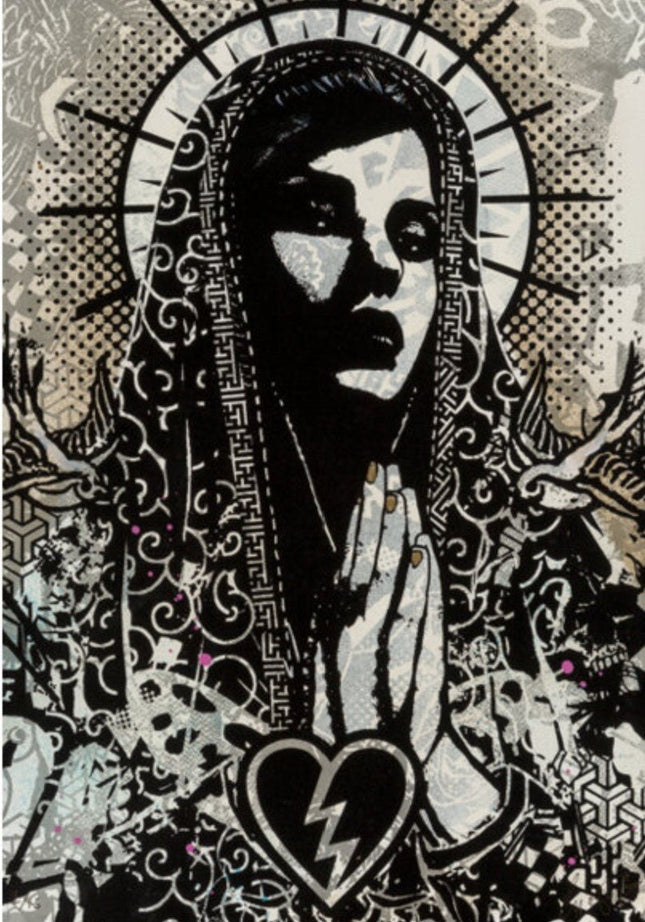
Copyright Signs Black HPM Silkscreen Print by Copyright
Signs- Black Limited Edition Hand-Embellished HPM 2-Color Silkscreen on Fabriano Watercolor Paper by Copyright Graffiti Street Artist Modern Pop Art. Copyright (20th century) Signs (Black), 2016 Mixed media screenprint in colors on Fabriano Watercolor paper 19-3/4 x 13-3/4 inches (50.2 x 34.9 cm) (sheet) Ed. 2/13 Signed and numbered in ink along the lower edge.
$503.00
-
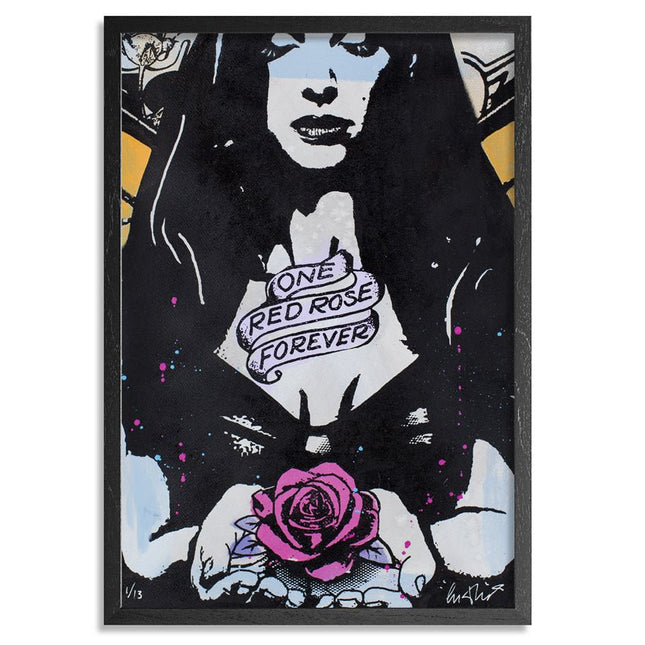
Copyright One Rose Black Silkscreen Print by Copyright
One Rose- Black Limited Edition 2-Color Hand-Pulled Silkscreen Mixed Media Spray Paint Print on 300 gsm Fabriano Watercolour Paper by Copyright Graffiti Street Artist Modern Pop Art. "I did an exhibition last year that opened on Valentine's Day which was called ‘One Red Rose Forever’. It’s an old Sailor Jerry tattoo phrase. I always like to revisit and re-imagine my own personal archive of imagery in new ways. This image is a reworking of a much larger piece I painted a couple of years back. I'm always thinking, if my paintings were songs what would they sound like? Often I'll be listening to a song and it'll give me an idea for a painting. All it takes is a phrase, or sometimes I'll come up with a particular profound emotion and try to depict it as an image in the same way a musician would in a song." - Copyright
$352.00