Await Artwork Giclee Limited Edition Print on 290gsm Fine Art Paper by Pop Culture Graffiti Artist Kevin Peterson.
2019 Signed & Numbered Limited Edition Await Edition of 100 26x20 inches / 66x50.8 cm Fine art print on 290gsm paper Hand signed and numbered by the artist
Kevin Peterson’s Await: Urban Isolation and the Quiet Power of Companionship
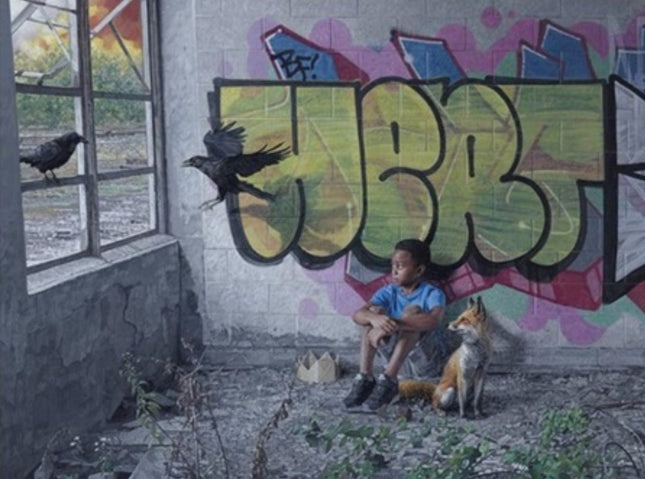
Kevin Peterson’s Await, released in 2019 as a signed and numbered giclée limited edition of 100, captures a hauntingly tender moment within the decayed remains of an urban structure. Measuring 26 x 20 inches and printed on 290gsm fine art paper, the work brings together hyperrealistic detail and narrative symbolism through the lens of Street Pop Art & Graffiti Artwork. A young boy sits on the floor of an abandoned building, his body language quiet and contemplative. He is not alone—a fox rests by his side, and two crows linger near a shattered window. Behind them, vibrant graffiti commands the wall, asserting presence in a space otherwise forgotten. Peterson continues his thematic exploration of childhood resilience in fractured environments. The child, dressed in a blue shirt and sneakers, becomes the emotional center of the piece, gazing into the distance as if waiting for something uncertain. The fox—calm, alert, and intimate—sits with him like a watchful companion. The crows hover on the boundary between inside and out, motion frozen mid-flight. These animals are not placed for aesthetic decoration—they are symbols. The fox often signifies cunning, adaptability, and trust in folklore, while crows bring with them meanings of observation, change, and memory. Together, they form a trio that blurs the lines between survival and stillness.
Decay as a Canvas for Meaning
The setting of Await is rendered in stunning detail, with cracked concrete, broken window panes, overgrown weeds, and dust-covered tile telling a story of abandonment. Yet the walls are not silent. Behind the boy, the word “UBRT” explodes in saturated graffiti. The boldness of the lettering stands in stark contrast to the muted greys and crumbling surfaces of the environment. The wall’s artwork becomes a voice—vivid, expressive, and alive—asserting that this space, though forgotten by the world, still holds energy and identity. Peterson treats the graffiti not as a backdrop, but as a character in its own right. The use of street art as part of the composition affirms the work’s alignment with Street Pop Art & Graffiti Artwork. Peterson is not merely documenting urban environments; he is mythologizing them. These ruins are not empty—they are sacred arenas where inner lives play out, where emotion survives despite absence. The boy’s paper crown, lying near his feet, adds another layer of poetic symbolism. It evokes lost innocence, imaginative sovereignty, or the fragile authority children construct in unstable realities.
Stillness, Survival, and Street Pop Allegory
What elevates Await beyond realism is its sense of sacred quiet. Peterson’s figures do not pose—they exist. The boy and his animal companions do not dramatize their condition; they endure it with grace. The lack of spectacle intensifies the atmosphere. The viewer is invited not just to look, but to sit with the scene, to inhabit its silence. The title itself, Await, implies anticipation—but for what remains unknown. The answer is left to the viewer, suspended like the crows midair, fluttering at the edge of an open window. Peterson’s work belongs to a school of Street Pop Art that replaces the bombast of rebellion with narrative intimacy. He shows us that the city, even when broken, remains a place of encounter, symbolism, and inner transformation. Await is not about spectacle—it is about presence. In a world often moving too fast to notice moments like this, Peterson slows time down just enough for us to see the waiting, the watching, and the quiet beauty in staying still.
Read
more
less