
Flag
-
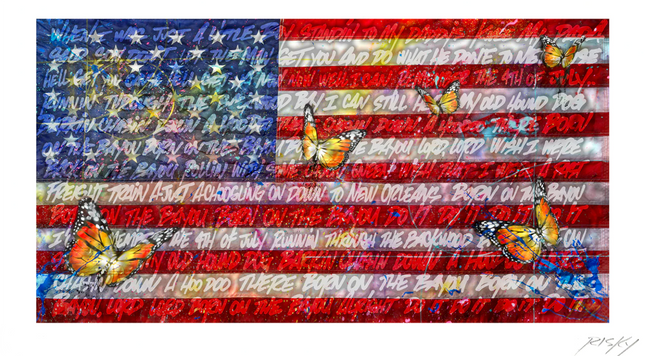
Risk Rock Born on the 4th Giclee Print by Risk Rock
Born on the 4th Giclee Print by Risk Rock Artwork Limited Edition Print on 290gsm Heavy Cold Press Cotton Rag Fine Art Paper Graffiti Pop Street Artist. 2023 Signed & Numbered Limited Edition of 50 Artwork Size 30x18 4th of July American Flag Risk Rock – Born on the 4th in Street Pop Art & Graffiti Artwork Born on the 4th by Risk Rock is a 2023 limited edition giclée print that merges patriotic symbolism with the kinetic force of graffiti. Printed on 290gsm heavy cold press cotton rag fine art paper, this 30x18 inch artwork is a signed and numbered edition of 50. As one of the foundational figures in American graffiti, Kelly Graval—known as Risk Rock—channels decades of visual rebellion into a piece that reflects on identity, memory, and national mythology. With the American flag as its base, overlayed by glowing butterflies and wild-style script lyrics, the work delivers a layered commentary on freedom, heritage, and transformation. The flag is rendered in expressive textures, saturated reds and blues, and stars blurred into bursts of light. Atop the stripes, Risk overlays dense, handstyle calligraphy referencing lyrics from Creedence Clearwater Revival’s Born on the Bayou—a gritty, reflective Southern anthem. The use of handwritten text, characteristic of graffiti, becomes a form of protest and remembrance, embedding personal and cultural history into a national symbol. The choice of lyrics anchors the work in themes of place, nostalgia, and longing, while simultaneously questioning the cost and complexity of American identity. This fusion of visual intensity and personal message is a hallmark of Street Pop Art & Graffiti Artwork. Graffiti Aesthetics Intertwined with Patriotic Imagery The most striking aspect of Born on the 4th is the collision of visual languages: the structured, iconic format of the American flag is interrupted by dynamic spray textures and gestural text. Risk employs his signature handstyle with fluid precision, making every line feel like a freestyle verse across a national canvas. The use of butterflies—painted in vibrant oranges, blues, and golds—adds a contrasting softness and becomes a symbol of freedom, metamorphosis, and fragility. Their presence floating across the flag challenges the rigidity of the structure they inhabit. They seem to represent untamed hope within a framework of constraint. This push and pull between containment and flight mirrors graffiti’s own relationship with authority and space. By reclaiming the flag—often a symbol of establishment—and remixing it with subversive lyricism and street-coded aesthetics, Risk reframes national pride through the lens of rebellion and individuality. This gesture is in direct conversation with the goals of street art: to reclaim public symbols and inject them with alternative narratives and truths. Risk Rock’s Legacy in Street Pop Visual Culture Risk Rock began his career painting freeway overpasses and freight trains in Los Angeles during the 1980s, becoming one of the first to take graffiti from underground subculture into the realm of commercial and gallery art without compromising its raw aesthetic. His work has always balanced fine art execution with street authenticity. Born on the 4th is a continuation of that legacy—layered, polished, and unflinchingly honest. The giclée printing process enhances the saturation and detail, preserving the energy of aerosol textures and brushwork that define his style. In the context of Street Pop Art & Graffiti Artwork, Risk’s flag is not a patriotic celebration alone—it is a visual poem of contradictions, stitched together by memory, struggle, and transformation. It captures the spirit of American graffiti: resistant, self-aware, and defiantly beautiful. The limited edition format adds collectible weight to the message, ensuring the piece remains both art object and cultural statement. Risk Rock’s Born on the 4th stands as a vibrant meditation on place, power, and the stories we write across the banners we inherit.
$493.00
-
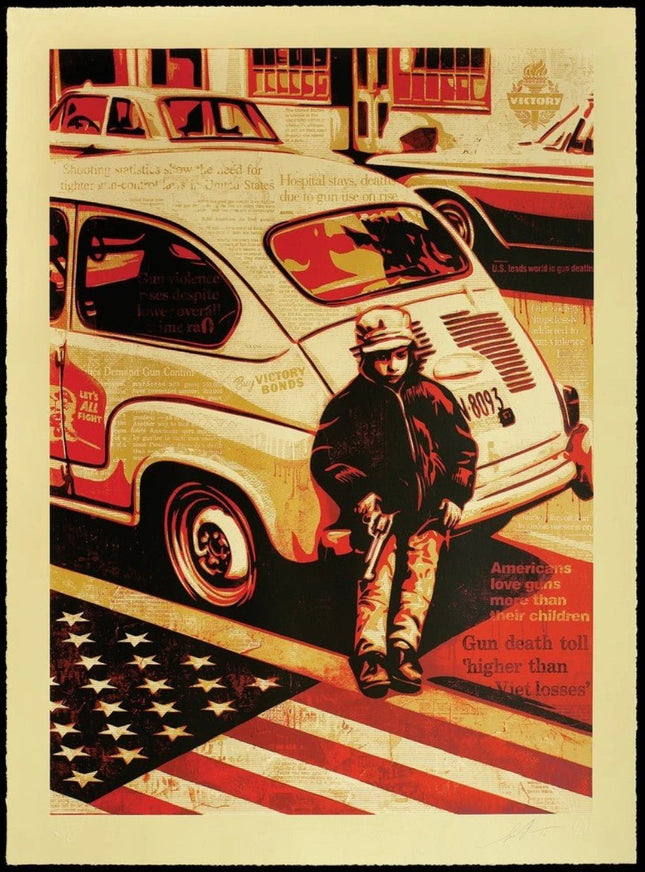
Shepard Fairey- OBEY Gun Culture- Large Format Serigraph Print by Shepard Fairey- OBEY
Gun Culture- Large Format Limited Edition Hand Pulled 4-Color Serigraph Print on Varnished 100% Cotton Rag Archival Paper with hand-deckled edges by Shepard Fairey Graffiti Street Artist Modern Pop Art. 4-Color Serigraph on Varnished 100% Cotton Rag Archival Paper. 30 x 40 inches. Signed by Shepard Fairey. Numbered edition of 100. Jim Marshall captured what at first glance is regarded as an innocent child playing with a toy gun in Greenwich Village, New York, in 1963.
$4,011.00