Flowers & Plants

1 artwork

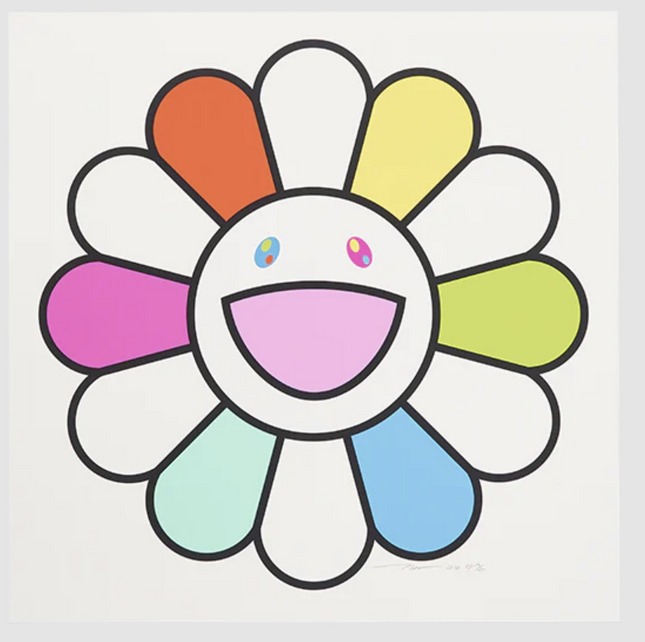
  • Smiley Days with Ms Flower to You! Silkscreen Print by Takashi Murakami TM/KK

    Takashi Murakami TM/KK Smiley Days with Ms Flower to You! Silkscreen Print by Takashi Murakami TM/KK

    Smiley Days with Ms. Flower to You! 8-Color Hand-Pulled Limited Edition Silkscreen Print on Fine Art Paper by Takashi Murakami TM/KK Rare Street Art Famous Pop Artwork Artist. 2020 Signed & Numbered Limited Edition of 100 Artwork Size 19.7x19.7 Rare Takashi Murakami TM/KK Ms. Mr. Rainbow Flower Silkscreen Print Artwork. Small handling bumps to the left/right lower corner, small bump to the upper right corner. Takashi Murakami's Smiley Days with Ms. Flower to You!: Flattened Joy in Pop Art Precision Takashi Murakami’s Smiley Days with Ms. Flower to You! encapsulates his signature blend of cheerful imagery, cultural layering, and ultra-clean graphic execution. Created in 2020 as an 8-color hand-pulled silkscreen print, this limited edition of 100 works stands at 19.7 x 19.7 inches and is signed and numbered by the artist. The artwork features the instantly recognizable flower motif with alternating petal colors and an exaggerated smile across the central face. What appears at first to be a playful, almost childlike symbol of joy is, in Murakami’s visual language, a deeply coded cultural artifact that questions the nature of happiness, identity, and image saturation in the contemporary world. The symmetrical structure and bold outlines suggest cartoon aesthetics, yet Murakami’s execution is far from spontaneous. Every curve, gradient, and color choice is calculated to reinforce a sense of artificial perfection. The smiling flower character, often mistaken for simplistic pop decoration, emerges from a broader lineage of Japanese visual culture—including Edo-period painting, kawaii consumer goods, and the hyper-saturated imagery of anime and manga. By distilling all of these elements into a single figure, Murakami has produced a contemporary symbol that functions across cultures and commercial systems. Superflat Theory and the Deconstruction of Depth Murakami’s Smiley Days with Ms. Flower to You! is a direct application of his Superflat philosophy, which merges traditional Japanese aesthetics with the shallow perspective of digital-age visual consumption. The flatness in this print is not merely stylistic but ideological. It represents a collapse of distinction between fine art and mass media, high culture and consumer object. The lack of depth in the flower’s face, along with the pristine uniformity of the petals, draws attention to how culture packages emotion and sells it as aesthetic surface. Rather than invite introspection through complexity, Murakami’s print bombards the viewer with immediate, digestible visual pleasure. But that sensory overload is deceptive. The flower’s manic grin—framed by perfectly arranged petals in pastel and neon hues—suggests an almost disturbing insistence on happiness. It becomes a symbol not of actual emotional expression but of imposed positivity. The eyes, colored with soft gradients and cartoon sparkle, recall the exaggerated features of anime mascots but also serve as hollow portals in an otherwise flattened identity. Street Pop Art & Graffiti Artwork Rendered with Surgical Cleanliness Though not rooted in traditional graffiti practice, Murakami’s work has been deeply influential in the evolution of Street Pop Art. He merges the visual appeal of mass-produced graphic design with the thematic subversions common in graffiti. The flower motif, while seemingly benign, has appeared on luxury fashion collaborations, vinyl toys, and fine art prints alike, highlighting how symbols circulate between subculture and commerce. Murakami’s deliberate use of commercial channels does not dilute his message—it amplifies it. The print’s pristine execution and wide appeal comment on the mechanisms of art as commodity, without needing to stage rebellion through messiness or illegality. The silkscreen process used in this edition aligns with Murakami’s obsession with perfection. Each color layer is meticulously printed, ensuring consistency and uniform saturation, mimicking the effect of digital art but with the tangible value of a handmade print. This duality—the tactile reality of traditional craft paired with the aesthetics of digital media—reinforces the thematic content of the flower itself: joy as production, identity as design, emotion as product. Murakami’s Smiley Days with Ms. Flower to You! ultimately operates as both a visual balm and a conceptual warning. In Street Pop Art & Graffiti Artwork, surface often holds as much power as meaning, and Murakami leverages that to brilliant, unsettling effect. The flower smiles because it must. Its joy is performative, its beauty standardized—and in that, it holds a mirror to the world that created it.

    $4,936.00

Flower Street Pop Art & Graffiti Artwork
Flowers and plants have been central motifs in art for centuries, and their interpretation in Street Pop Art and graffiti Artwork is no exception. As subjects, they carry a wealth of symbolism and have been used to communicate a broad spectrum of ideas, from the transient nature of beauty to the endurance of growth. In the context of pop art, these natural elements were often rendered in a style that was antithetical to their organic origins, playing into the movement's fascination with commercialization and the banality of mass-produced goods. Artists like Andy Warhol and Roy Lichtenstein brought flowers and plants into the pop art conversation, turning them into repetitive, almost mechanical prints, challenging traditional aesthetics and the art world's elitism.

Floral Imagery in Pop Art

Pop art was known for embracing ordinary objects and its commentary on consumerism. Flowers in this genre were stripped of their individuality and reproduced en masse, much like the commodities they were meant to represent. This treatment of floral subjects underscored the pop art movement's preoccupation with the ideas of standardization and commodification.

Graffiti Art and Botanical Forms

In contrast to the controlled and commercialized depictions in pop art, graffiti artists use flowers and plants to bring a sense of the spontaneous and the organic into urban environments. These artists often choose floral subjects to oppose their harsh concrete canvases directly. The growth of a flower through a crack in the sidewalk is a powerful metaphor for the resilience of nature and is a frequent theme in street art, symbolizing hope and the reclaiming of space by natural beauty.

Street Art's Natural Aesthetic

Street artists have adopted and adapted the flower symbol as a personal tag or signature. The diversity of styles and interpretations among artists is vast, with some using photorealistic depictions of plants to criticize environmental issues. In contrast, others employ a more abstract or stylized approach to convey different messages or emotions. The public nature of street art means these works are not confined to galleries or private collections but are instead part of the everyday landscape, accessible to all.

Symbiosis of Urban and Natural

Street Pop Art and graffiti Artwork often create a symbiosis between the urban environment and the natural world. Flowers and plants depicted in these genres can transform dull or overlooked spaces into areas of interest and beauty. They also serve as a reminder of the natural world amid urban sprawl, offering a moment of reflection for the viewer.

Evolution of Botanical Motifs

The evolution of botanical motifs in street art and pop art reflects broader changes in societal attitudes toward the environment and urban living. As cities become more aware of the importance of green spaces, using plant imagery in street art becomes a visual representation of this shift in consciousness. It is a way for artists to participate in and sometimes lead the conversation on ecological and urban renewal.

Impact on Public Perception

The impact of these natural motifs on public perception and urban aesthetics cannot be overstated. Flowers and plants in street and pop art act not only as decoration but as integral parts of urban communities, shaping the identities of neighborhoods and influencing how residents and visitors interact with their environment.

Artistic Techniques and Media

The techniques and media used to depict these natural forms vary widely, from spray paint to stencils and from paste-ups to large-scale murals. Each method brings a different quality to the plant imagery and can alter its perception. Whether through a stencil's bold, solid colors or the intricate lines of freehand spray paint, the depiction of flowers and plants in street art is as diverse as the artists themselves.

Cultural and Social Significance

Culturally, incorporating flowers and plants into street and pop art has significant social implications. It can be a tool for community engagement, brightening up neglected areas, or making powerful statements about social and environmental issues. This art form is uniquely positioned to engage with the public on a grassroots level, often sparking discussions and inspiring community-driven initiatives.

Preservation and Documentation

While street art is inherently ephemeral, there has been a movement towards preserving and documenting these works. Photographs and books cataloging street art have become increasingly popular, ensuring that the temporary blooms on city walls are recorded and remembered.

Flowers & Plants in Graffiti Pop Art

In sum, flowers and plants as subjects in Street Pop Art and graffiti Artwork bridge the urban landscape and the natural world. They offer a visual respite from the concrete jungle and a reminder of the persistent force of nature. These motifs continue to evolve, capturing the imagination of artists and audiences alike and solidifying their place in the annals of contemporary art history.
Footer image

© 2025 Sprayed Paint Art Collection,

    • Amazon
    • American Express
    • Apple Pay
    • Bancontact
    • Diners Club
    • Discover
    • Google Pay
    • iDEAL
    • Mastercard
    • PayPal
    • Shop Pay
    • Visa

    Login

    Forgot your password?

    Don't have an account yet?
    Create account