Japan

5 artworks

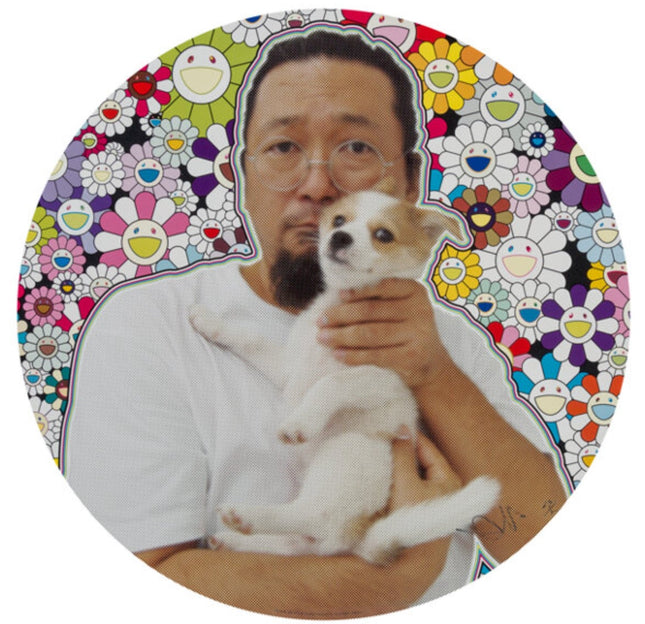
  • POM & Me Lithograph Print by Takashi Murakami TM/KK

    Takashi Murakami TM/KK POM & Me Lithograph Print by Takashi Murakami TM/KK

    POM & Me Offset Lithograph Print Limited Edition Artwork on Round Smooth Wove Paper by Pop Urban Artist Takashi Murakami TM/KK. 2013 Signed & Numbered Limited Edition of 300 Round Cut Artwork Size 19.75x19.75 (Round) Takashi Murakami (b. 1962) POM & Me, 2013 Offset lithograph in colors on smooth wove paper 19-5/8 inches (49.8 cm) diameter (sheet) Ed. 300 Signed and numbered in ink lower right Published by Kaikai Kiki Co. Ltd., Tokyo "POM & Me" is a lithograph print by the renowned Japanese artist Takashi Murakami. Known for his unique style that blends traditional Japanese art with contemporary pop culture, Murakami has gained international acclaim for his work. His signature "Superflat" style is characterized by bold, vibrant colors and flattened, two-dimensional imagery. The "POM & Me" print is one of many artworks that Murakami has created over the years, often featuring his iconic characters and motifs. This particular piece includes recurring elements from Murakami's body of work, such as his famous flowers, himself and his dog Pom. As an artist, Murakami has worked in various media, from painting and sculpture to fashion and commercial products. His work has been exhibited in major galleries and museums worldwide, and he has collaborated with well-known brands and celebrities.

    $2,368.00

  • Jellyfish Eyes Black 1 Lithograph Print by Takashi Murakami TM/KK

    Takashi Murakami TM/KK Jellyfish Eyes Black 1 Lithograph Print by Takashi Murakami TM/KK

    Jellyfish Eyes Black 1 Lithograph Print by Takashi Murakami TM/KK Hand-Pulled Print on Wove Fine Art Paper Limited Edition Graffiti Street Pop Artwork. 2004 Signed & Numbered Limited Edition of 300 Artwork Size 19.75x19.75 Jellyfish Eyes Black 1 by Takashi Murakami – A Psychedelic Icon of Street Pop Art & Graffiti Artwork Jellyfish Eyes Black 1 is a 2004 signed and numbered limited edition lithograph by renowned Japanese contemporary artist Takashi Murakami, measuring 19.75 x 19.75 inches. Issued in an edition of 300, the print features a cluster of floating, stylized eyes with jellyfish-like appendages, hovering across a black background with vibrant, pulsating color. The concentric orbs and whimsical lashes form an enigmatic composition that is both playful and surreal, drawing viewers into Murakami’s immersive visual universe. This work exemplifies Murakami’s ability to merge traditional Japanese aesthetics with global pop culture, injecting high-energy iconography into the realms of Street Pop Art & Graffiti Artwork. Neo-Pop Formalism Meets Subcultural Visual Language The hypnotic design of Jellyfish Eyes Black 1 showcases Murakami’s deep engagement with visual repetition and pop surrealism. Each eye radiates concentric bands of neon pink, electric blue, acid green, and gold—colors more commonly associated with commercial animation, toy design, and graffiti murals than traditional lithography. The black background intensifies the floating sensation of these biomorphic forms, transforming the space into a dreamlike field of suspended consciousness. Murakami’s roots in Nihonga painting and Edo-period compositions are evident in the fluid arrangement and balance, while the synthetic palette and digital smoothness embrace the commercialized intensity of pop iconography. In Street Pop Art & Graffiti Artwork, this blend of classical order with radical form asserts Murakami’s place as both historian and provocateur. Eyes, Surveillance, and the Otaku Psyche The eyes that populate Jellyfish Eyes Black 1 are not passive. They gaze back with unsettling presence, creating a dynamic tension between observer and observed. The motif reflects Murakami’s frequent exploration of otaku culture, surveillance capitalism, and the consumer gaze. These eyes are playful, even cute, but also obsessive, invasive, and endlessly watching. Some appear innocent; others twitch with layered concentric pupils and pupil-like satellites. This multiplicity mirrors the fragmentation of identity in digital and urban life. As seen across the broader scope of Street Pop Art & Graffiti Artwork, these eyes function as pop sigils—icons that entertain, disturb, and invite deeper inspection. Takashi Murakami and the Legacy of Superflat in Street Art Takashi Murakami’s impact on both fine art and street culture cannot be overstated. Through his Superflat theory, he developed a framework for collapsing the boundaries between high and low, ancient and hyper-modern, traditional painting and graffiti-inspired visual immediacy. Jellyfish Eyes Black 1 exists within that lineage as a work that is collectible, cultural, and subversively simple. The lithograph form nods to limited edition printmaking history while its aesthetic remains grounded in the saturated language of mass media and youth culture. As Street Pop Art & Graffiti Artwork continues to evolve globally, Murakami’s work offers a lens into how Japanese visual codes, anime motifs, and psychedelic surface treatments can coexist with the raw expressiveness of street-born art forms. Jellyfish Eyes Black 1 does not demand translation—it simply stares back, glowing in the dark, inviting you to feel.

    $2,250.00

  • Jellyfish Eyes Black 2 Lithograph Print by Takashi Murakami TM/KK Modern

    Takashi Murakami TM/KK Jellyfish Eyes Black 2 Lithograph Print by Takashi Murakami TM/KK

    Jellyfish Eyes Black 2 Lithograph Print by Takashi Murakami TM/KK Hand-Pulled Print on Wove Fine Art Paper Limited Edition Graffiti Street Pop Artwork. 2004 Signed & Numbered Limited Edition of 300 Artwork Size 19.75x19.75. Comes Framed in 2 Frame Styles, Modern Blck Frame Size 22x22, Beige Matte Frame Size 28.75x28.75 Jellyfish Eyes Black 2 by Takashi Murakami – Floating Optics in Street Pop Art & Graffiti Artwork Takashi Murakami’s 2004 lithograph Jellyfish Eyes Black 2 stands as a vibrant continuation of his exploration into recurring motifs of vision, surveillance, and playful abstraction. Measuring 19.75 x 19.75 inches, the print is part of a signed and numbered limited edition of 300, released under the TM/KK imprint. Executed on fine wove art paper, the composition features a constellation of color-saturated, stylized eyes that hover and merge across a velvety black field. The piece is available in two distinct presentation options—modern black frame at 22 x 22 inches, and an elegantly soft beige matte frame at 28.75 x 28.75 inches—each emphasizing the spatial fluidity of Murakami’s floating forms. In the context of Street Pop Art & Graffiti Artwork, this piece emerges as both a study in surface aesthetics and a philosophical meditation on perception and presence. Murakami’s Animated Language of Form The visual structure of Jellyfish Eyes Black 2 builds upon the iconography of its predecessor, deploying a series of floating eyeball-like entities that fuse pop animation with organic drift. Set against a deep black background, the circular forms appear to pulse and glow, shifting subtly in tone and layering. Each figure is constructed with concentric rings of bold color—lime greens, blush pinks, scarlets, turquoise, ochres—punctuated with lashes, droplets, and slight distortions. The connective tissue that flows between the eyes resembles both mycelium and neural pathways, suggesting a symbiotic or collective intelligence. Within the lexicon of Street Pop Art & Graffiti Artwork, this mapping of interlinked optics translates as a metaphor for social networks, media vision, and collective consciousness. Murakami’s abstraction is not random; it is tightly ordered chaos, echoing both Japanese folklore and cybernetic futurism. Optical Play and the Superflat Aesthetic True to Murakami’s Superflat manifesto, Jellyfish Eyes Black 2 rejects the illusion of spatial depth while simultaneously creating tension and layering. The eyes are rendered in a graphic, poster-like style, referencing both commercial design and the techniques of Japanese anime and manga. The lithographic medium allows for pristine color reproduction, retaining Murakami’s digital sharpness and uniform flatness. This results in a visual experience where each element competes equally for attention, much like signage in urban space or characters in graffiti murals. The framing options further influence viewer reception—one suggesting sleek modernity and the other a nostalgic museum-grade presentation. Both emphasize the contrast between high-end collectibility and subcultural rawness. Eyes as Agents of Identity and Control In Jellyfish Eyes Black 2, the floating eyes are both whimsical and menacing. They call to mind not only the innocence of animated characters but the omnipresence of surveillance and digital observation. Murakami leverages the symbol of the eye to reflect the watching, documenting, self-aware nature of modern identity. The multiplicity of eyes within the same space speaks to fragmentation, overload, and an inability to escape the gaze—whether from others, institutions, or ourselves. In the realm of Street Pop Art & Graffiti Artwork, eyes often appear as markers of territory, vision, and spiritual assertion. Here, they become avatars of psychological atmosphere. Takashi Murakami’s Enduring Influence in Global Pop Visual Culture Takashi Murakami continues to serve as one of the most influential artists at the intersection of commercial design, conceptual painting, and urban culture. His approach unites Japanese Edo traditions with the immediacy of contemporary visual storytelling. Jellyfish Eyes Black 2 is emblematic of this approach—deceptively simple, richly layered, and hauntingly joyous. It occupies a space where traditional craftsmanship meets hyper-modern aesthetics, and where personal mythologies intermingle with digital consumer culture. The piece is not merely collectible—it is a portal into a stylized cosmos of symbolic resonance, humor, and introspection, rendered in flawless print form for the language of the street and the gallery alike.

    $2,250.00

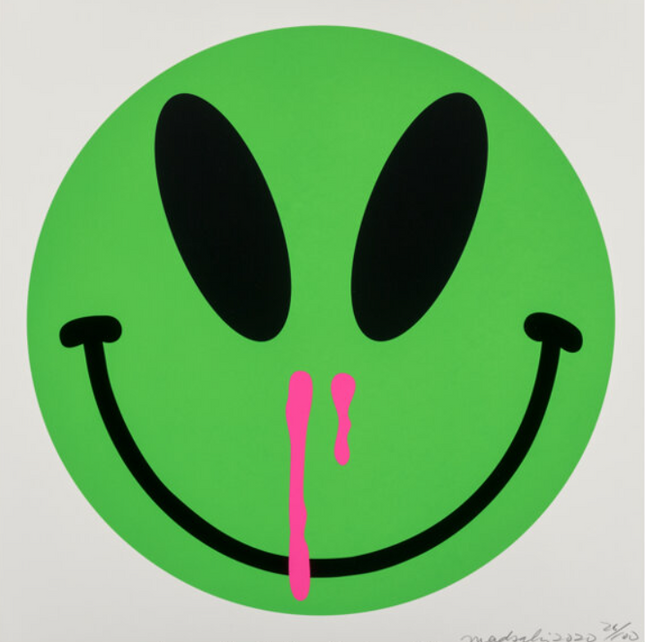
  • Cosmic Overdose_P Offset Lithograph Print by Madsaki

    Madsaki Cosmic Overdose_P Offset Lithograph Print by Madsaki

    Happiness Overdose Azul Mariano_P Offset Lithograph Print by Madsaki Print on Wove Fine Art Paper Limited Edition Hand-Pulled Street Pop Artwork Graffiti. 2020 Signed & Numbered Limited Edition of 100 Offset Lithograph Artwork Print Size 19.75x19.75 Smiley Face With Bloody Nose in Blue. Kaikai Kiki Co. Ltd, Tokyo. Unconventional Aesthetics of Madsaki's Artwork Madsaki's artwork, characterized by its distinctive use of color and form, critiques modern society's obsession with happiness and the often ironic underpinnings of this pursuit. The "Happiness Overdose Azul Mariano_P" print showcases a smiley face—a universally recognized symbol of joy—juxtaposed with a bloody nose, suggesting an overdose of happiness to the point of harm. This striking imagery, rendered in bold blue on fine art paper, invites viewers to question the true nature of joy and the cost of its excess. The resurgence of pop art in the contemporary art scene is epitomized by the creative convergence of street art and graffiti, with artists like Madsaki at the forefront. "Happiness Overdose Azul Mariano_P," a limited edition offset lithograph print by Madsaki, exemplifies this trend, blending the rebellious spirit of street art with the vibrant aesthetics of pop art. Madsaki's artwork, characterized by its distinctive use of color and form, critiques modern society's obsession with happiness and the often ironic underpinnings of this pursuit. The "Happiness Overdose Azul Mariano_P" print showcases a smiley face—a universally recognized symbol of joy—juxtaposed with a bloody nose, suggesting an overdose of happiness to the point of harm. This striking imagery, rendered in bold blue on fine art paper, invites viewers to question the true nature of joy and the cost of its excess. The Cultural Significance of Offset Lithograph Prints Offset lithography, a common technique for fine art reproduction, allows artists like Madsaki to reach a wider audience by creating multiple copies of original works. This print's size of 19.75x19.75 inches is substantial yet accessible, fitting the urban environments that often inspire street pop art. Hand-pulling each print ensures that every piece retains a touch of the artist's hand despite being part of a limited edition series. The choice of woven fine art paper as the medium further signifies a blend of street art's immediacy and fine art's enduring quality. In the context of street pop culture, limited edition artworks such as "Happiness Overdose Azul Mariano_P" reflect the exclusivity and collectibility that street art has gained in the art market. The limited edition of 100 pieces, each signed and numbered by Madsaki, speaks to the artist's personalized connection with his work and collectors. It represents a shift from the transient nature of traditional graffiti to a more permanent, revered form of artistic expression. Integration of Street Art into Mainstream Art Galleries Madsaki's collaboration with Kaikai Kiki Co. Ltd, Tokyo, a company known for its role in promoting contemporary artists, underscores the increasing integration of street pop art into mainstream art galleries and the broader art world. This partnership illustrates the potential for street-inspired artworks to be celebrated alongside more traditional acceptable art forms, signaling a shift in cultural perceptions and the breaking down of barriers between high art and popular culture. The impact of "Happiness Overdose Azul Mariano_P" extends beyond its visual composition; it encapsulates the evolution of street art into a form that is both a critical commentary on society and a coveted acceptable art commodity. Through his work, Madsaki challenges viewers to reassess their understanding of happiness, consumerism, and the role of art in modern culture. His street pop art & graffiti artwork continue to resonate with audiences around the globe, bridging the gap between underground art movements and the polished white walls of galleries.

    $2,188.00

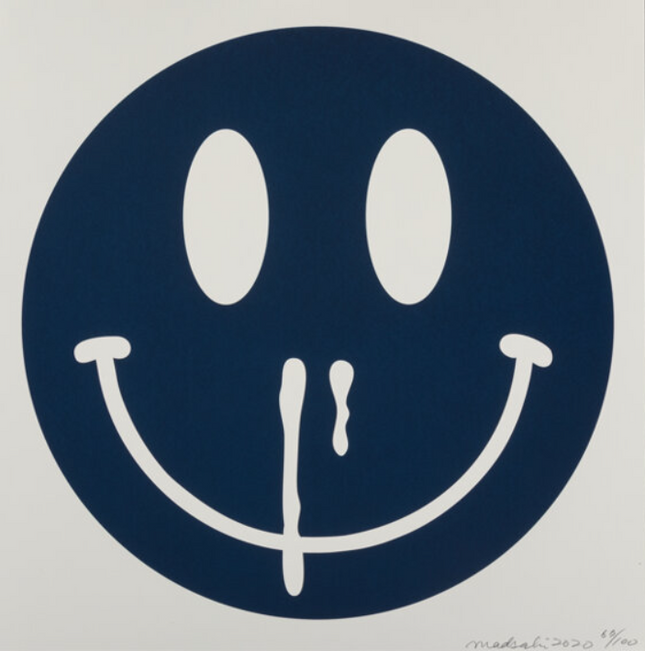
  • Happiness Overdose Azul Mariano_P Offset Lithograph Print by Madsaki

    Madsaki Happiness Overdose Azul Mariano_P Offset Lithograph Print by Madsaki

    Happiness Overdose Azul Mariano_P Offset Lithograph Print by Madsaki Print on Wove Fine Art Paper Limited Edition Hand-Pulled Street Pop Artwork Graffiti. 2020 Signed & Numbered Limited Edition of 100 Offset Lithograph Artwork Print Size 19.75x19.75 Smiley Face With Bloody Nose in Blue. Kaikai Kiki Co. Ltd, Tokyo. Blending Iconography with Contemporary Critique "Happiness Overdose Azul Mariano_P" is a captivating example of Madsaki's work, exemplifying the essence of Street Pop Art and graffiti Artwork through its graphic simplicity and poignant symbolism. This 2020 offset lithograph print on wove fine art paper, signed and numbered as a limited edition of only 100, showcases a unique blend of street art's rawness with the mass appeal of pop art. The artwork, measuring 19.75x19.75 inches, presents a stylized smiley face with a blue hue and a notable addition: a bloody nose. This visual twist plays with the universally recognized symbol of happiness, the smiley face, subverting it to convey a more profound, more complex message. Madsaki's choice to depict the smiley with a bloody nose might be interpreted as a commentary on the excesses of contemporary society, where the pursuit of happiness can sometimes lead to self-destructive behaviors. The use of a singular bold color, Azul Mariano, lends the piece a striking visual presence, with the blue acting as both a backdrop and a critical element of the artwork. The color choice may invoke various emotional responses, from calmness to melancholy, further enriching the artwork's interpretive layers. Artistic Expression in Street Pop Art & Graffiti Artwork Madsaki's "Happiness Overdose Azul Mariano_P" is a testament to the power of Street Pop Art and graffiti Artwork to communicate complex ideas through seemingly simple imagery. The expressive capacity of the work is amplified by its minimalist approach, where the absence of intricate details forces the viewer to confront the unsettling juxtaposition of the smiley's cheerful connotations with the graphic indication of distress. As with much of Street Pop Art and graffiti Artwork, there's an inherent accessibility in Madsaki's lithograph. The smiley face, a pervasive icon of modern digital communication, becomes a canvas for social commentary, allowing the artwork to resonate with a diverse audience. The limited-edition nature of "Happiness Overdose Azul Mariano_P" elevates it from a piece of street art to a sought-after collectible, bridging the gap between graffiti's ephemeral nature and fine art's permanence. In conclusion, the piece serves as a work of art and a cultural critique, encapsulating the dualities in pursuing happiness in the modern age. The choice to produce a limited run of prints ensures that each piece remains a unique and valuable addition to contemporary art discourse. Madsaki's "Happiness Overdose Azul Mariano_P" stands as a compelling intersection of pop iconography and street art sensibility, a visual exploration of the highs and lows of the human condition.

    $2,188.00

Baby Milo Horizon 400% Be@rbrick by Medicom Toy x Karimoku
apan has been a significant influence in the world of art, and graffiti and pop art are no exceptions. In the 1970s and 1980s, Japan became a hotbed for both graffiti and pop art, and since then, it has influenced artists from around the world. Graffiti art in Japan has a unique style that combines traditional Japanese calligraphy with modern graffiti techniques. The result is a style that is both contemporary and rooted in Japanese culture. One of the most prominent graffiti artists in Japan is known as ESOW, who has been active since the early 2000s. His work often features a combination of cartoon-like characters and calligraphy, and he has gained international recognition for his unique style. Pop art in Japan has a different style than the pop art that originated in the West. Japanese pop art, or "Superflat," was popularized by the artist Takashi Murakami in the 1990s. Superflat is characterized by bright colors, anime and manga influences, and flat, two-dimensional shapes. Murakami's work often features cute and whimsical characters, such as his famous "Mr. DOB" character, which is based on Mickey Mouse. Other notable Japanese pop artists include Yoshitomo Nara, who is known for his edgy and provocative depictions of children, and Yayoi Kusama, whose work often features polka dots and psychedelic patterns. In addition to the unique styles of graffiti art and pop art that originated in Japan, the country has also had a significant influence on street art and urban culture as a whole. Tokyo, in particular, has become a hub for street art and graffiti, with many artists using the city's walls and buildings as a canvas. One notable street artist from Japan is Aiko Nakagawa, who goes by the moniker Aiko. Her work often features bold, colorful images of strong women, and she has gained international recognition for her murals and installations around the world. Another prominent Japanese artist in the world of street art is the collective known as teamLab. The group creates immersive, interactive installations that blur the line between art and technology. Their work often features elements of Japanese culture and tradition, such as cherry blossoms and traditional calligraphy. In the realm of pop culture, Japan has also had a significant impact on music and fashion. The country's fashion scene, which is known for its avant-garde and streetwear styles, has influenced fashion trends around the world. Japanese music, particularly J-pop and anime soundtracks, has also gained a dedicated following outside of Japan. Overall, Japan's influence on graffiti art and pop art is just one part of a broader cultural impact that the country has had on the world. From street art to fashion to music, Japan continues to be a source of inspiration for artists and creatives around the globe. There have been many famous and influential Japanese artists throughout history. Here is a list of some of the most notable: Hokusai Katsushika - A painter and printmaker from the Edo period, known for his iconic print "The Great Wave off Kanagawa." Yayoi Kusama - A contemporary artist known for her bold and colorful installations and sculptures, often featuring polka dots. Takashi Murakami - A contemporary artist who is credited with founding the "Superflat" movement of pop art in Japan. Yoshitomo Nara - A contemporary artist known for his stylized and edgy depictions of children and animals. Hiroshige Utagawa - A painter and printmaker from the Edo period, known for his landscape prints. Isamu Noguchi - A sculptor and designer who worked in a variety of mediums, including stone, wood, and metal. Tadanori Yokoo - A graphic designer and artist known for his psychedelic and colorful works. Shiko Munakata - A woodblock printmaker who was awarded the title of Living National Treasure in Japan. Kishio Suga - A contemporary sculptor and installation artist who was a part of the Mono-ha movement in Japan. Kazuo Shiraga - A painter who was a part of the Gutai group, a post-war Japanese avant-garde art collective. This list is by no means exhaustive, as there are many other notable Japanese artists from a variety of disciplines and time periods.
Footer image

© 2025 Sprayed Paint Art Collection,

    • Amazon
    • American Express
    • Apple Pay
    • Bancontact
    • Diners Club
    • Discover
    • Google Pay
    • iDEAL
    • Mastercard
    • PayPal
    • Shop Pay
    • Visa

    Login

    Forgot your password?

    Don't have an account yet?
    Create account