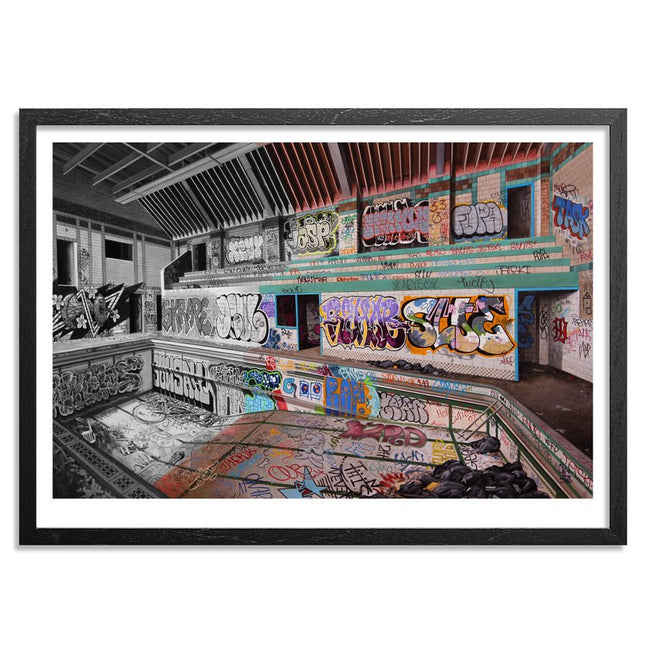
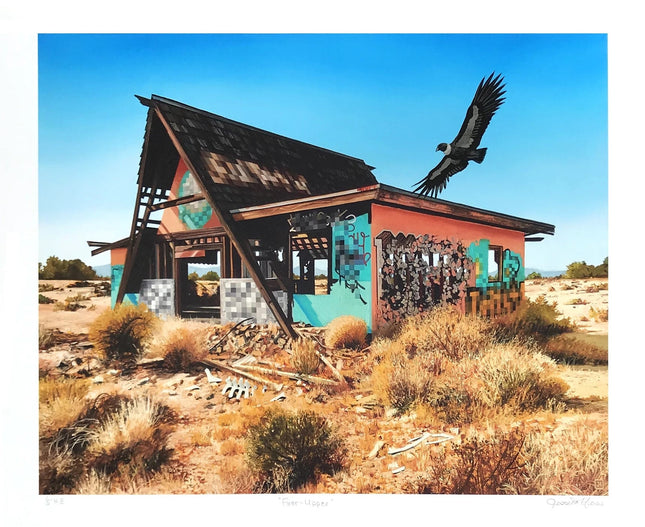
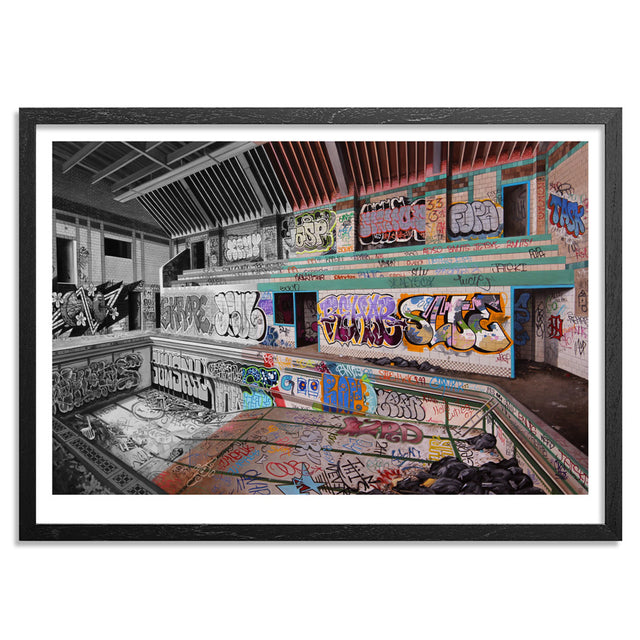
Break Free 29 Limited Edition Hand-Embellished HPM Archival Pigment Prints on 290gsm Moab Fine Art Paper by Jessica Hess Graffiti Street Artist Modern Pop Art.
Hand-Embellished Archival Pigment Print on 290gsm Moab Fine Art Paper Size: 24 x 20 Inches Release: July 26, 2019
“Break Free” is part of a new series of paintings focusing on the strange abstraction of manmade structures through disuse, decay, and demolition in contrast with the beauty of their reclamation by nature. All will return to the Earth one day." - Jessica Hess
Jessica Hess’s Break Free 29: The Architecture of Decay and the Language of Graffiti
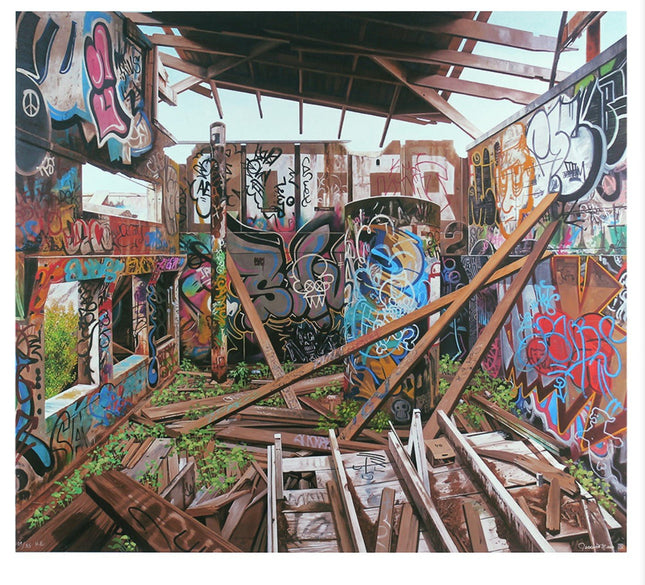
Jessica Hess’s Break Free 29 is a hand-embellished archival pigment print measuring 24 x 20 inches, released in 2019 as part of a series that documents abandoned urban architecture overtaken by graffiti and natural elements. Printed on 290gsm Moab fine art paper, this limited edition exemplifies Hess’s mastery in photorealistic painting and her ability to transform urban ruin into visual poetry. The image captures a collapsed interior space—possibly a warehouse or industrial relic—where nature begins to reclaim its territory, and every visible surface is layered in tags, murals, and weathered pigment. The work is not a simple celebration of street art. It is a nuanced meditation on impermanence, resilience, and transformation. Hess does not stylize or exaggerate the graffiti; she paints it faithfully, respecting it as an honest record of human mark-making. The decaying beams, broken floorboards, and skeletal remains of the roof add to the visual complexity. Everything in the composition is in flux. The structure is failing, yet the surfaces breathe with new life. Green plants push through the cracks. Bright sprays of color resist silence. The collapse is not an end, but an evolution.
Photorealism as Preservation of Street Pop Ephemera
Jessica Hess’s work functions as a form of visual preservation. By painstakingly recreating graffiti-covered ruins in photorealistic detail, she immortalizes temporary art in the face of time, destruction, and erasure. In Break Free 29, no surface is left untouched—pillars, window frames, pipes, and debris are covered in overlapping layers of aerosol marks, stickers, and paint drips. Each tag is an anonymous voice, part of a larger visual conversation layered over time. Hess does not edit or curate these voices. She captures them in all their raw complexity. The technique of hand-embellishment in each print adds to the authenticity of the piece. It reinforces the physical nature of graffiti itself—built through layers, retouches, and repetition. The painted elements do not merely replicate; they reactivate the image. Hess’s use of high-fidelity realism and handwork bridges the worlds of graffiti and fine art without compromising either. It reflects her deep respect for the spaces and the artists who have left their imprint there.
Entropy, Memory, and the Rewilding of Urban Space
Break Free 29 contributes to the ongoing dialogue within Street Pop Art & Graffiti Artwork about the meaning of space, decay, and authorship. Hess doesn’t paint the act of graffiti in motion—she paints its aftermath, its documentation. The structure she depicts is no longer defined by its original function. It is a new environment shaped by collapse, intervention, and neglect. The architecture becomes an accidental canvas, and nature slowly encroaches as a silent collaborator. There is no central human figure in the scene, but human presence is everywhere—in the spray lines, in the tags, in the layers of messages written across time. The graffiti doesn’t just decorate the ruins; it gives them meaning in their disuse. Hess’s framing of this space reveals an alternate kind of beauty—one not built on design, but on decomposition and reoccupation. Plants grow through concrete. Sunlight filters through the broken roof. The manmade yields, and the earth begins to rewrite the structure’s story. Through Break Free 29, Jessica Hess presents ruin not as loss but as transformation. It’s a portrait of impermanence painted with care and precision, reminding us that nothing is truly static—not cities, not art, not nature. Everything is in motion, and everything eventually breaks free.
Read
more
less