Landmark

1 artwork

  • Sale -15% $100 Dollar Bill Backside HPM Serigraph Print by Steve Kaufman SAK

    Steve Kaufman SAK $100 Dollar Bill Backside HPM Serigraph Print by Steve Kaufman SAK

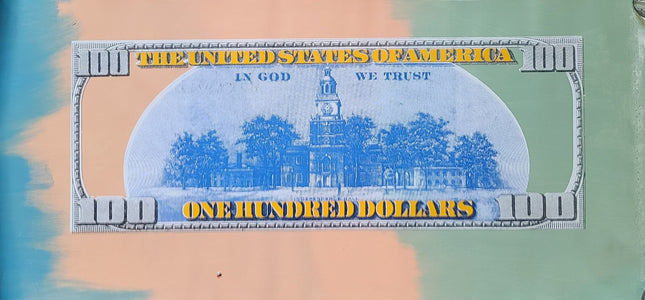
    $100 Dollar Bill- Backside Limited Edition Hand-Embellished Oil Paint HPM Silkscreen Print on Canvas by Steve Kaufman SAK Graffiti Street Artist Modern Pop Art. 1995 Signed & Numbered Limited Edition of 100 Artwork Size 34x15 Unstretched canvas, the image is in perfect condition. Back of the United States $100 dollar bill money from the 1990s. $100 Dollar Bill- Backside Limited Edition Hand-Embellished Oil Paint HPM Silkscreen Print on Canvas by Steve Kaufman The $100 Dollar Bill- Backside silkscreen print on canvas by Steve Kaufman is a striking example of street pop art and graffiti artwork that captures the essence of American consumer culture and wealth symbolism. Created in 1995, this signed and numbered hand-embellished oil paint HPM (Hand-Painted Multiple) is part of a limited edition of 100. Measuring 34x15 inches on unstretched canvas, this piece presents a visually compelling reinterpretation of the back of a 1990s United States $100 bill. Kaufman’s distinctive approach to printmaking, combined with his background in graffiti and modern pop art, makes this artwork a significant statement within the genre. Steve Kaufman’s Influence on Street Pop Art Steve Kaufman, often referred to by his initials SAK, was a pivotal figure in contemporary street pop art. As a former assistant to Andy Warhol, Kaufman developed his own signature style that blended commercial iconography with hand-painted elements. His work frequently centered on themes of capitalism, mass production, and American identity, utilizing recognizable imagery such as currency, famous celebrities, and consumer products. This piece, depicting the back of a $100 bill, is a prime example of his ability to elevate everyday symbols into fine art. By incorporating graffiti-inspired aesthetics with screen printing techniques, Kaufman transformed traditional art forms into something dynamic and relevant to the modern era. His ability to merge street culture with fine art galleries made him a bridge between two artistic worlds. This limited edition print, with its rich colors and textured embellishments, continues his legacy of challenging conventional notions of value, art, and commerce. The Symbolism of Money in Modern Pop Art The use of currency as a subject in modern pop art has deep historical roots, often serving as a critique of wealth, power, and societal values. Kaufman’s portrayal of the $100 bill’s backside takes a familiar object and recontextualizes it through color, scale, and artistic intervention. The presence of Independence Hall in the composition is particularly significant, symbolizing the intersection of American history and contemporary consumer culture. This piece is more than just a reproduction of money—it becomes a meditation on the influence of wealth and financial systems in art and daily life. Kaufman’s choice to hand-embellish each print adds a layer of uniqueness, reinforcing the idea that even in a world driven by mass production, individuality and artistic expression remain essential. The bold use of color and contrast amplifies the visual impact, making the print stand out as both a statement piece and a collector’s item. A Collector’s Piece with Lasting Impact This $100 Dollar Bill- Backside print holds a special place in the world of limited edition street pop art and graffiti artwork. As an unstretched canvas, it offers flexibility for framing and display, allowing collectors to showcase it in a way that best fits their aesthetic. Kaufman’s legacy as a groundbreaking artist continues to thrive, and his works are highly sought after for their cultural relevance and visual appeal. For art enthusiasts and collectors who appreciate the fusion of graffiti, pop culture, and fine art, this piece serves as a powerful representation of Kaufman’s vision. It encapsulates the bold, unapologetic nature of street pop art while remaining deeply tied to the broader narrative of American economic and artistic history.

    $1,917.00 $1,629.00

Landmark
Graffiti art and street art prints have been gaining increased attention in recent years, with more and more artists making a name for themselves in this expressive and often controversial art form. Landmarks, as subjects in these works, provide an intriguing opportunity for artists to merge traditional, historical, and cultural elements with the contemporary and often subversive nature of street art. In this essay, we will explore the role of landmarks in graffiti art and street art prints, delving into their significance, the different ways they are portrayed, and the impact they have on both the art world and the general public. Landmarks, by their very nature, hold historical, cultural, or architectural significance, making them a rich source of inspiration for artists. The incorporation of landmarks in graffiti and street art prints can serve to draw attention to the history of a place, the cultural heritage of a region, or simply the architectural beauty of a particular structure. In some cases, the choice of a landmark as a subject can be seen as an act of defiance or an attempt to subvert the traditional perception of a place, highlighting the often politically charged nature of street art. One of the most famous examples of landmarks in graffiti art is Banksy's controversial work on the Israeli West Bank Barrier, which separates Israel from the Palestinian territories. Banksy's murals, which often feature famous landmarks such as the Eiffel Tower and the Statue of Liberty, serve as a commentary on political and social issues surrounding the barrier. By juxtaposing these iconic landmarks with the harsh reality of the barrier, Banksy challenges the viewer to question the perceived freedom associated with these symbols and the harsh divisions they unintentionally promote. Another prominent use of landmarks in street art is the transformation of the Berlin Wall, once a symbol of division and oppression, into a canvas for expression and unity. After the fall of the Wall in 1989, artists from around the world flocked to the site, leaving their mark on the remaining sections. Today, the East Side Gallery stands as a testament to the power of art in promoting unity, showcasing over 100 murals from artists worldwide. The use of landmarks in these works, such as Brandenburg Gate and the TV Tower, serves to celebrate the city's history while asserting the importance of freedom and connection. Apart from the overtly political statements, landmarks can also provide a unique aesthetic backdrop for graffiti and street art. For example, the street artist JR uses the technique of large-scale photographic portraiture to interact with landmarks, such as his work "The Wrinkles of the City" in Havana, Cuba, where he placed photographs of elderly residents on the facades of historic buildings. In this case, the landmark serves as a canvas for the artist to create a dialogue between the city's past and present and to celebrate the human stories connected to it. Landmarks in graffiti art and street art prints serve multiple purposes, ranging from challenging societal norms and political boundaries to celebrating a city's history and cultural heritage. As artists continue to explore the intersection of these powerful symbols and the contemporary world, we can expect to see more innovative and thought-provoking works that inspire conversation and reflection on the significance of the landmarks we often take for granted. As landmarks continue to evolve and transform, so too will the art that surrounds them, demonstrating the enduring relationship between art and the spaces it inhabits.
Footer image

© 2025 Sprayed Paint Art Collection,

    • Amazon
    • American Express
    • Apple Pay
    • Bancontact
    • Diners Club
    • Discover
    • Google Pay
    • iDEAL
    • Mastercard
    • PayPal
    • Shop Pay
    • Visa

    Login

    Forgot your password?

    Don't have an account yet?
    Create account