Landmark

100 artworks

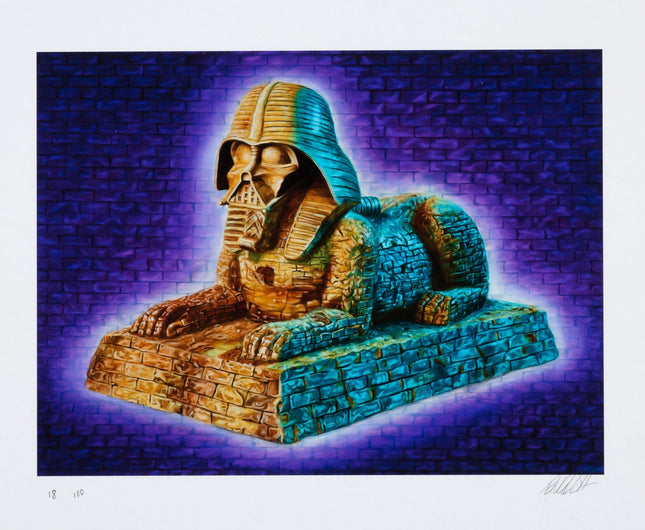
  • Vader Sphinx Archival Print by Ron English- POPaganda

    Ron English- POPaganda Vader Sphinx Archival Print by Ron English- POPaganda

    Vader Sphinx Limited Edition Archival Pigment Fine Art Prints on Moab Entrada Fine Art Paper by Graffiti Street Art and Pop Culture Artist Ron English- POPaganda. 2021 Signed & Numbered Limited Edition of 100 Archival Pigment Print in Colors on Moab Entrada Fine Art Paper Artwork Size 16x13 The "Vader Sphinx" is an extraordinary piece from the collection of Ron English- POPaganda, a prominent figure in contemporary art, renowned for his unique amalgamation of pop culture references with street art aesthetics. In this particular limited edition series, English conjures up a captivating blend of ancient symbolism and modern mythology by juxtaposing the iconic visage of Darth Vader with the timeless form of the Egyptian Sphinx. Limited to a set of 100, each print has been signed and numbered by the artist himself, ensuring its value as a collectible item. The work is sized at 16x13 inches and is printed using archival pigment on Moab Entrada Fine Art Paper, a premium choice that enhances the depth and vibrancy of the artwork's colors. This print serves as a visual dialogue between past and present, invoking the power and mystery of both entities it represents. Vader, an emblem of the dark side in the "Star Wars" universe, is superimposed onto the body of a Sphinx, traditionally seen as a guardian of sacred spaces and knowledge. English's work invites contemplation on the fusion of these powerful symbols, suggesting parallels between the cultural significance of ancient deities and contemporary fictional characters. Through this lens, the print can be seen as a statement on how modern narratives have become a form of mythology and how characters such as Darth Vader have assumed a mythic status in popular culture. The use of bold and expressive colors in the print underscores the themes of power and enigma that are central to the piece. English's proficiency in drawing from graffiti and street art techniques is evident in the way the artwork commands attention and provokes thought. The "Vader Sphinx" is not merely a piece of pop art; it is an artifact of contemporary society's cultural landscape, encapsulating the fusion of historical reverence with modern-day iconography. By crafting such pieces, Ron English- POPaganda cements his role as a bridge between the subversive edge of street art and the polished sphere of fine art, creating works that are as thought-provoking as they are visually striking.

    $366.00

  • Zeni Geva Zen Guerrilla Black Manna 1996 San Francisco California Silkscreen Print by Frank Kozik

    Frank Kozik Zeni Geva Zen Guerrilla Black Manna 1996 San Francisco California Silkscreen Print by Frank Kozik

    Zeni Geva Zen Guerrilla Black Manna 1996 San Francisco California Silkscreen Print by Frank Kozik Hand-Pulled on Fine Art Paper Limited Edition Pop Street Art Artwork. 1996 Signed by Kozik & Numbered Limited Edition of 650 Artwork Size 17.5x22.5 Silkscreen Print Band Gig Poster by Frank Kozik. October 13, 1996 Das Kilowatt in San Francisco, California Capturing the raw energy and unbridled spirit of the 1990s San Francisco music scene, Frank Kozik’s silkscreen print for the Zeni Geva, Zen Guerrilla, and Black Manna gig on October 13, 1996, stands as a significant piece of pop and street art. Kozik, well-known for his contribution to the visual side of rock culture, has infused this piece with a compelling blend of political commentary and vivid imagery, hallmark traits of street art and his style. The limited edition print, measuring 17.5x22.5 inches, was meticulously hand-pulled on fine art paper, underscoring the artist's commitment to quality and the traditional methods of printmaking. With only 650 signed and numbered editions, this artwork is a treasure for collectors and enthusiasts. Its depiction of the Statue of Liberty, surrounded by figures wearing gas masks and holding flags, offers a subversive take on American iconography. The use of iconic symbols juxtaposed with elements that suggest upheaval reflects the era's punk and alternative rock ethos, resonating with themes of resistance and independence prevalent in the genres associated with the bands featured. The event, hosted at Das Kilowatt in San Francisco, California, is immortalized in Kozik’s signature style—where the text is as much a part of the art as the images. His choice of vibrant colors and bold lettering reflects the energy and intensity of the bands, making the poster a visual shout that echoes the music it advertises. This piece is more than promotional material; it's a snapshot of when street art began crossing into mainstream consciousness, blurring the lines between commercial art and political statements. Kozik’s work with this print serves not just to announce a concert but to stake a claim in the ongoing dialogue between art and society, where the streets become a canvas for messages that are as likely to provoke thought as they are to promote an event. In the world of street art, such pieces are vital—they challenge, they commemorate, and they often become a part of the history they depict.

    $242.00

  • Sale -10% Sueño de Día en El Desierto de Cactus Giclee Print by Alexis Mata

    Alexis Mata Sueño de Día en El Desierto de Cactus Giclee Print by Alexis Mata

    Sueño de Día en El Desierto de Cactus Giclee Print by Alexis Mata Daydream in the Cactus Desert Artwork Limited Edition Print on Hahnemühle Fine Art Paper Graffiti Pop Street Artist. 2025 Signed & Numbered Limited Edition of 50 Artwork Size 27.5x39.3 Sueño de Día en El Desierto de Cactus by Alexis Mata: Surreal Fragmentation in Street Pop Art & Graffiti Artwork Sueño de Día en El Desierto de Cactus is a 2025 limited edition giclée print by Mexican artist Alexis Mata, widely recognized under the name Ciler. This signed and numbered edition of 50, printed on Hahnemühle fine art paper and measuring 27.5 x 39.3 inches, reflects Mata’s ongoing exploration of fragmentation, surrealism, and visual distortion within the context of Street Pop Art & Graffiti Artwork. The image is a dreamlike desert landscape drenched in golden sunlight, where natural beauty is digitally unraveled. In the midst of this vast terrain of cactus and color, Mata disrupts the illusion with vertical glitch-like distortions that slice through the scenery, turning cacti, shadows, and flora into stretched chromatic bands. The peaceful warmth of the desert is pulled apart, reassembled in skewed data-like structures, reflecting a visual language that speaks equally to nature and code. The top portion of the composition presents a cinematic vision of a glowing desert sun suspended in a sky of volatile, painterly clouds. Jagged rock formations and mesas rise in the distance like totems. Yet beneath this traditional beauty, Mata introduces a digital intervention that fractures the organic flow. The middle and lower halves of the work are invaded by thick, vertical pixel drags—like the desert is melting through corrupted memory. Cactus forms and flowering succulents are caught mid-glitch, their textures pulled downward in colored bands. This contrast between smooth, atmospheric painting and mechanical disruption defines the emotional structure of the piece. Symbolic Terrain and Digital Manipulation in Ciler’s Visual Practice Alexis Mata’s approach to landscape is both reverent and confrontational. By introducing digital disintegration into an otherwise idyllic desert, he reminds viewers that memory, history, and land are not fixed. The artwork’s glitches are not flaws—they are intentional ruptures in perception. The desert, often romanticized as still and eternal, becomes unstable and morphing. These distortions mirror the influence of media saturation, environmental exploitation, and emotional fragmentation. Mata turns the terrain into both a physical and psychological map, where natural beauty coexists with collapse. This strategy aligns with the sensibility of Street Pop Art & Graffiti Artwork, which often reclaims imagery and injects urban energy into spaces of tradition. Mata’s piece disrupts the expectations of landscape art by applying techniques derived from the visual language of error—compression artifacts, pixel drag, color interference. The result is a visual push-and-pull between harmony and chaos. The sun still burns above, but the ground no longer obeys gravity or realism. The desert is awake, but its dream is unstable. Alexis Mata and the Evolution of Landscape in Street Pop Art Mata has long operated within the territories of collage, urban decay, and symbolic erasure. While his earlier work often focused on portraiture and politically charged disruptions of identity, Sueño de Día en El Desierto de Cactus marks a shift in subject while preserving his core approach. The cactus desert becomes a new surface for resistance. By reinterpreting the land through digital breakdown, Mata questions authenticity, memory, and permanence. It is not destruction for its own sake, but a reflection of contemporary instability—where even nature is glitched by systemic pressure. The tension in the work is beautifully managed. The distortion never fully overwhelms the landscape, but neither does the desert escape unscathed. Mata balances painterly craft with modern interference, capturing the moment when tradition gives way to transformation. The giclée format ensures that every brushstroke and digital fracture is preserved in high resolution, emphasizing texture, hue, and depth across the printed surface. Each piece in the edition is a precise and immersive artifact of this visual narrative. Sueño de Día en El Desierto de Cactus as Emotional Terrain and Cultural Signal This work functions not only as an aesthetic experiment but as a meditative disruption. Sueño de Día en El Desierto de Cactus turns the desert into a symbol of contested memory, where natural forms are encoded with meaning and then partially corrupted. Alexis Mata does not simply present beauty—he investigates it, challenges its endurance, and repositions it within the language of graffiti, digital manipulation, and conceptual resistance. As part of the growing movement within Street Pop Art & Graffiti Artwork, this print expands what landscape can mean in the age of distortion. It acknowledges nostalgia while confronting digital decay. The desert becomes a mirror for emotional fragmentation, its surface caught in the middle of loading, collapsing, or transforming into something new. Mata’s work reminds us that beauty is not immune to interference—and that dreams, even in daylight, are never completely stable.

    $1,197.00 $1,077.00

  • Sale -10% Absolute Power Silkscreen Print by Cleon Peterson

    Cleon Peterson Absolute Power Silkscreen Print by Cleon Peterson

    Absolute Power Silkscreen Print by Cleon Peterson Hand-Pulled on Deckled 290gsm Coventry Rag Fine Art Paper Limited Edition Artwork. 2018 Signed & Numbered Limited Edition of 150 Artwork Size 26x34 Silkscreen Print Cleon Peterson Absolute Power 2018 Silkscreen Print Cleon Peterson, born in the United States in 1973, is widely recognized for his stark visual narratives exploring dominance, submission, and institutional violence within Street Pop Art & Graffiti Artwork. Absolute Power, released in 2018, is a hand pulled silkscreen print produced on deckled 290gsm Coventry Rag fine art paper. Measuring approximately 26 x 34 inches, the edition is limited to 150 and each print is signed and numbered by the artist. Peterson’s work is defined by flattened silhouettes, restricted color palettes, and confrontational imagery that strips human conflict down to symbolic extremes. Through disciplined screen printing and high contrast composition, Absolute Power reinforces his reputation as a leading contemporary voice in politically charged Street Pop Art & Graffiti Artwork. Inverted Authority and Stark Political Symbolism The composition presents an upside down suited figure suspended in a field of red, black, and white, evoking themes of overturned authority and destabilized power structures. In the background, architectural forms resembling government institutions appear alongside barren trees and stark landscape elements, intensifying the atmosphere of institutional critique. The limited palette amplifies the emotional force of the imagery, allowing negative space and silhouette to carry the narrative weight. Peterson’s approach draws on the visual immediacy associated with Street Pop Art & Graffiti Artwork, where simplified forms and bold contrasts deliver direct commentary without reliance on intricate detail. The inversion of the central figure functions as a visual metaphor for corrupted leadership and the precarious nature of control. Limited Edition Craftsmanship in Contemporary Street Pop Art & Graffiti Artwork Absolute Power is printed on heavyweight Coventry Rag paper with deckled edges, reinforcing its status as a refined fine art multiple rather than a mass produced reproduction. The hand pulled silkscreen process ensures dense ink saturation and crisp edges, hallmarks of Peterson’s meticulous production standards. Limited to 150 signed and numbered impressions, the print follows the scarcity model that defines much of today’s Street Pop Art & Graffiti Artwork market. Through uncompromising imagery and disciplined execution, Absolute Power stands as a powerful example of how contemporary printmakers use bold graphic language to confront themes of authority, imbalance, and systemic violence.

    $1,233.00 $1,110.00

Landmark
Graffiti art and street art prints have been gaining increased attention in recent years, with more and more artists making a name for themselves in this expressive and often controversial art form. Landmarks, as subjects in these works, provide an intriguing opportunity for artists to merge traditional, historical, and cultural elements with the contemporary and often subversive nature of street art. In this essay, we will explore the role of landmarks in graffiti art and street art prints, delving into their significance, the different ways they are portrayed, and the impact they have on both the art world and the general public. Landmarks, by their very nature, hold historical, cultural, or architectural significance, making them a rich source of inspiration for artists. The incorporation of landmarks in graffiti and street art prints can serve to draw attention to the history of a place, the cultural heritage of a region, or simply the architectural beauty of a particular structure. In some cases, the choice of a landmark as a subject can be seen as an act of defiance or an attempt to subvert the traditional perception of a place, highlighting the often politically charged nature of street art. One of the most famous examples of landmarks in graffiti art is Banksy's controversial work on the Israeli West Bank Barrier, which separates Israel from the Palestinian territories. Banksy's murals, which often feature famous landmarks such as the Eiffel Tower and the Statue of Liberty, serve as a commentary on political and social issues surrounding the barrier. By juxtaposing these iconic landmarks with the harsh reality of the barrier, Banksy challenges the viewer to question the perceived freedom associated with these symbols and the harsh divisions they unintentionally promote. Another prominent use of landmarks in street art is the transformation of the Berlin Wall, once a symbol of division and oppression, into a canvas for expression and unity. After the fall of the Wall in 1989, artists from around the world flocked to the site, leaving their mark on the remaining sections. Today, the East Side Gallery stands as a testament to the power of art in promoting unity, showcasing over 100 murals from artists worldwide. The use of landmarks in these works, such as Brandenburg Gate and the TV Tower, serves to celebrate the city's history while asserting the importance of freedom and connection. Apart from the overtly political statements, landmarks can also provide a unique aesthetic backdrop for graffiti and street art. For example, the street artist JR uses the technique of large-scale photographic portraiture to interact with landmarks, such as his work "The Wrinkles of the City" in Havana, Cuba, where he placed photographs of elderly residents on the facades of historic buildings. In this case, the landmark serves as a canvas for the artist to create a dialogue between the city's past and present and to celebrate the human stories connected to it. Landmarks in graffiti art and street art prints serve multiple purposes, ranging from challenging societal norms and political boundaries to celebrating a city's history and cultural heritage. As artists continue to explore the intersection of these powerful symbols and the contemporary world, we can expect to see more innovative and thought-provoking works that inspire conversation and reflection on the significance of the landmarks we often take for granted. As landmarks continue to evolve and transform, so too will the art that surrounds them, demonstrating the enduring relationship between art and the spaces it inhabits.
Footer image

© 2026 Sprayed Paint Art Collection,

    • Amazon
    • American Express
    • Apple Pay
    • Bancontact
    • Diners Club
    • Discover
    • Google Pay
    • iDEAL Wero
    • Mastercard
    • PayPal
    • Satispay
    • Shop Pay
    • Visa