Lithograph Fine Art Print

3 artworks

  • Jellyfish Eyes Black 2 Lithograph Print by Takashi Murakami TM/KK Modern

    Takashi Murakami TM/KK Jellyfish Eyes Black 2 Lithograph Print by Takashi Murakami TM/KK

    Jellyfish Eyes Black 2 Lithograph Print by Takashi Murakami TM/KK Hand-Pulled Print on Wove Fine Art Paper Limited Edition Graffiti Street Pop Artwork. 2004 Signed & Numbered Limited Edition of 300 Artwork Size 19.75x19.75. Comes Framed in 2 Frame Styles, Modern Blck Frame Size 22x22, Beige Matte Frame Size 28.75x28.75 Jellyfish Eyes Black 2 by Takashi Murakami – Floating Optics in Street Pop Art & Graffiti Artwork Takashi Murakami’s 2004 lithograph Jellyfish Eyes Black 2 stands as a vibrant continuation of his exploration into recurring motifs of vision, surveillance, and playful abstraction. Measuring 19.75 x 19.75 inches, the print is part of a signed and numbered limited edition of 300, released under the TM/KK imprint. Executed on fine wove art paper, the composition features a constellation of color-saturated, stylized eyes that hover and merge across a velvety black field. The piece is available in two distinct presentation options—modern black frame at 22 x 22 inches, and an elegantly soft beige matte frame at 28.75 x 28.75 inches—each emphasizing the spatial fluidity of Murakami’s floating forms. In the context of Street Pop Art & Graffiti Artwork, this piece emerges as both a study in surface aesthetics and a philosophical meditation on perception and presence. Murakami’s Animated Language of Form The visual structure of Jellyfish Eyes Black 2 builds upon the iconography of its predecessor, deploying a series of floating eyeball-like entities that fuse pop animation with organic drift. Set against a deep black background, the circular forms appear to pulse and glow, shifting subtly in tone and layering. Each figure is constructed with concentric rings of bold color—lime greens, blush pinks, scarlets, turquoise, ochres—punctuated with lashes, droplets, and slight distortions. The connective tissue that flows between the eyes resembles both mycelium and neural pathways, suggesting a symbiotic or collective intelligence. Within the lexicon of Street Pop Art & Graffiti Artwork, this mapping of interlinked optics translates as a metaphor for social networks, media vision, and collective consciousness. Murakami’s abstraction is not random; it is tightly ordered chaos, echoing both Japanese folklore and cybernetic futurism. Optical Play and the Superflat Aesthetic True to Murakami’s Superflat manifesto, Jellyfish Eyes Black 2 rejects the illusion of spatial depth while simultaneously creating tension and layering. The eyes are rendered in a graphic, poster-like style, referencing both commercial design and the techniques of Japanese anime and manga. The lithographic medium allows for pristine color reproduction, retaining Murakami’s digital sharpness and uniform flatness. This results in a visual experience where each element competes equally for attention, much like signage in urban space or characters in graffiti murals. The framing options further influence viewer reception—one suggesting sleek modernity and the other a nostalgic museum-grade presentation. Both emphasize the contrast between high-end collectibility and subcultural rawness. Eyes as Agents of Identity and Control In Jellyfish Eyes Black 2, the floating eyes are both whimsical and menacing. They call to mind not only the innocence of animated characters but the omnipresence of surveillance and digital observation. Murakami leverages the symbol of the eye to reflect the watching, documenting, self-aware nature of modern identity. The multiplicity of eyes within the same space speaks to fragmentation, overload, and an inability to escape the gaze—whether from others, institutions, or ourselves. In the realm of Street Pop Art & Graffiti Artwork, eyes often appear as markers of territory, vision, and spiritual assertion. Here, they become avatars of psychological atmosphere. Takashi Murakami’s Enduring Influence in Global Pop Visual Culture Takashi Murakami continues to serve as one of the most influential artists at the intersection of commercial design, conceptual painting, and urban culture. His approach unites Japanese Edo traditions with the immediacy of contemporary visual storytelling. Jellyfish Eyes Black 2 is emblematic of this approach—deceptively simple, richly layered, and hauntingly joyous. It occupies a space where traditional craftsmanship meets hyper-modern aesthetics, and where personal mythologies intermingle with digital consumer culture. The piece is not merely collectible—it is a portal into a stylized cosmos of symbolic resonance, humor, and introspection, rendered in flawless print form for the language of the street and the gallery alike.

    $2,250.00

  • Jellyfish Eyes Black 1 Lithograph Print by Takashi Murakami TM/KK

    Takashi Murakami TM/KK Jellyfish Eyes Black 1 Lithograph Print by Takashi Murakami TM/KK

    Jellyfish Eyes Black 1 Lithograph Print by Takashi Murakami TM/KK Hand-Pulled Print on Wove Fine Art Paper Limited Edition Graffiti Street Pop Artwork. 2004 Signed & Numbered Limited Edition of 300 Artwork Size 19.75x19.75 Jellyfish Eyes Black 1 by Takashi Murakami – A Psychedelic Icon of Street Pop Art & Graffiti Artwork Jellyfish Eyes Black 1 is a 2004 signed and numbered limited edition lithograph by renowned Japanese contemporary artist Takashi Murakami, measuring 19.75 x 19.75 inches. Issued in an edition of 300, the print features a cluster of floating, stylized eyes with jellyfish-like appendages, hovering across a black background with vibrant, pulsating color. The concentric orbs and whimsical lashes form an enigmatic composition that is both playful and surreal, drawing viewers into Murakami’s immersive visual universe. This work exemplifies Murakami’s ability to merge traditional Japanese aesthetics with global pop culture, injecting high-energy iconography into the realms of Street Pop Art & Graffiti Artwork. Neo-Pop Formalism Meets Subcultural Visual Language The hypnotic design of Jellyfish Eyes Black 1 showcases Murakami’s deep engagement with visual repetition and pop surrealism. Each eye radiates concentric bands of neon pink, electric blue, acid green, and gold—colors more commonly associated with commercial animation, toy design, and graffiti murals than traditional lithography. The black background intensifies the floating sensation of these biomorphic forms, transforming the space into a dreamlike field of suspended consciousness. Murakami’s roots in Nihonga painting and Edo-period compositions are evident in the fluid arrangement and balance, while the synthetic palette and digital smoothness embrace the commercialized intensity of pop iconography. In Street Pop Art & Graffiti Artwork, this blend of classical order with radical form asserts Murakami’s place as both historian and provocateur. Eyes, Surveillance, and the Otaku Psyche The eyes that populate Jellyfish Eyes Black 1 are not passive. They gaze back with unsettling presence, creating a dynamic tension between observer and observed. The motif reflects Murakami’s frequent exploration of otaku culture, surveillance capitalism, and the consumer gaze. These eyes are playful, even cute, but also obsessive, invasive, and endlessly watching. Some appear innocent; others twitch with layered concentric pupils and pupil-like satellites. This multiplicity mirrors the fragmentation of identity in digital and urban life. As seen across the broader scope of Street Pop Art & Graffiti Artwork, these eyes function as pop sigils—icons that entertain, disturb, and invite deeper inspection. Takashi Murakami and the Legacy of Superflat in Street Art Takashi Murakami’s impact on both fine art and street culture cannot be overstated. Through his Superflat theory, he developed a framework for collapsing the boundaries between high and low, ancient and hyper-modern, traditional painting and graffiti-inspired visual immediacy. Jellyfish Eyes Black 1 exists within that lineage as a work that is collectible, cultural, and subversively simple. The lithograph form nods to limited edition printmaking history while its aesthetic remains grounded in the saturated language of mass media and youth culture. As Street Pop Art & Graffiti Artwork continues to evolve globally, Murakami’s work offers a lens into how Japanese visual codes, anime motifs, and psychedelic surface treatments can coexist with the raw expressiveness of street-born art forms. Jellyfish Eyes Black 1 does not demand translation—it simply stares back, glowing in the dark, inviting you to feel.

    $2,250.00

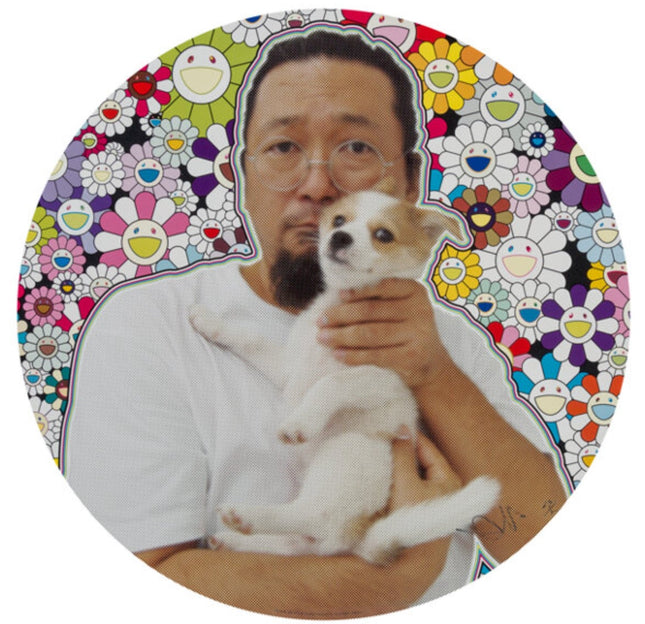
  • POM & Me Lithograph Print by Takashi Murakami TM/KK

    Takashi Murakami TM/KK POM & Me Lithograph Print by Takashi Murakami TM/KK

    POM & Me Offset Lithograph Print Limited Edition Artwork on Round Smooth Wove Paper by Pop Urban Artist Takashi Murakami TM/KK. 2013 Signed & Numbered Limited Edition of 300 Round Cut Artwork Size 19.75x19.75 (Round) Takashi Murakami (b. 1962) POM & Me, 2013 Offset lithograph in colors on smooth wove paper 19-5/8 inches (49.8 cm) diameter (sheet) Ed. 300 Signed and numbered in ink lower right Published by Kaikai Kiki Co. Ltd., Tokyo "POM & Me" is a lithograph print by the renowned Japanese artist Takashi Murakami. Known for his unique style that blends traditional Japanese art with contemporary pop culture, Murakami has gained international acclaim for his work. His signature "Superflat" style is characterized by bold, vibrant colors and flattened, two-dimensional imagery. The "POM & Me" print is one of many artworks that Murakami has created over the years, often featuring his iconic characters and motifs. This particular piece includes recurring elements from Murakami's body of work, such as his famous flowers, himself and his dog Pom. As an artist, Murakami has worked in various media, from painting and sculpture to fashion and commercial products. His work has been exhibited in major galleries and museums worldwide, and he has collaborated with well-known brands and celebrities.

    $2,368.00

Lithograph Fine Art Print Graffiti Street Pop Artwork

Process and Appeal of Lithograph Print Fine Art Graffiti Street Pop Artwork Printing

Lithograph Print Fine Art Graffiti Street Pop Artwork involves etching a design onto a flat stone or metal plate with a greasy substance. The surface is then treated with a mixture of acid and gum Arabic, etching the ungreased portions of the design into the surface. When the plate is moistened, these etched areas retain water while the greasy parts repel it, allowing an oil-based ink to adhere only to the original drawing. The inked image can then be transferred to a piece of paper, producing a print. The ability to produce several high-quality reproductions from a single image has made lithography a favorite among artists and collectors. For street pop art and graffiti artists, whose work often begins in public spaces and on unconventional canvases, lithography offers a means to transfer their fleeting creations into a more permanent and distributable form. The lithograph print, a traditional printmaking technique, has found a unique and enduring place within pop art, street art, and graffiti artwork. This method of printing, based on the principle that oil and water do not mix, has been utilized by artists since the end of the 18th century and continues to be relevant today. Lithography allows for a high degree of detail and a richness of color, particularly appealing to artists in these genres, who often seek to create bold and impactful works.

Lithography's Role in Pop Art, Street Art, and Graffiti

In pop art, street art, and graffiti, lithograph prints have served as a bridge between the illicit thrill of creating art in public spaces and the established traditions of the fine art world. Artists like Keith Haring and Shepard Fairey have used lithography significantly to disseminate their work more widely and to create a different form of engagement with their audience. The accessibility of lithograph prints has allowed these art forms to transcend their origins and enter the homes and galleries of a diverse audience. The collectibility of lithograph prints is well-established, as they offer a more accessible entry point for collectors looking to own a piece of pop or street art. Unlike unique street murals or canvases, which can be challenging to acquire and preserve, lithograph prints are more accessible to distribute and own. For artists, lithographs present a method to share their work with a broader audience without diluting their art's original message or aesthetic. The influence of lithograph prints is also significant in preserving and documenting street pop art and graffiti artwork, which are inherently transient and often subject to destruction or decay.

Technological Advances and Lithograph Print Fine Art Graffiti Street Pop Artwork

Technological advances have also impacted the production of Lithograph Print Fine Art Graffiti Street Pop Artwork, with digital methods complementing traditional stone and plate techniques. These advancements have expanded the possibilities for artists, who can now produce lithographs that combine the old with the new, incorporating digital manipulation into the traditional process. This fusion of techniques aligns well with the ethos of street and graffiti art, which often involves a dialogue between traditional and contemporary, between permanence and impermanence. Lithograph prints represent a unique confluence of artistry, craftsmanship, and technology. They offer a snapshot of the ever-evolving landscape of visual art, capturing the essence of street pop art and graffiti in a form that is both enduring and accessible. As both a medium and a method, lithography has ensured that the vibrant visuals of the street can be appreciated far from their original locations, preserving the transient beauty of street art for future generations to study and enjoy.
Footer image

© 2025 Sprayed Paint Art Collection,

    • Amazon
    • American Express
    • Apple Pay
    • Bancontact
    • Diners Club
    • Discover
    • Google Pay
    • iDEAL
    • Mastercard
    • PayPal
    • Shop Pay
    • Visa

    Login

    Forgot your password?

    Don't have an account yet?
    Create account