

Mickey Mouse
-
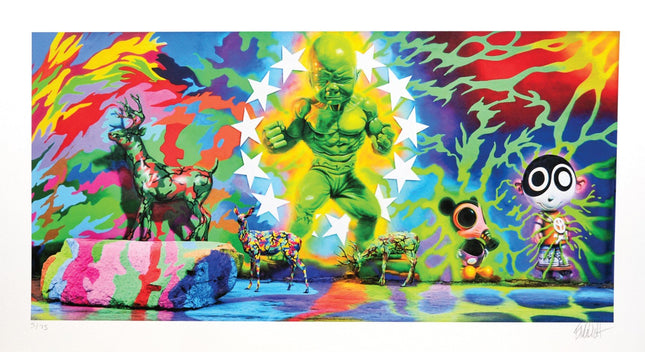
Ron English- POPaganda Temper Tot 10th Year Commemoration Giclee Print by Ron English- POPaganda
Temper Tot Wynwood Walls 10th Year Commemoration Artwork Giclee Limited Edition Print on Cold Press Acid-Free 100% Cotton Paper by Pop Culture Graffiti Artist Ron English- POPaganda. EDITION OF 75 Signed and numbered by the artist, 2015 10” x 18” Archival Giclee print on Cold Press Acid-Free 100% Cotton Paper / 305 gsm / 200lb Published by Goldman Global Arts, Miami. 8” x 16” with 2" borders on Archival Giclee print on Cold Press Acid-Free 100% Cotton Paper / 305 gsm / 200lb
$371.00
-

Raid71 My Heart and Soul Red Silkscreen Print by Raid71
My Heart and Soul Red Silkscreen Print by Raid71 Hand-Pulled on Fine Art Paper Limited Edition Artwork. 2023 Signed & Numbered Limited Edition of TBD Artwork Size 18x30 Silkscreen Print of Stylized Mickey Mouse with Disney & Star Wars Related Tattoos All Over. The Cultural Fusion in Raid71's Artwork Raid71, an artist known for his bold and often intricate work, has produced a silkscreen print that speaks volumes about the interplay between popular culture and art. This piece, hand-pulled on fine art paper, is a limited edition, signed and numbered by the artist, ensuring its status as a collectible item. The artwork measures 18x30 inches, a size that allows the details and colors to stand out, drawing the viewer into a closer inspection of the interwoven designs. At first glance, "My Heart and Soul" may seem like a simple homage to the classic character of Mickey Mouse. However, upon closer inspection, the print reveals a complex array of tattoos referencing other significant cultural icons, including elements from Disney and Star Wars. This amalgamation of symbols serves not only as an aesthetic choice but also as a narrative device, telling a story that spans across different eras and fandoms. Street Pop Art and graffiti Artwork have long been a vibrant and transformative force in visual culture, offering a canvas for artists to challenge norms, express societal commentary, and embrace iconic imagery with a twist. "My Heart and Soul Red Silkscreen Print" by Raid71 encapsulates this spirit, presenting a familiar figure adorned with a tapestry of symbolic tattoos that merge the nostalgic with the contemporary. Technique and Tradition in Silkscreen Printing The technique of silkscreen printing, chosen by Raid71 for this artwork, is a meticulous and hands-on process revered for its ability to produce vibrant, saturated colors and sharp images. Hand-pulling a print requires precision and skill, making each piece unique. This traditional method of printmaking aligns with the ethos of Street Pop Art and graffiti Artwork, where the hand of the artist is valued and the physical act of creation is part of the artwork's narrative. Silkscreen prints have a rich history in pop art and street art, with artists like Andy Warhol popularizing the technique in the 1960s. Raid71's use of this method creates a direct lineage to the pop art movement, while the subject matter and styling of the piece place it firmly in the contemporary conversation of street art. Reflections of Pop Culture in Modern Art "My Heart and Soul" is more than a piece of art; it is a cultural artifact that reflects the pervasive influence of pop culture in modern society. The tattoos adorn the iconic character are not random; they are carefully chosen emblems that many viewers will recognize and connect with. By incorporating these symbols into the artwork, Raid71 invites reflection on the impact of media and entertainment on our collective consciousness. This blending of pop culture references within the artwork indicates a broader trend in Street Pop Art and graffiti Artwork, where the lines between high art and low art are blurred. Raid71's print stands as a testament to the democratization of art, showcasing how universally recognized imagery can be repurposed to create something new and thought-provoking. The Significance of Limited Edition Artworks The decision to produce "My Heart and Soul" as a limited edition print plays a significant role in its desirability and potential legacy. Collectors and enthusiasts of Street Pop Art and graffiti Artwork often seek out little edition pieces for their exclusivity and investment potential. The practice of numbering and signing each print also adds a personal touch from the artist, creating a connection between the creator and the collector. In the context of street art and pop art, limited editions help to bridge the gap between the often ephemeral nature of street art—typically seen on public walls and therefore subject to change—and the permanence sought by collectors. By offering a finite number of prints, Raid71 ensures that "My Heart and Soul" retains a sense of rarity and value. "My Heart and Soul Red Silkscreen Print" by Raid71 is a vibrant intersection of artistry, pop culture, and printmaking tradition. It embodies the innovative and referential qualities that are hallmark traits of Street Pop Art and graffiti Artwork. As the piece makes its way into the collections of art lovers, it carries the spirit of the streets, the allure of pop culture, and the timelessness of fine art printmaking.
$226.00
-

Raid71 My Heart and Soul Blue Silkscreen Print by Raid71
My Heart and Soul Blue Silkscreen Print by Raid71 Hand-Pulled on Fine Art Paper Limited Edition Artwork. 2023 Signed & Numbered Limited Edition of 40 Artwork Size 18x30 Silkscreen Print of Stylized Mickey Mouse with Disney & Star Wars Related Tattoos All Over. The Cultural Fusion in Raid71's Artwork Raid71, an artist known for his bold and often intricate work, has produced a silkscreen print that speaks volumes about the interplay between popular culture and art. This piece, hand-pulled on fine art paper, is a limited edition, signed and numbered by the artist, ensuring its status as a collectible item. The artwork measures 18x30 inches, a size that allows the details and colors to stand out, drawing the viewer into a closer inspection of the interwoven designs. At first glance, "My Heart and Soul" may seem like a simple homage to the classic character of Mickey Mouse. However, upon closer inspection, the print reveals a complex array of tattoos referencing other significant cultural icons, including elements from Disney and Star Wars. This amalgamation of symbols serves as an aesthetic choice and a narrative device, telling a story that spans across different eras and fandoms. Street Pop Art and graffiti Artwork have long been a vibrant and transformative force in visual culture, offering a canvas for artists to challenge norms, express societal commentary, and embrace iconic imagery with a twist. "My Heart and Soul Blue Silkscreen Print" by Raid71 encapsulates this spirit, presenting a familiar figure adorned with a tapestry of symbolic tattoos that merge the nostalgic with the contemporary. Technique and Tradition in Silkscreen Printing The technique of silkscreen printing, chosen by Raid71 for this artwork, is a meticulous and hands-on process revered for its ability to produce vibrant, saturated colors and sharp images. Hand-pulling a print requires precision and skill, making each piece unique. This traditional method of printmaking aligns with the ethos of Street Pop Art and graffiti Artwork, where the hand of the artist is valued, and the physical act of creation is part of the artwork's narrative. Silkscreen prints have a rich history in pop and street art, with artists like Andy Warhol popularizing the technique in the 1960s. Raid71's use of this method creates a direct lineage to the pop art movement, while the subject matter and styling of the piece place it firmly in the contemporary conversation of street art. Reflections of Pop Culture in Modern Art "My Heart and Soul" is more than a piece of art; it is a cultural artifact that reflects the pervasive influence of pop culture in modern society. The tattoos adorn the iconic character are not random; they are carefully chosen emblems that many viewers will recognize and connect with. By incorporating these symbols into the artwork, Raid71 invites reflection on the impact of media and entertainment on our collective consciousness. This blending of pop culture references within the artwork indicates a broader trend in Street Pop Art and graffiti Artwork, where the lines between high art and low art are blurred. Raid71's print stands as a testament to the democratization of art, showcasing how universally recognized imagery can be repurposed to create something new and thought-provoking. The Significance of Limited Edition Artworks The decision to produce "My Heart and Soul" as a limited edition print plays a significant role in its desirability and potential legacy. Collectors and enthusiasts of Street Pop Art and graffiti Artwork often seek out little edition pieces for their exclusivity and investment potential. The practice of numbering and signing each print also adds a personal touch from the artist, creating a connection between the creator and the collector. In the context of street art and pop art, limited editions help to bridge the gap between the often ephemeral nature of street art—typically seen on public walls and therefore subject to change—and the permanence sought by collectors. By offering a finite number of prints, Raid71 ensures that "My Heart and Soul" retains a sense of rarity and value. "My Heart and Soul Blue Silkscreen Print" by Raid71 is a vibrant intersection of artistry, pop culture, and printmaking tradition. It embodies the innovative and referential qualities that are hallmark traits of Street Pop Art and graffiti Artwork. As the piece makes its way into the collections of art lovers, it carries the spirit of the streets, the allure of pop culture, and the timelessness of fine art printmaking.
$462.00
-

Dalek- James Marshall Marching to Oblivion Blue Raspberry Silkscreen Print by Dalek- James Marshall
Marching to Oblivion Blue Raspberry Silkscreen Print by Dalek- James Marshall 13 Color Hand-Pulled on Blue Raspberry Card Stock Fine Art French Paper Co Limited Edition Screenprint Artwork. 2025 Signed & Numbered Limited Edition of 12 Artwork Size 18x24 Silkscreen Print Marching to Oblivion Blue Raspberry by Dalek (James Marshall) in Street Pop Art & Graffiti Artwork Marching to Oblivion Blue Raspberry is a limited edition silkscreen print released in 2025 by American artist James Marshall, known professionally as Dalek. Measuring 18 by 24 inches, this vibrant screenprint was produced in a small run of twelve, each signed and numbered by the artist. Printed by hand using thirteen colors on Blue Raspberry card stock from the French Paper Company, this work demonstrates the technical precision and conceptual intent that Dalek brings to Street Pop Art & Graffiti Artwork. Marshall first gained recognition for his Space Monkey character, which served as a foundation for his exploration of identity, repetition, and urban visual culture. This piece reflects his continued evolution through high-contrast compositions, bold color fields, and animated character design rooted in both street art and contemporary pop aesthetics. Visual Language and Character Aesthetics The central figure in Marching to Oblivion Blue Raspberry is a hyper-energized creature with bright green limbs, circular mouse-like ears, and a wide, exaggerated mouth punctuated with polka-dot colors. The character is captured mid-motion, rhythmically juggling toy-like mallets while dancing atop a minimalistic gray platform. The cyan-blue background offers striking contrast, pushing the character forward in a burst of visual noise and balance. Each limb and accessory has been carefully positioned to evoke movement, volume, and rhythm without relying on traditional depth cues. This precise, graphic composition speaks to Dalek’s background in illustration and graffiti, where storytelling often happens in frozen frames of chaos. The use of bright, flat colors, iconic shapes, and cartoon logic aligns this piece firmly within Street Pop Art & Graffiti Artwork, blending urban visual codes with gallery-level execution. Material Process and Printmaking Precision Executed through a thirteen-color hand-pulled silkscreen process, this print demonstrates a refined commitment to craft and color theory. The Blue Raspberry cardstock provides an unconventional foundation that transforms the background into an active visual element rather than a passive support. This material choice amplifies the fluorescent color palette while maintaining a sense of tactile richness. Each ink layer was applied manually, reinforcing the physical labor often associated with graffiti and mural practices. The careful registration and color saturation required for this level of quality elevate the piece to a standard of contemporary printmaking rarely achieved in editions this small. The hand-pulled nature of the print ensures that subtle variations exist between each copy, emphasizing the importance of uniqueness even in a multiple. Cultural Relevance and Street Pop Evolution Dalek’s Marching to Oblivion Blue Raspberry serves as more than a static image—it operates as a cultural document of the fusion between street energy and pop precision. James Marshall continues to explore visual intensity without sacrificing clarity or depth. His art speaks to the performative and repetitive aspects of daily life, represented through his chaotic yet controlled characters. The tension between play and purpose, repetition and spontaneity, mirrors the structure of graffiti itself: repetitive tags, ritualistic motion, and bursts of controlled energy in public view. This print brings those values to the collector’s wall without erasing their roots. It exists within Street Pop Art & Graffiti Artwork as both homage and innovation, offering a clean yet electric artifact that speaks directly to audiences familiar with the pulse of contemporary visual culture.
$340.00
-

Dalek- James Marshall Marching to Oblivion Nightshift Silkscreen Print by Dalek- James Marshall
Marching to Oblivion Nightshift Silkscreen Print by Dalek- James Marshall 13 Color Hand-Pulled on Nightshift Card Stock Fine Art French Paper Co Limited Edition Screenprint Artwork. 2025 Signed & Numbered Limited Edition of 12 Artwork Size 18x24 Silkscreen Print Marching to Oblivion Nightshift by Dalek (James Marshall) in Street Pop Art & Graffiti Artwork Marching to Oblivion Nightshift is a 2025 limited edition silkscreen print by American artist James Marshall, known professionally as Dalek. This hand-pulled screenprint is executed in thirteen colors on Nightshift Blue cardstock provided by the French Paper Company, a material choice that adds depth and richness to the saturated neon palette. Each print in the edition of twelve measures 18 by 24 inches and is signed and numbered by the artist. Dalek is recognized for his ability to merge the graphic power of graffiti with the conceptual nuance of contemporary pop aesthetics. This print exemplifies his approach, featuring a character in mid-march across a minimal platform, caught in a moment of chaotic animation. It continues the tradition of Dalek’s hybridization of Street Pop Art & Graffiti Artwork, offering a fusion of hand-crafted technique, cartoon logic, and layered commentary on repetition, identity, and movement. Character Design and Color Theory in Motion The character in Marching to Oblivion Nightshift is an evolved iteration of Dalek’s signature Space Monkey figure, which first appeared in his early 2000s work. Rendered in high-contrast greens, purples, and blues, the figure juggles mallets and orbs with an expression that suggests manic joy or mechanical precision. The forms are sharp yet playful, occupying a visual space between Saturday morning animation and the visual codes of graffiti tagging. The character’s exaggerated limbs, oversized eyes, and dynamic posture project energy and volume, qualities central to Street Pop Art & Graffiti Artwork. These forms emerge from the background with crisp clarity due to the precision of screenprint layering, where each color is added by hand in sequence. The piece plays with spatial depth and surface illusion, making it both a spectacle and a meditation on repetition and performance. Materials and Printmaking Craft Dalek’s commitment to fine art printmaking is evident in the level of detail and control required to produce a 13-color silkscreen on dark-toned French Paper. The Nightshift Blue stock is a deliberate departure from traditional white backgrounds, offering a deep foundation that intensifies the vibrancy of the neon inks. This technical choice enhances contrast while grounding the character in a nocturnal atmosphere. The hand-pulled process not only honors the roots of street art as a physical and labor-intensive form, but also situates the piece within a lineage of craft-based art making. Every color alignment, registration mark, and clean edge testifies to the labor behind the image, making each edition both a finished work and a documentation of process. Within the context of Street Pop Art & Graffiti Artwork, this commitment to print fidelity mirrors the hand-painted dedication of murals and throw-ups. Contemporary Positioning and Artistic Intention Marching to Oblivion Nightshift exists at a crossroad of character art, street culture, and fine art editioning. James Marshall continues to define a unique visual territory where his characters do not speak with words but with posture, movement, and repetition. This silence allows viewers to project their own narratives onto the scene, creating a dialogue that aligns with the viewer-driven ethos of street art. The tension between joy and oblivion in the title suggests a deeper reflection on routine, spectacle, and distraction in modern life. By issuing this work in a deliberately limited edition of twelve, Dalek emphasizes the importance of intention and scarcity, key concepts that contrast with the reproducibility of digital imagery. Through projects like Marching to Oblivion Nightshift, Dalek strengthens the voice of Street Pop Art & Graffiti Artwork as a serious, evolving discipline capable of combining critical theory, visual pleasure, and masterful production.
$340.00
-

Dalek- James Marshall Rocket Monkey Uncut Yellow Silkscreen Test Print by Dalek- James Marshall
Rocket Monkey Uncut Sheet Yellow Silkscreen Test Print by Dalek- James Marshall Hand-Pulled on Fine Art Paper Limited Edition Screenprint Artwork. 2025 Signed & Numbered Limited Edition of 5 Test Prints Artwork Size 18x24 Silkscreen Print Rocket Monkey Uncut Sheet Yellow by Dalek (James Marshall) in Street Pop Art & Graffiti Artwork Rocket Monkey Uncut Sheet Yellow is a 2025 silkscreen test print by American artist James Marshall, known professionally as Dalek. This print, produced in a signed and numbered limited edition of five, measures 18 by 24 inches and was hand-pulled on fine art paper provided by the French Paper Company. The yellow background is bold and electric, serving as the launchpad for four identical renderings of Dalek’s Rocket Monkey figure. These uncut sheets are typically used in the print production process to evaluate color alignment, layer accuracy, and visual balance. Far from being throwaway proofs, test prints like this one hold a unique place in Street Pop Art & Graffiti Artwork for capturing process as part of the final piece. Each screen registration mark, alignment target, and color note serves as a visible record of the print’s creation, transforming what is often hidden behind the scenes into a collectible object of its own. Character Design and Graphic Energy Rocket Monkey represents a stylistic evolution of Dalek’s early Space Monkey character, rendered with a streamlined silhouette and exaggerated cartoon proportions. The figure appears to be floating or hovering with the aid of a backpack-like structure, one hand holding a container that emits a curling tongue or stream of vapor. With large circular eyes and a pink tongue that curves outward like smoke, the character carries both innocence and intensity. The repetition of the image across the uncut sheet creates a rhythmic visual field that references both sticker culture and factory production. This setup speaks directly to graffiti’s mass-distribution mindset, where repetition and reproduction enhance visual dominance. Set against a pure yellow background, the turquoise, pink, green, and black inks pop with unmistakable clarity. The design is clean but retains the punk urgency and joyful absurdity that have become signatures of Dalek’s contributions to Street Pop Art & Graffiti Artwork. Process Visibility and the Test Print Format What makes Rocket Monkey Uncut Sheet Yellow particularly compelling is its transparency. Test prints are often used by screen printers to refine alignment and saturation before the final edition is produced. Dalek embraces this transitional stage, turning it into an intentional work. The registration marks and Pantone notes along the edges are printed data that would usually be trimmed off, but here they remain intact, reminding the viewer of the mechanical and manual labor involved in creating the image. This choice celebrates the silkscreen method and roots the work firmly in the traditions of street art, where process is often as important as product. The raw nature of the format speaks to graffiti’s improvisational quality, while the precision of the final image reflects Dalek’s disciplined, design-driven approach. Positioning in Contemporary Urban Print Culture Rocket Monkey Uncut Sheet Yellow exemplifies how Street Pop Art & Graffiti Artwork can blend mass production and fine art without losing its conceptual edge. By framing a production-stage object as finished artwork, Dalek draws attention to the stages of making that are typically invisible. It also challenges viewers to see beauty in repetition, imperfection, and structure. The small edition size adds exclusivity, while the content and format maintain accessibility through visual humor and street-level attitude. As with much of Dalek’s work, this piece offers cultural commentary through character-driven imagery, expanding the language of graffiti beyond lettering into full symbolic universes. Rocket Monkey floats above its cartoon context, part avatar, part design experiment, and part critique of how images are produced and consumed in both the streets and the studio.
$523.00