Money & Cash

2 artworks

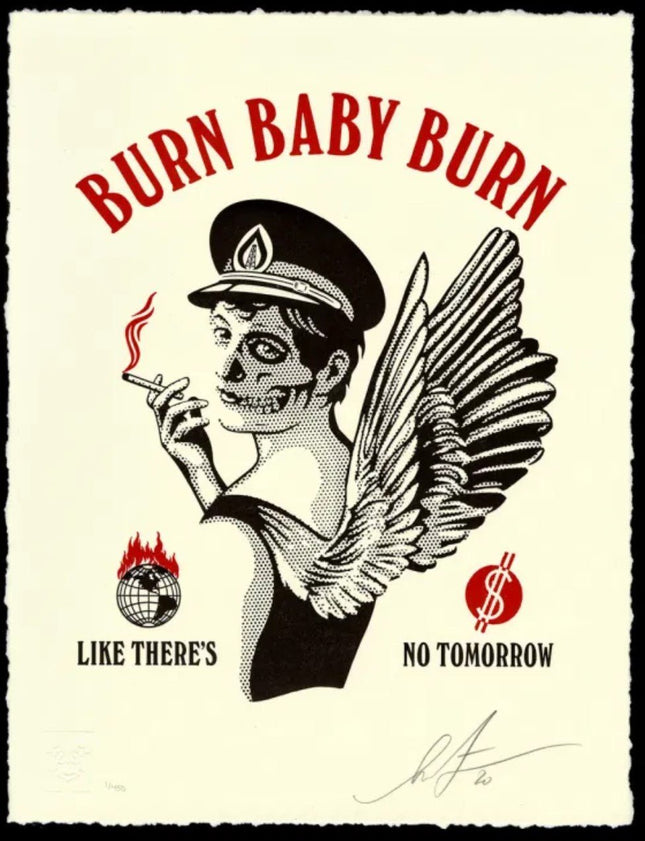
  • Burn Baby Burn Letterpress Print by Shepard Fairey- OBEY

    Shepard Fairey- OBEY Burn Baby Burn Letterpress Print by Shepard Fairey- OBEY

    Burn Baby Burn 2-Color Hand-Pulled Limited Edition Letterpress Print on Cream Speckle Tone Paper by Shepard Fairey Rare Street Art OBEY Pop Artwork Artist. 10 inches by 13 inches Edition of 450 February 2, 2021 About Burn Baby Burn, inspired by the aesthetics of “live fast – die young” rock ’n’ roll, is a critique of some harmful habits we are addicted to. Not just the harmful effects of burning fossil fuels, but also the dangerous psychology of denial and nihilism that underpins the apathy toward the planet’s future (and ours)! Whether it is the defiant greed of the fossil fuel corporations or the indifference of a public comfortable with status quo habits around fossil fuels, further delay in transitioning to renewable energy sources will be catastrophic for the planet and all of its species. I know that none of us like the idea of disrupting a comfortable habit.-Shepard Fairey

    $384.00

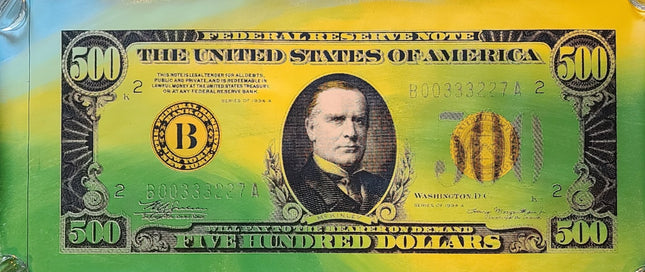
  • Sale -25% $500 Dollar Bill Green HPM Serigraph Print by Steve Kaufman SAK

    Steve Kaufman SAK $500 Dollar Bill Green HPM Serigraph Print by Steve Kaufman SAK

    $500 Dollar Bill- Green Limited Edition Hand-Embellished Oil Paint HPM Silkscreen Print on Canvas by Steve Kaufman SAK Graffiti Street Artist Modern Pop Art. 1995 Signed Custom Framed Front of the United States $500 dollar bill money from 1934 featuring US President William McKinley. $500 Dollar Bill Green Limited Edition Hand-Embellished Oil Paint HPM Silkscreen Print on Canvas by Steve Kaufman The $500 dollar bill Green Limited Edition Hand-Embellished Oil Paint HPM Silkscreen Print on Canvas is a striking piece of Street Pop Art and Graffiti Artwork by Steve Kaufman, a legendary modern pop artist. The artwork is a signed and custom-framed rendition of the front of the United States $500 bill from 1934, featuring President William McKinley. This piece, created in 1995, stands as a powerful example of Kaufman’s signature approach to transforming historical and cultural symbols into vibrant modern masterpieces. Steve Kaufman and His Impact on Street Pop Art and Graffiti Artwork Steve Alan Kaufman, born in 1960 in the United States, was a student and assistant to Andy Warhol before developing his own unique artistic voice. He expanded on Warhol’s pop art techniques by incorporating hand embellishments, graffiti elements, and unconventional color schemes, making his works one-of-a-kind collectibles. Kaufman’s contributions to Street Pop Art and Graffiti Artwork involved a deep engagement with American cultural imagery, including currency, historical figures, and iconic consumer symbols. His work frequently explored themes of capitalism, nostalgia, and the power of recognizable images to evoke emotion and commentary. This $500 dollar bill print is an excellent representation of Kaufman’s ability to fuse financial iconography with street art aesthetics. Through the use of hand-applied oil paint embellishments and silkscreen techniques, the piece achieves a tactile richness that contrasts with the traditional design of American currency. By reimagining the bill in bold colors, Kaufman breathes new life into an object typically associated with economic power and exclusivity. Symbolism of the $500 Bill in Pop Art and Street Graffiti Culture The $500 bill, particularly the 1934 series featuring President William McKinley, is a rare and discontinued form of U.S. currency. While once in circulation, these high-denomination bills were removed from general use and now exist mainly as collectors’ items. In the context of Street Pop Art and Graffiti Artwork, the depiction of large-denomination currency serves as a commentary on wealth, value, and the transient nature of money. Kaufman’s reinterpretation of the bill in vivid green and yellow hues transforms it from a monetary instrument into a striking visual statement. The contrast between the structured, official design of the original banknote and the expressive, graffiti-inspired application of color creates an engaging tension. This reimagining forces the viewer to reconsider the meaning of money beyond its traditional role in transactions, turning it into an artistic expression of power, history, and cultural significance. Kaufman’s use of layering, texture, and freehand detailing adds an urban, almost rebellious energy to the piece, making it stand out in any collection of modern pop art. Legacy of Kaufman’s $500 Dollar Bill Artwork Steve Kaufman’s limited edition $500 dollar bill Green HPM silkscreen print exemplifies his approach to combining financial symbolism with artistic innovation. The custom-framed piece is more than a decorative statement; it encapsulates the essence of Street Pop Art and Graffiti Artwork by challenging traditional notions of wealth and status. The bold color palette, hand-embellished details, and large-scale reinterpretation of a historical banknote ensure that this piece remains both visually captivating and intellectually thought-provoking. Through works like this, Kaufman cemented his legacy as a pivotal figure in modern pop art, influencing artists who continue to blend fine art techniques with urban street culture. His reinterpretation of the $500 bill serves as a lasting testament to his ability to elevate ordinary objects into extraordinary pieces of art that capture the energy and complexity of contemporary society.  

    $2,607.00 $1,955.00

Money & Cash

Money & Cash has been a popular topic in graffiti street art for many years. It is often used as a symbol of power, wealth, and corruption in society. Graffiti artists may use images of currency, such as dollar bills or coins, to comment on the influence of money in politics, economics, and culture. One common theme in money-related graffiti is the concept of greed. Artists may use images of fat cats or pigs with money bags to criticize those who accumulate wealth at the expense of others. Graffiti artists may also use images of dollar bills with slogans like "Money Talks" or "Cash Rules Everything" to comment on the ways in which money influences people's behavior and values. In addition to critiquing the negative aspects of money, graffiti artists may also use money-related imagery to celebrate the positive aspects of wealth and success. For example, they may create images of successful entrepreneurs or athletes who have made a significant impact on their communities. Overall, money as a topic in graffiti street art can be used to reflect on the complex and multifaceted ways in which money shapes our world. The cash sign ($) is a popular symbol used in graffiti, street art, and pop art to convey various messages related to money, power, and status. In graffiti, the cash sign is often used as a tag or signature by street artists to mark their work and gain recognition in the community. It may also be used to convey messages about wealth and consumer culture, as well as social and economic inequality. In pop art, the cash sign is frequently used as a motif to comment on the commercialization of art and society. Artists may incorporate the symbol into their work to explore themes of greed, materialism, and the commodification of culture. The use of the cash sign in graffiti, street art, and pop art reflects a complex relationship between money, power, and artistic expression in contemporary culture. ash plays a significant role in both Graffiti Art and Pop Art, although in different ways. Graffiti Art is often associated with street culture and urban environments, and it emerged as a form of rebellion against societal norms and authority. In its early days, Graffiti Art was primarily created by young people who had limited financial means and used cheap spray cans and markers to create their art. However, as Graffiti Art gained popularity and recognition, some artists began to monetize their work through commissioned pieces, selling prints, or even opening their galleries. While the commercialization of Graffiti Art has led to some controversy within the art community, it has also allowed some artists to earn a living from their work. Some of the most famous Graffiti Artists, such as Banksy and Shepard Fairey, have achieved mainstream success, with their works selling for millions of dollars. In contrast, Pop Art emerged in the 1950s and 1960s as a response to consumer culture and the increasing commercialization of art. Pop Artists such as Andy Warhol, Roy Lichtenstein, and Claes Oldenburg often incorporated images of everyday consumer objects and mass-produced items into their artwork, highlighting the pervasive influence of consumer culture on American society. The irony of Pop Art is that while it critiques consumer culture, it also celebrates it, and many Pop Artists became successful commercial artists themselves. Warhol, for example, famously declared that "Making money is art, and working is art, and good business is the best art." His prints and other works continue to sell for high prices today. While Graffiti Art emerged as a form of rebellion against authority, it has also become a commercialized art form that allows some artists to earn a living. In contrast, Pop Art critiques consumer culture while celebrating it, and many Pop Artists have themselves become successful commercial artists.

Footer image

© 2025 Sprayed Paint Art Collection,

    • Amazon
    • American Express
    • Apple Pay
    • Bancontact
    • Diners Club
    • Discover
    • Google Pay
    • iDEAL
    • Mastercard
    • PayPal
    • Shop Pay
    • Visa

    Login

    Forgot your password?

    Don't have an account yet?
    Create account