Original Artwork

1 artwork

  • Sale -15% Sidewalk Closed Wood Original Mixed Media Street Sign Painting by Sonic Bad

    Sonic Bad Sidewalk Closed Wood Original Mixed Media Street Sign Painting by Sonic Bad

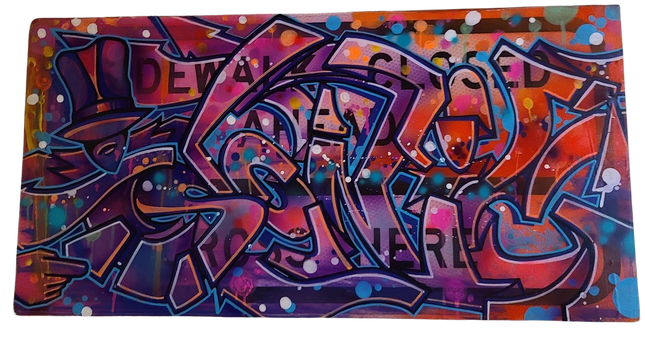
    Sidewalk Closed- Wood Original Mixed Media Graffiti Artist Modern Pop Art on Real Street Sign by Sonic Bad. 2018 Signed Original Spray Paint & Mixed Media on Wooden New York City NYC Sidewalk Closed Vintage Sign Artwork Size 21.5x11.5 The Artistic Alchemy of Sonic Bad: Reimagining Public Notices Sonic Bad's 'Sidewalk Closed - Wood' is an exemplary showcase of modern pop art manifested through the lens of street sensibilities and graffiti culture. Created in 2018, this signed original piece is a vibrant declaration of the transformative power inherent in street pop art and graffiti artwork. The fusion of spray paint and mixed media on a wooden canvas that once served as a New York City sidewalk sign encapsulates the artist's penchant for repurposing the functional into the visually extraordinary. Technique and Symbolism in Sonic Bad's Work The artwork, measuring 21.5x11.5 inches, is a testament to Sonic Bad's mastery over mixed media. The piece harmoniously integrates the textures of wood with the fluidity of spray paint, achieving a layered effect that adds depth and complexity to the composition. The choice of a 'Sidewalk Closed' sign is significant; it takes an object that signifies obstruction and transforms it into a portal of creative expression, thus inviting reflection on the role of public space and the rules that govern it. Sonic Bad's approach to the sign is subversive yet playful, disrupting its original intent and engaging viewers in a dialogue about the accessibility of art and public communication. The vibrant color palette and intricate design work serve to capture the gaze and provoke thought, a hallmark of effective street pop art. The way the letterforms and characters are interwoven with the sign's warning embodies a kind of artistic alchemy, turning the mundane into the magical. Impact and Reception of Sonic Bad's Street Sign Artwork The 'Sidewalk Closed - Wood' piece by Sonic Bad does not simply occupy space; it commands attention and interaction. Its existence in a gallery or a private collection continues to challenge perceptions of street art's place within the art world hierarchy. Sonic Bad's work is celebrated for its unabashed embrace of street art aesthetics while simultaneously pushing the boundaries of what such art can communicate and how it is perceived. Sonic Bad, an artist who remains an enigmatic figure in the graffiti art scene, utilizes anonymity as a tool, allowing the work to speak for itself. The artist's contributions to street pop art are measured by the vibrancy of the pieces left in public view and the conversations they ignite. The influence of such work extends beyond the streets, infiltrating popular culture and challenging traditional art's status quo. Sonic Bad's Legacy in Street Pop Art Sonic Bad's 'Sidewalk Closed - Wood' is not merely a piece of reclaimed street furniture but a microcosm of street art's potential to redefine the aesthetics of urban living. This work stands as a cultural artifact, a piece of New York City's story told through the eyes of a street artist. Sonic Bad's legacy is enshrined in every color splash and line twist, a testament to the enduring allure and social commentary of street pop art and graffiti artwork. The legacy of artists like Sonic Bad is often measured by the endurance of their work in the public imagination and their ability to inspire future generations of artists. By turning a sidewalk sign into a canvas, Sonic Bad has not only altered the sign's trajectory but also contributed to the narrative of street art as a form of modern pop art. This piece will continue to be a point of reference for discussions about the interplay between public space and artistic freedom, embodying the spirit of street art that refuses to be sidelined.

    $1,698.00 $1,443.00

Original Artwork

Original Artwork as a Core Medium in Street Pop Art & Graffiti Artwork

Original artwork remains the most direct and impactful form of creative expression within Street Pop Art & Graffiti Artwork. These works, executed by hand in a single iteration, serve as the foundation of an artist’s visual identity. Whether composed on canvas, wood, street signs, found objects, or walls, original pieces are where experimentation, emotion, and intent are fully visible. Artists working in this space often blend graffiti-based techniques with graphic aesthetics, using materials like aerosol, ink, acrylic, and marker to develop layered compositions. Each original artwork stands apart from multiples or editions because it is singular—a one-off that embodies the gesture and immediacy of the artist’s hand. In a culture shaped by tagging, repetition, and stylized language, the original work holds particular weight, not only as an object of authenticity but as a form of raw communication.

Technique, Surface, and Raw Process

The process of creating original artwork within Street Pop Art & Graffiti Artwork is often defined by speed, layering, and material responsiveness. Many artists trained in graffiti culture carry with them a commitment to direct mark-making and improvisation. Surfaces are selected not only for their texture or durability but for their connection to the urban environment. Metal panels, salvaged signage, shipping crates, and concrete slabs are all commonly repurposed as canvases. Paint application varies from clean, graphic block-outs to expressive drips, fades, and sprays. In many cases, the energy of the piece lies in its imperfections—overspray, buffed areas, or abrupt transitions are not hidden, they are celebrated as part of the visual language. The use of stencil, sticker layering, and raw brushwork reflects the ongoing influence of the street, where control and chaos are in constant negotiation.

Artist Voice and Cultural Positioning

Original artwork allows for full expression of the artist’s intent without the boundaries of format, size, or duplication. Within Street Pop Art & Graffiti Artwork, artists like OG Slick, Shepard Fairey, Retna, and Futura have all built careers around the strength of their original pieces. These works often carry deeper commentary than their commercial counterparts, diving into themes such as consumerism, rebellion, identity, and coded language. The ability to paint freely, to make permanent decisions without concern for replication, creates a space where risk and vision intersect. Many artists return to original works as a way to evolve or reset their approach. It is within the one-of-one painting or sculpture that new techniques are often born—then carried forward into print runs, murals, or product design.

Collectors and Institutional Value of One-of-One Works

Original artwork within Street Pop Art & Graffiti Artwork has gained significant attention in both private and institutional collections. As the line between contemporary and urban art continues to dissolve, these unique pieces are now featured in museum collections, major exhibitions, and fine art auctions. The scarcity of originals elevates their value, not just in market terms but in cultural significance. Each piece represents an unfiltered snapshot of the artist’s mindset at a specific moment. While prints and editions extend reach and accessibility, originals are held as archives of the creative process, where surface, intent, and execution converge. In a visual culture often saturated by digital imagery and mass production, the original artwork asserts itself as irreplaceable—standing as a document, a statement, and a physical presence that reflects the urgency and influence of Street Pop Art & Graffiti Artwork.
Footer image

© 2025 Sprayed Paint Art Collection,

    • Amazon
    • American Express
    • Apple Pay
    • Bancontact
    • Diners Club
    • Discover
    • Google Pay
    • iDEAL
    • Mastercard
    • PayPal
    • Shop Pay
    • Visa

    Login

    Forgot your password?

    Don't have an account yet?
    Create account