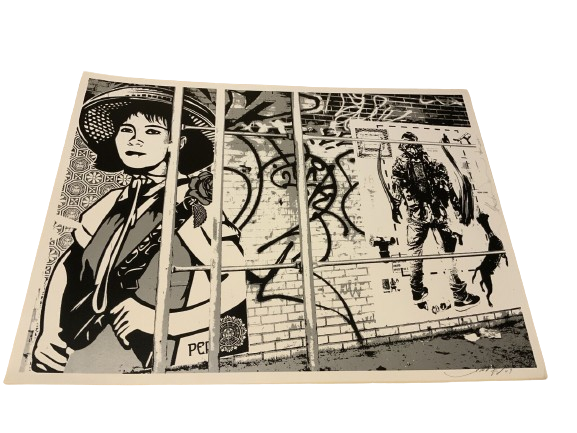


Paris in Street Pop Art & Graffiti Artwork
Paris holds a vital position in the evolution of Street Pop Art & Graffiti Artwork as one of the key international cities where graffiti culture transformed from subcultural expression into a recognized visual language. From the early 1980s onward, Parisian metro stations, alleyways, and industrial zones became laboratories for aerosol experimentation. As American graffiti influences began to cross borders, Paris quickly developed its own identity through a fusion of traditional tagging and bold calligraphic innovations. Parisian graffiti adopted a unique balance of raw energy and graphic refinement, with artists using both letterform complexity and illustrative character work to reflect the city’s dynamic social and political atmosphere. The architectural density of Paris gave graffiti writers a unique canvas to navigate, where aged stone facades, canal walls, and multi-tiered train lines created a natural rhythm for visual interruption and intervention.
Key Artists, Crews, and Neighborhoods of Influence
Paris became home to a powerful wave of graffiti writers whose names helped shape global recognition of European style. Artists such as Bando, Mode2, Lokiss, and JonOne made early marks that elevated the status of Paris in the international graffiti conversation. Bando in particular introduced a refined wildstyle with sharp structure and a focus on outline clarity, while Mode2 introduced a more figurative approach, often integrating hip-hop aesthetics with full-body characters and dance movement. These artists formed part of pivotal crews like BBC and CTK, whose members traveled and traded styles across borders. Neighborhoods such as Belleville, Stalingrad, and Vitry-sur-Seine became hotspots for both legal and illegal graffiti practice. In Vitry, the collaboration between artists like C215 and the community helped transform the area into a living museum of stenciled art, murals, and wheatpastes that span buildings, shutters, and fences.
Stenciling, Political Commentary, and Fine Art Crossover
Paris is also central to the development of stencil-based street work, which gained prominence in the 1990s and continues to define the city’s graffiti identity. Artists such as Blek le Rat used the stencil as a method of rapid deployment and cultural critique, paving the way for politically-charged visual narratives in public space. His influence can be seen in later global figures who adopted the stencil not just for utility but for precision and message. The Parisian scene became known not only for its wildstyle but also for its ability to blend elegance and rebellion, often referencing art history, revolutionary posters, or cinematic imagery. As the street and studio worlds collided, Paris saw its graffiti artists move into galleries without abandoning their street roots. Exhibitions in spaces such as Galerie Itinerrance, Le Grand Palais, and Palais de Tokyo showcased how graffiti artists could redefine the art establishment from the outside in.
Cultural Relevance and International Impact
Paris remains a city where the boundaries between art, architecture, protest, and style collapse into a single visual plane. Graffiti in Paris functions as both personal declaration and civic reflection, responding to the politics of the moment and the mood of the population. Metro tunnels and highway underpasses stand beside gallery walls and rooftops as equally respected spaces for mark-making. Street Pop Art & Graffiti Artwork in Paris carries a rhythm shaped by the city’s philosophical traditions, graphic culture, and layered urban sprawl. It continues to influence artists globally through its blend of elegance, aggression, and articulation of voice in public space. Whether through letterforms, stencils, murals, or installations, Parisian graffiti is a constantly evolving visual code that holds space in both historical archives and living streets.