President Barack Obama

2 artworks

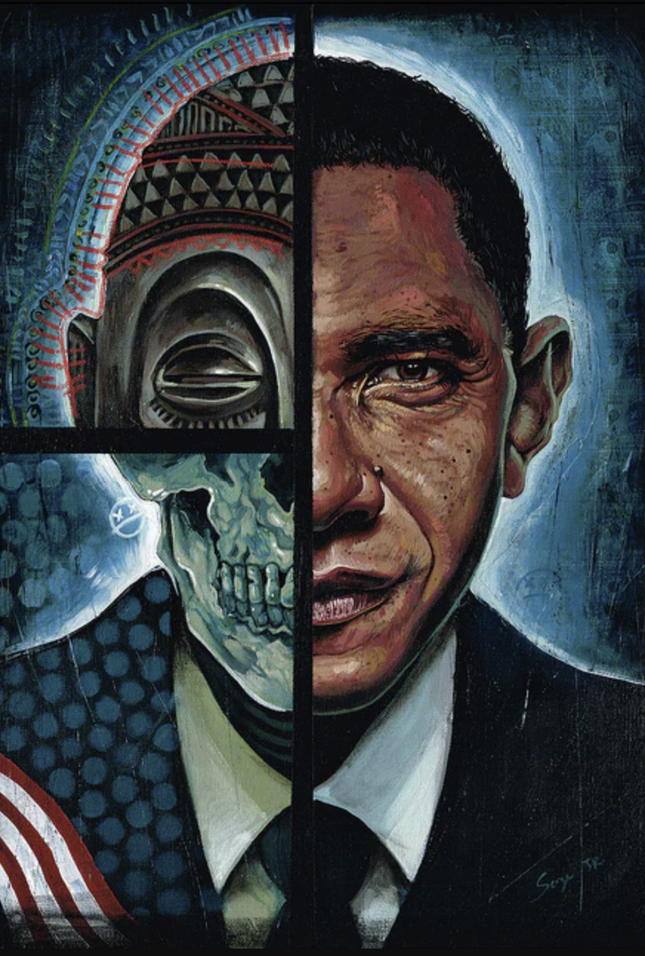
  • One Third Barack Obama Giclee Print by Serge Gay Jr

    Serge Gay Jr One Third Barack Obama Giclee Print by Serge Gay Jr

    One Third Barack Obama Giclee Print by Serge Gay Jr Archival Pigment Fine Art Limited Edition Print on 12pt C2S Cardstock Paper Pop Artist Modern Artwork.  2012 Signed & Numbered Limited Edition of 50 Artwork Size 12x18 Barak Obama 3 Ways One Third Barack Obama Giclee Print by Serge Gay Jr – Limited Edition Street Pop Art & Graffiti Artwork Serge Gay Jr., an artist known for his intricate and socially conscious compositions, presents One Third Barack Obama, a striking 12x18-inch archival pigment fine art print created in 2012. Released as a signed and numbered limited edition of 50, this piece captures the former U.S. president in a fragmented, multi-dimensional portrait that challenges the viewer’s perception of identity, history, and cultural symbolism. Printed on 12pt C2S cardstock paper, the artwork merges realism with abstraction, layering different facets of visual storytelling in a way that speaks to the complexity of political imagery in Street Pop Art & Graffiti Artwork. The composition is divided into three distinct sections, each portraying a different aspect of Barack Obama’s persona. The first segment features a traditional African mask, evoking deep ancestral roots and the history of cultural heritage. The second reveals a skeletal, almost decayed version of his face, a stark contrast to the refined, public-facing image. The third, painted in hyperrealistic detail, presents Obama as a polished, composed figure—his gaze intense and unshaken. The use of bold color shifts and fragmented framing techniques creates a powerful visual dialogue between identity, perception, and legacy. The Symbolism Behind One Third Barack Obama This piece is a layered exploration of leadership, representation, and the way historical narratives shape public figures. By incorporating an African mask, Serge Gay Jr. acknowledges the deep cultural significance of ancestry and the unspoken narratives tied to Obama’s heritage. The skeletal imagery, often a symbol of mortality and hidden truths, suggests the weight of history, perhaps alluding to the struggles, contradictions, and political challenges faced by leaders in modern society. The final third, the most recognizable, serves as a reminder of the carefully crafted public persona that defines leadership in the contemporary political landscape. Street Pop Art & Graffiti Artwork has often been used as a medium to deconstruct powerful figures, challenging the way they are perceived and interpreted. This artwork dissects the visual iconography of Obama, questioning what lies beneath public admiration, media representation, and personal legacy. The use of fragmented portraiture creates an intentional disruption, forcing viewers to examine not just what is seen, but what is implied. Serge Gay Jr.’s Influence in Street Pop Art & Graffiti Artwork Serge Gay Jr. has established himself as an artist who blends fine art techniques with urban influences, creating visually stunning and socially charged pieces that resonate beyond the gallery space. His work often carries a strong narrative, whether addressing political themes, cultural identity, or the human experience. His attention to texture, contrast, and symbolism allows his pieces to communicate complex themes while maintaining a visually captivating aesthetic. Incorporating both traditional and modern techniques, his style is a fusion of realism and surrealism, often employing sharp contrasts in color and form. His ability to manipulate historical references alongside contemporary themes has made his work stand out in the world of Street Pop Art & Graffiti Artwork. One Third Barack Obama is a testament to this approach, presenting a subject that is instantly recognizable yet layered with deeper, thought-provoking elements. The Impact of One Third Barack Obama in Contemporary Urban Art One Third Barack Obama remains a powerful piece within contemporary Street Pop Art & Graffiti Artwork, reflecting the intersection of culture, politics, and artistic expression. By dissecting a highly recognizable political figure into multiple visual components, the piece challenges the audience to reconsider how identity is shaped by both personal history and public perception. The deliberate use of cultural symbolism, juxtaposed with hyperrealism and abstraction, forces the viewer to engage with the complexity of representation in modern society. The limited edition nature of the print makes it highly collectible, as it encapsulates a moment in time when political discourse, cultural identity, and artistic critique converged in a single image. Serge Gay Jr. continues to push boundaries within urban contemporary art, using his talent to create thought-provoking, visually striking pieces that leave a lasting impact. One Third Barack Obama stands as a bold example of how street art can serve as both a political statement and a deep exploration of identity, ensuring its relevance in the ongoing dialogue between art and society.

    $134.00

  • Lincoln Obama 15 President Barrack Vinyl Art Sculpture by Ron English

    Ron English- POPaganda Lincoln Obama 15 President Barrack Vinyl Art Sculpture by Ron English

    Lincoln Obama 15 President Barrack Vinyl Art Sculpture by Ron English- POPaganda Limited Edition Collectible Sculpture Figure Fine Artwork by Graffiti Pop Street Artist. 2008 Limited Edition of 50 Artwork Size 10x15 New In Box Stamped Vinyl Fine Art Toy Figure Sculpture. Ron English- POPaganda – Abraham Obama Vinyl Sculpture in Street Pop Art & Graffiti Artwork Ron English- POPaganda’s Abraham Obama vinyl art sculpture is one of the most audacious and conceptually layered pieces in the evolution of Street Pop Art & Graffiti Artwork. Created in 2008 during the height of President Barack Obama’s first campaign, this limited edition collectible (edition of 50) merges two of America’s most culturally significant presidents—Abraham Lincoln and Barack Obama—into a singular hybrid bust. Standing 10 inches tall by 15 inches boxed, and produced in vinyl by MINDstyle, this figure embodies Ron English- POPaganda’s signature approach: visual collision, political parody, and cultural remix, all filtered through the lens of pop surrealism and graffiti-inspired fine art. The sculpture presents Obama with Lincoln’s iconic facial hair and historical attire, challenging the viewer to reexamine not only the legacy of leadership but also the collective symbols of American hope and progress. The packaging reinforces this fusion with a bold, saturated yellow and green colorway and English’s graffiti-styled hand lettering. It’s equal parts street culture artifact and fine art satire. With this work, English transforms campaign-era idealism into a collectible statement piece, collapsing timelines and creating a new icon meant to provoke, amuse, and unsettle. Visual Satire and Political Remix in 3D Form This sculpture is more than a mashup—it’s a sculptural commentary on how America constructs its heroes. By merging Lincoln, the president who ended slavery, with Obama, the first Black president of the United States, Ron English- POPaganda uses Street Pop Art’s remix culture to speak directly to race, legacy, and the mythology of leadership. The fusion is visually seamless yet conceptually jarring, forcing viewers to ask whether America’s dreams of progress are genuine or simply surface-level branding. English has long employed pop culture icons in his work—Mickey Mouse, Ronald McDonald, superheroes—manipulating them into grotesque or exaggerated versions of themselves. In Abraham Obama, however, the satire is more refined, bordering on reverence while still critiquing the idealization of political figures. It questions whether Obama’s image was being mythologized in real time, turning him into an icon before history could judge the substance of his presidency. That complexity is central to graffiti and pop-infused art: using popular imagery not to worship, but to dissect. Street Culture Meets Designer Toy Aesthetic As part of the collectible art toy movement, Abraham Obama also bridges the gap between street-level art and gallery collectible culture. The piece follows a lineage of vinyl sculpture rooted in graffiti aesthetics, lowbrow art, and limited edition consumer drops. Much like street art stickers and mural culture, these figures carry the urgency of ephemera and rebellion—but rendered in high-quality materials with gallery-level craft. The use of vinyl makes the work accessible in both material and tone, a tactile evolution of street pop's visual ethos. These types of sculptures are the three-dimensional cousins of stenciled posters and wheatpasted satire, designed to occupy the same cultural headspace while entering private collections. Like a Banksy piece pulled from a wall, Abraham Obama is designed to be portable without losing its streetwise edge. Legacy of Political Pop in Urban Visual Culture Ron English- POPaganda’s Abraham Obama is one of the most definitive statements of political remix in the contemporary art landscape. It belongs to a genre that not only challenges political narratives but also reframes how visual culture mythologizes leadership. In the hands of a graffiti pop veteran like English, the sculpture becomes more than a novelty—it becomes an archive of American hopes, contradictions, and media-driven spectacle. Within the expanding lexicon of Street Pop Art & Graffiti Artwork, Abraham Obama stands as a hybrid icon—part toy, part bust, part satire, part prayer. It encapsulates the power of street-level aesthetics to shape and reflect the nation’s deepest cultural tensions, all while making it possible to hold a piece of visual revolution right in your hands.

    $500.00

President Barack Obama Graffiti Street Pop Artworks

President Barack Obama in Street Pop Art & Graffiti Artwork

President Barack Obama has been one of the most iconic and visually represented political figures in the history of Street Pop Art & Graffiti Artwork. His presidency not only marked a historic milestone in American politics but also became a catalyst for a new era of political expression in urban art. The image of Obama—stylized, replicated, reinterpreted—has been used by artists around the world to represent hope, change, progress, and, at times, the limitations of political power. His face, often framed in red, white, and blue or cast in stark contrasts, became a living symbol of transformation and aspiration in the 21st century. Perhaps the most famous visual associated with Barack Obama is Shepard Fairey’s HOPE poster. Originally designed in 2008 during Obama’s first presidential campaign, this silkscreen image turned street art into a national icon. Featuring a stylized portrait of Obama in bold hues of blue, beige, and red with the word HOPE beneath, the piece merged pop art aesthetics with political urgency. Though not officially commissioned by the campaign, the image became a cornerstone of Obama’s public identity and is now one of the most influential pieces of political art in modern history. Its impact reshaped how campaign imagery could function within the language of street art—bold, accessible, and emotionally resonant.

Visual Language and the Urban Canvas

Obama’s face and presence lent itself naturally to the iconography of Street Pop Art. His features—clean lines, thoughtful expression, and sharp profile—translated seamlessly into stencil and wheatpaste formats. Artists in Los Angeles, New York, London, Berlin, and beyond created murals, posters, and graffiti works using Obama’s image to communicate ideals of leadership, representation, and the possibility of systemic change. Whether in large-scale urban murals or intimate gallery prints, Obama’s visage became a repeated motif symbolizing modern progressive vision. Beyond Shepard Fairey, numerous other artists adapted Obama into their visual narratives. Ron English reimagined him with comic book aesthetics, while artists like Mr. Brainwash and D*Face used collage and distortion to either elevate or critique his persona. These interpretations reflect the broader tradition of Street Pop Art & Graffiti Artwork, where public figures are never just portrayed—they are reframed, dissected, celebrated, or satirized depending on context and intention.

Obama as Symbol and Subject of Dialogue

Street artists did not only celebrate Obama—they also used his image to interrogate policy and public sentiment. After the excitement of the 2008 election and his inauguration in 2009, some works began to question the realities of political compromise, drone warfare, and immigration policy under his administration. This dual use—of Obama as both hero and critique—illustrates how graffiti and pop artists do not function as propagandists, but rather as cultural commentators. They reflect the complexity of leadership and the evolving relationship between the people and power. Obama’s image, when used in street art, often appears alongside symbols like doves, fists, the Capitol, or civil rights leaders like Martin Luther King Jr. This layering connects his presidency to a broader historical struggle for justice and equality. The art doesn’t merely portray a man—it visualizes a moment in time when history, hope, and politics collided in the public imagination.

Legacy in the Urban Visual Archive

Today, Barack Obama’s presence in Street Pop Art & Graffiti Artwork remains strong. From murals in South Central LA to galleries in Brooklyn, his image continues to surface in new works that revisit the meaning of hope, the weight of representation, and the unresolved questions of justice. The use of his likeness in stencil, spray, collage, and print has become a permanent part of the urban art lexicon. His legacy, at least in visual terms, has transcended the boundaries of presidency and become a symbol both historical and aspirational. Through street pop art, Barack Obama is immortalized not just as a political figure but as an evolving visual language—a canvas upon which artists express the spectrum of belief, doubt, pride, and inquiry. His presence in this movement marks a moment where politics and paint collided to move people, not through speeches, but through walls.

Footer image

© 2025 Sprayed Paint Art Collection,

    • Amazon
    • American Express
    • Apple Pay
    • Bancontact
    • Diners Club
    • Discover
    • Google Pay
    • iDEAL
    • Mastercard
    • PayPal
    • Shop Pay
    • Visa

    Login

    Forgot your password?

    Don't have an account yet?
    Create account