
Smiley Face

1 artwork

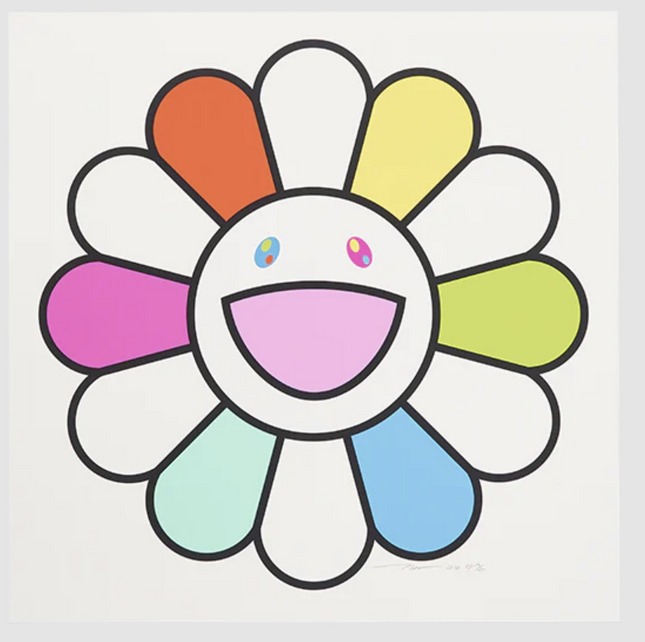
  • Smiley Days with Ms Flower to You! Silkscreen Print by Takashi Murakami TM/KK

    Takashi Murakami TM/KK Smiley Days with Ms Flower to You! Silkscreen Print by Takashi Murakami TM/KK

    Smiley Days with Ms. Flower to You! 8-Color Hand-Pulled Limited Edition Silkscreen Print on Fine Art Paper by Takashi Murakami TM/KK Rare Street Art Famous Pop Artwork Artist. 2020 Signed & Numbered Limited Edition of 100 Artwork Size 19.7x19.7 Rare Takashi Murakami TM/KK Ms. Mr. Rainbow Flower Silkscreen Print Artwork. Small handling bumps to the left/right lower corner, small bump to the upper right corner. Takashi Murakami's Smiley Days with Ms. Flower to You!: Flattened Joy in Pop Art Precision Takashi Murakami’s Smiley Days with Ms. Flower to You! encapsulates his signature blend of cheerful imagery, cultural layering, and ultra-clean graphic execution. Created in 2020 as an 8-color hand-pulled silkscreen print, this limited edition of 100 works stands at 19.7 x 19.7 inches and is signed and numbered by the artist. The artwork features the instantly recognizable flower motif with alternating petal colors and an exaggerated smile across the central face. What appears at first to be a playful, almost childlike symbol of joy is, in Murakami’s visual language, a deeply coded cultural artifact that questions the nature of happiness, identity, and image saturation in the contemporary world. The symmetrical structure and bold outlines suggest cartoon aesthetics, yet Murakami’s execution is far from spontaneous. Every curve, gradient, and color choice is calculated to reinforce a sense of artificial perfection. The smiling flower character, often mistaken for simplistic pop decoration, emerges from a broader lineage of Japanese visual culture—including Edo-period painting, kawaii consumer goods, and the hyper-saturated imagery of anime and manga. By distilling all of these elements into a single figure, Murakami has produced a contemporary symbol that functions across cultures and commercial systems. Superflat Theory and the Deconstruction of Depth Murakami’s Smiley Days with Ms. Flower to You! is a direct application of his Superflat philosophy, which merges traditional Japanese aesthetics with the shallow perspective of digital-age visual consumption. The flatness in this print is not merely stylistic but ideological. It represents a collapse of distinction between fine art and mass media, high culture and consumer object. The lack of depth in the flower’s face, along with the pristine uniformity of the petals, draws attention to how culture packages emotion and sells it as aesthetic surface. Rather than invite introspection through complexity, Murakami’s print bombards the viewer with immediate, digestible visual pleasure. But that sensory overload is deceptive. The flower’s manic grin—framed by perfectly arranged petals in pastel and neon hues—suggests an almost disturbing insistence on happiness. It becomes a symbol not of actual emotional expression but of imposed positivity. The eyes, colored with soft gradients and cartoon sparkle, recall the exaggerated features of anime mascots but also serve as hollow portals in an otherwise flattened identity. Street Pop Art & Graffiti Artwork Rendered with Surgical Cleanliness Though not rooted in traditional graffiti practice, Murakami’s work has been deeply influential in the evolution of Street Pop Art. He merges the visual appeal of mass-produced graphic design with the thematic subversions common in graffiti. The flower motif, while seemingly benign, has appeared on luxury fashion collaborations, vinyl toys, and fine art prints alike, highlighting how symbols circulate between subculture and commerce. Murakami’s deliberate use of commercial channels does not dilute his message—it amplifies it. The print’s pristine execution and wide appeal comment on the mechanisms of art as commodity, without needing to stage rebellion through messiness or illegality. The silkscreen process used in this edition aligns with Murakami’s obsession with perfection. Each color layer is meticulously printed, ensuring consistency and uniform saturation, mimicking the effect of digital art but with the tangible value of a handmade print. This duality—the tactile reality of traditional craft paired with the aesthetics of digital media—reinforces the thematic content of the flower itself: joy as production, identity as design, emotion as product. Murakami’s Smiley Days with Ms. Flower to You! ultimately operates as both a visual balm and a conceptual warning. In Street Pop Art & Graffiti Artwork, surface often holds as much power as meaning, and Murakami leverages that to brilliant, unsettling effect. The flower smiles because it must. Its joy is performative, its beauty standardized—and in that, it holds a mirror to the world that created it.

    $4,936.00

Smiley Face Graffiti Street Pop Artwork

Smiley Face: A Universal Emblem in Street Pop Art and Graffiti Artwork

The Smiley Face, a universal symbol of happiness and positivity, has permeated various art forms, including graffiti and street art. Its presence in the urban landscape, represented through a simple yet powerful icon, has garnered attention and admiration from artists and audiences alike. Graffiti and street art prints incorporating the Smiley Face demonstrate the power of this symbolic design and the way it has transcended its origins to become an enduring fixture of modern art. The emergence of the Smiley Face in graffiti art can be traced back to the counterculture movement of the 1960s and 1970s. As a symbol of happiness and peace, it was embraced by artists who wished to convey messages of optimism and unity amidst the social and political unrest of the era. As street art and graffiti became more prevalent, the Smiley Face naturally found its way onto the walls of urban environments, often as part of a larger artistic narrative or as an independent, standalone image. In contemporary graffiti and street art prints, the Smiley Face has evolved to take on various forms, reflecting the diverse styles and approaches of the artists themselves.
Some artists opt for a minimalist approach, utilizing simple lines and shapes to depict the iconic design. In contrast, others may incorporate more complex patterns, textures, or abstract elements to create unique interpretations. This adaptability has allowed the Smiley Face to flourish in street art, as it can be seamlessly integrated into a wide range of artistic styles. The smiley face, a simple depiction of a smiling face with two dots for eyes and a curved line for a mouth, has become one of the most ubiquitous symbols in modern culture. Its journey from a mere mood-lifter to a significant icon in street pop art and graffiti artwork is a testament to its versatile appeal and power as a means of communication. The smiley face transcends languages and cultures, embodying a universal message of happiness and goodwill that various art movements, including pop art, street art, and graffiti, have embraced. In street pop art, the smiley face has often been used to bring a sense of joy and whimsy to the urban landscape. Graffiti artists have adopted this icon to inject a playful character into their work, contrasting the cityscape's often severe and gritty nature. The simplicity of the smiley allows for quick recognition and direct emotional response, making it an effective tool for artists to connect with a broad audience. Whether splashed across a brick wall, stickered on a lamppost, or stenciled onto a sidewalk, the smiley face in graffiti artwork often serves as an unexpected interruption to the mundane, prompting passersby to pause and engage with their surroundings with a lighter heart.

The Evolution of the Smiley Face in Modern Art Forms

The evolution of the smiley face within modern art forms such as street pop art and graffiti has mirrored societal changes and the shifting tides of emotional expression in public spaces. From its inception, the smiley has been reimagined and recontextualized to fit the messages artists wish to convey. It has been depicted in many variations, from the classic bright yellow circle to more elaborate and sometimes subversive adaptations. The smiley face can often be found in street art as a standalone symbol and incorporated into larger pieces that address themes ranging from peace and love to irony and social critique. The versatility of the smiley face means that it can be both a nostalgic reference to the past and a contemporary commentary. Some artists have used it to invoke the carefree spirit of the 1960s and 70s, while others have adapted it to critique the commercialization of happiness and the pressures of modern life. In this way, the smiley face serves as a canvas upon which artists can project various narratives, making it a powerful and adaptable element in the visual language of street art. One of the most iconic examples of the Smiley Face in street art can be found in the works of renowned British artist Banksy. His satirical approach to street art often incorporates the Smiley Face in provocative and thought-provoking contexts. In one of his most famous pieces, a rioter is depicted wearing a Smiley Face mask, juxtaposing the symbol of happiness with the chaotic scene unfolding around it. This clever use of the Smiley Face challenges viewers to question the true nature of happiness in modern society.
Street artists like Shepard Fairey, creator of the Obey Giant, have reimagined the Smiley Face in their works. Fairey's version, called "Andre the Giant Has a Posse," is a hybrid of the Smiley Face and the visage of Andre the Giant, a professional wrestler. The piece is a commentary on the power of mass media and its ability to create influential symbols. By incorporating the Smiley Face into his work, Fairey effectively highlights the significance and omnipresence of such icons in popular culture. Graffiti and street art prints featuring the Smiley Face are highly sought after by collectors and enthusiasts alike. These works often embody a sense of optimism, resilience, and defiance despite the challenges faced in the modern world. The Smiley Face, in its various forms, continues to serve as a potent reminder that happiness can be found even amidst the most chaotic and unexpected circumstances. The Smiley Face has left an indelible mark on graffiti and street art prints. Its simple, universally recognized design and ability to adapt to various artistic styles make it a favorite subject among artists and collectors. As a symbol of happiness, peace, and positivity, the Smiley Face brings joy and inspiration to those who encounter it in the streets and on the walls of our urban landscapes.

The Smiley Face as a Cultural Icon in Street Art

As a cultural icon, the smiley face occupies a unique position within the world of street art. It symbolizes the counterculture and a mainstream motif, embraced by artists who appreciate its history and ability to speak to a broad audience. The smiley face has been used to foster a sense of community, to challenge the status quo, and to express solidarity or dissent. It is a symbol that can be found in the works of seasoned street artists and the scribbles of anonymous individuals alike, highlighting its democratic nature and its resonance with a diverse range of voices within the urban environment. In street pop art and graffiti, the smiley face often reflects the artist's intent and the cultural moment in which it is created. It connects the mood of a society or offers a counterpoint to it. As such, the smiley face in street art is not merely decorative; it is a potent means of expression, loaded with the potential to inspire, provoke, and connect. The enduring legacy of the smiley face in street pop art and graffiti artwork lies in its simplicity and depth. It is a motif that has been embraced and reinterpreted countless times, yet it retains its core message of happiness and positivity. The smiley face is a reminder of the power of art to influence mood and perspective, to bring light to dark places, and to offer a moment of connection in the fast-paced and often isolating urban environment. Through its various incarnations in street art, the smiley continues to engage with audiences, to challenge and delight, and to serve as a beacon of universal communication in the visual tapestry of the city.
Footer image

© 2025 Sprayed Paint Art Collection,

    • Amazon
    • American Express
    • Apple Pay
    • Bancontact
    • Diners Club
    • Discover
    • Google Pay
    • iDEAL
    • Mastercard
    • PayPal
    • Shop Pay
    • Visa

    Login

    Forgot your password?

    Don't have an account yet?
    Create account