Tribal Druid & Native

5 artworks

  • Marchers White Silkscreen Print by Cleon Peterson

    Cleon Peterson Marchers White Silkscreen Print by Cleon Peterson

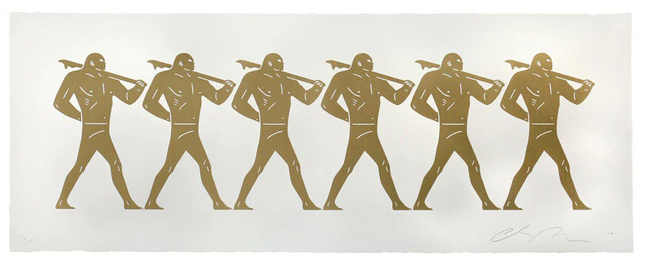
    Marchers White Silkscreen Print by Cleon Peterson 2 Color Hand-Pulled on Deckled Fine Art Paper Limited Edition Pop Street Art Artwork. 2016 Signed & Numbered Limited Edition of 125 Artwork Size 13x34 Silkscreen Print of Tribal Men Carrying Bloody Swords Marching In Line. Marchers White by Cleon Peterson – Limited Edition Silkscreen in Street Pop Art & Graffiti Artwork Marchers White is a 2016 hand-pulled 2-color silkscreen print by American artist Cleon Peterson. This signed and numbered limited edition of 125 was printed on deckled fine art paper and measures 13 x 34 inches. It features a procession of six stylized, muscular figures in a uniform line, each carrying a blood-streaked sword draped across their shoulders. The artwork is a graphic portrayal of conformity and violence, rendered in Peterson’s iconic flattened silhouette style. With clean lines and bold simplicity, the figures march in lockstep across a stark white background, forming a visual rhythm that mimics propaganda friezes and ancient relief carvings. The use of gold and red ink intensifies the contrast between elegance and brutality, a hallmark of Peterson’s visual language. Symbolism of Power, Violence, and Uniformity In Marchers White, Peterson explores the mechanization of power and the erosion of individuality within systems of control. Each figure appears identical, stripped of personal identity and locked in a hypnotic march. The red-tipped blades suggest recent violence or continuous bloodshed, reinforcing the idea that aggression has become routine, even ceremonial. The figures’ nudity, stylized musculature, and emotionless posture evoke primal force restrained within a ritual of obedience. The repeated form not only recalls ancient military parades or mythic processions, but also comments on contemporary structures of state, surveillance, and oppression. The absence of background or contextual setting forces viewers to focus entirely on the figures and their choreography, placing the act of violence and conformity at the center of the narrative. Cleon Peterson’s Allegorical Voice in Street Pop Art & Graffiti Artwork Cleon Peterson is known internationally for creating visual allegories that depict lawlessness, domination, and moral inversion. His works pull from classical art history, political propaganda, and modern editorial illustration to construct a world in collapse—where traditional boundaries between good and evil are blurred. Marchers White reflects Peterson’s ongoing examination of systemic violence and institutional complicity. While minimal in execution, the work functions as a complex statement on the banality of authoritarianism. It belongs squarely within the lineage of Street Pop Art & Graffiti Artwork, as it utilizes bold, graphic style to engage in socio-political critique. Peterson does not romanticize rebellion or glorify power—instead, he presents viewers with unfiltered snapshots of a dystopian order wrapped in seductive aesthetics. Printmaking Technique and Collector Value The Marchers White edition is crafted with the precision and attention to detail that characterizes Cleon Peterson’s fine art practice. Printed using a 2-color silkscreen method on heavyweight deckled fine art paper, the physical quality of the piece matches its conceptual weight. The crisp edges of the figures and the subtle texture of the ink application reflect a high standard of printmaking. Each print is individually signed and numbered, securing its authenticity and positioning it as a significant work within Peterson’s catalog. For collectors of Street Pop Art & Graffiti Artwork, Marchers White stands as a poignant artifact of modern discontent—a visually arresting and politically charged piece that underscores the silent march of violence accepted as structure.

    $1,199.00

  • Moniferal New Orleans 2011 Giclee Print by Swoon- Caledonia Curry

    Swoon- Caledonia Curry Moniferal New Orleans 2011 Giclee Print by Swoon- Caledonia Curry

    Moniferal New Orleans 2011 Giclee Print by Swoon- Caledonia Curry Artwork Limited Edition Print on Heavy Fine Art Rag Paper Graffiti Pop Street Artist. 2016 Signed & Numbered Limited Edition of 175 Artwork Size 19x13 From The Swoon Street Series Print Collection. Moniferal New Orleans 2011 Giclee Print by Caledonia Curry aka Swoon Moniferal New Orleans 2011 is a signed and numbered giclee print by Caledonia Curry, known in the Street Pop Art & Graffiti Artwork world as Swoon. This edition was released in 2016 in a limited run of 175 prints and measures 19 by 13 inches. The piece was produced on heavy fine art rag paper and belongs to the celebrated Swoon Street Series Print Collection. The artwork captures a moment from a site-specific installation in New Orleans, where Curry’s wheatpastes often explored vulnerability, resilience, and environmental rebirth through intimate human subjects fused into complex natural motifs. Caledonia Curry’s Swoon in New Orleans The city of New Orleans has held profound significance in the evolution of Swoon’s practice. After the devastation of Hurricane Katrina, Curry became deeply involved in collaborative recovery and rebuilding projects throughout the city. Moniferal was part of a wave of wheatpaste installations that carried emotional and symbolic resonance. This print preserves one such work that fuses portraiture and organic motifs into a visual experience of transformation. The subject appears grounded and contemplative, surrounded by intricate botanical linework that resembles both roots and wings. The muted, earthy tones and layered texture reflect the raw surfaces of the wall on which it was originally installed, making the giclee not just a documentation, but a continuation of that street-born experience. Technical Excellence in Giclee Reproduction The giclee print of Moniferal New Orleans 2011 honors the detailed linework and subtle tonal shifts of Curry’s original wheatpaste. The fine art rag paper supports the texture and depth, allowing collectors to experience the dimensionality that her murals evoke in public spaces. The choice to publish this piece as part of the Street Series Print Collection reflects its importance in capturing the fragility and strength of the human spirit—a recurring focus in Caledonia Curry’s work. As with other prints in the series, the limited edition number and artist signature confirm its place within the lineage of Street Pop Art & Graffiti Artwork adapted for the fine art context. Legacy of Swoon’s Human-Centered Street Art Caledonia Curry has long centered her practice on the power of human expression amid urban decay and social upheaval. Moniferal New Orleans 2011 serves as an artifact of both artistic innovation and humanitarian response. The figure in the composition becomes a universal stand-in for the survivor, the nurturer, or the witness, her form interwoven with hand-cut patterns and street textures. This edition captures the sensitivity of Swoon’s touch and the importance of preserving transient urban interventions in enduring form. Through Moniferal, Curry continues to redefine the aesthetic and cultural reach of Street Pop Art & Graffiti Artwork.

    $350.00

  • Old Man Varaniassi Autumn Vines Brooklyn 2013 Print by Swoon- Caledonia Curry

    Swoon- Caledonia Curry Old Man Varaniassi Autumn Vines Brooklyn 2013 Print by Swoon- Caledonia Curry

    The Old Man and Varaniassi With Autumn Vines Brooklyn 2013 Giclee Print by Swoon- Caledonia Curry Artwork Limited Edition Print on Heavy Fine Art Rag Paper Graffiti Pop Street Artist. 2016 Signed & Numbered Limited Edition of 175 Artwork Size 19x13 From The Swoon Street Series Print Collection. The Old Man and Varaniassi with Autumn Vines by Caledonia Curry aka Swoon The Old Man and Varaniassi with Autumn Vines Brooklyn 2013 is a striking giclee print by Caledonia Curry, the influential Street Pop Art & Graffiti Artwork figure known as Swoon. Released as part of the Swoon Street Series Print Collection in 2016, this signed and numbered edition of 175 showcases one of her most haunting and poetic wheatpaste interventions. Captured in situ, the piece features an intricate black-and-white wheatpaste portrait of an elderly man, placed against the weathered textures of a Brooklyn wall, overtaken by creeping autumn vines and surrounded by vibrant street ephemera. The print measures 19x13 inches and is produced on museum-grade fine art rag paper, emphasizing the detail and tonal richness of the original street composition. Street Pop Art Symbolism in Swoon's Urban Portraiture Caledonia Curry's ability to breathe emotional depth into public spaces has made her a defining voice in contemporary street culture. In The Old Man and Varaniassi with Autumn Vines, the figure appears contemplative and weathered, rendered in her signature hand-drawn, cut, and pasted style. The background creates a rich tapestry of decay and life—flaking paint, tags, stickers, and ivy coexist as both natural and cultural decay and regeneration. This synergy between subject and environment reflects one of the core themes in Curry’s body of work: honoring human dignity amid the chaos of urban life. The artwork draws on the language of both graffiti and fine art, blending portraiture with the physicality of the street surface and layering in symbolism that rewards slow looking. Graffiti Pop Street Artist Caledonia Curry and Her Printmaking Legacy Caledonia Curry has consistently pushed the boundaries of Street Pop Art & Graffiti Artwork by documenting her ephemeral public wheatpastes in limited-edition fine art prints. These prints are not mere reproductions but vital reimaginings that preserve the emotional and aesthetic impact of the original installations. The Old Man and Varaniassi with Autumn Vines is a key example of how Curry translates fleeting urban moments into permanent artistic records. The dense linework, atmospheric tone, and interplay between figure and urban decay reflect her background in printmaking and her dedication to community-centered narratives. This print is both a piece of art history and a continuation of street storytelling. Preserving Urban Stories through Fine Art Editions The Old Man and Varaniassi with Autumn Vines Brooklyn 2013 stands as an enduring document of Swoon's work in New York during a pivotal period in her career. Printed with archival inks on heavyweight fine art paper, the edition reflects the technical care and conceptual weight Curry brings to all her projects. Whether experienced on the street or as a gallery-quality print, her work communicates empathy, memory, and resilience. As part of the Swoon Street Series Print Collection, this piece allows collectors and institutions to engage with the raw immediacy of street culture in a format that honors its artistic and cultural value. Caledonia Curry continues to shape Street Pop Art & Graffiti Artwork through her visionary blend of fine art precision and social engagement.

    $350.00

  • Ice Queen Jogjakarta Indonesia Giclee Print by Swoon- Caledonia Curry

    Swoon- Caledonia Curry Ice Queen Jogjakarta Indonesia Giclee Print by Swoon- Caledonia Curry

    Ice Queen Jogjakarta Indonesia Giclee Print by Swoon- Caledonia Curry Artwork Limited Edition Print on Heavy Fine Art Rag Paper Graffiti Pop Street Artist. 2016 Signed & Numbered Limited Edition of 175 Artwork Size 19x13 From The Swoon Street Series Print Collection. Ice Queen Jogjakarta by Caledonia Curry aka Swoon Ice Queen Jogjakarta Indonesia is a powerful giclee print by Caledonia Curry, the American Street Pop Art & Graffiti Artwork artist internationally recognized under the name Swoon. Created in 2016 as part of her Street Series Print Collection, this work captures a moment of street intervention in Jogjakarta, Indonesia, and preserves it on 19x13 inch heavy fine art rag paper. The print is part of a signed and numbered limited edition of 175 and reflects Swoon’s enduring commitment to documenting ephemeral urban installations through high-quality archival prints that communicate the immediacy of her public work in permanent form. Street Pop Art Expression in Swoon’s Global Installations In Ice Queen Jogjakarta, Swoon presents a portrait of a regal, nature-bound figure pressed against an urban wall layered with graffiti tags and weathered textures. Rendered in her signature woodcut-inspired style, the Ice Queen wears an intricate arrangement of leaves and feathers, projecting strength, poise, and mysticism. The subject appears both delicate and formidable, staring off into the distance as the marks of graffiti culture swirl around her. The print captures the original street piece’s juxtaposition between handmade beauty and the unpredictable conditions of outdoor walls, delivering a dialogue between the natural and constructed. As with much of Swoon’s Street Pop Art & Graffiti Artwork, the work centers human presence in the urban context and makes a visual offering to the local environment. Caledonia Curry’s Practice and Global Footprint Caledonia Curry was born in the United States and emerged from the early 2000s street art movement in New York with her iconic wheatpaste portraits. As her practice evolved, she expanded her work to cities around the world, leaving pieces that speak to local identity, shared humanity, and social history. Ice Queen Jogjakarta is an example of her international reach and cultural sensitivity. The artwork not only documents her physical intervention in Indonesia but also reflects her collaborative and immersive approach to making art in unfamiliar settings. Each figure Curry creates has a presence that speaks beyond nationality, embodying archetypes of resilience and grace amid visual disorder. This piece, like others in her print catalog, is a distilled snapshot of a larger global narrative she continues to build. Preserving Street Ephemera through Fine Art The Ice Queen Jogjakarta giclee print encapsulates Curry’s ability to transform fleeting wheatpaste work into collector-grade fine art without losing its original emotional power. Printed on museum-quality rag paper, this edition respects the raw materiality of the street while elevating the work into the realm of collectible Street Pop Art & Graffiti Artwork. It stands as both an artwork and a historical document, preserving a specific moment in a foreign urban space. The entire Street Series Print Collection honors this dual purpose. For those interested in contemporary street culture and international artistic practice, this print offers a glimpse into the heart of Swoon’s creative mission and her lasting impact on public art.

    $350.00

  • Marchers Black Silkscreen Print by Cleon Peterson

    Cleon Peterson Marchers Black Silkscreen Print by Cleon Peterson

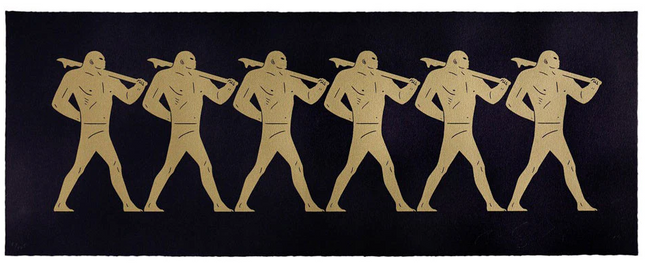
    Marchers Black Silkscreen Print by Cleon Peterson 2 Color Hand-Pulled on Deckled Fine Art Paper Limited Edition Pop Street Art Artwork. 2016 Signed & Numbered Limited Edition of 125 Artwork Size 13x34 Silkscreen Print of Tribal Men Carrying Bloody Swords Marching In Line. Marchers Black by Cleon Peterson – Limited Edition Silkscreen in Street Pop Art & Graffiti Artwork Marchers Black is a 2016 hand-pulled 2-color silkscreen print by Cleon Peterson, an American artist acclaimed for his stark allegories of violence, dominance, and control. This limited edition work is printed on 13 x 34 inch deckled fine art paper and was released in an edition of 125, each one signed and numbered by the artist. The image features six identical, stylized figures walking in strict formation, each with a sword slung over the shoulder. The figures are rendered in gold on a deep matte black background, emphasizing their ritualistic presence and evoking both ancient procession and modern conformity. The figures’ nudity, musculature, and uniform posture strip them of individual identity, instead casting them as instruments of institutional force, frozen in a silent parade of aggression. Conformity, Power, and the Aesthetic of Ritual In Marchers Black, Cleon Peterson isolates the mechanisms of systemic violence and repetition. The identical figures advance in step, their gestures calm yet loaded with menace. The blood-smeared blades on their backs are symbolic rather than graphic, suggesting not the moment of action but the aftermath—the silent normalization of brutality. The lack of expression or differentiation among the figures speaks to the erasure of individuality under oppressive structures, whether they be military, political, or societal. Their forward momentum, fixed and unrelenting, reads as both a march toward power and a descent into complicity. The black background serves not just as negative space but as psychological weight, amplifying the intensity of the gold silhouettes and enforcing a sense of visual and emotional gravity. Cleon Peterson’s Signature Themes in Street Pop Art & Graffiti Artwork Cleon Peterson is a leading voice in Street Pop Art & Graffiti Artwork, known for merging graphic minimalism with confrontational narratives. His compositions channel ancient mural traditions, propaganda design, and dystopian storytelling into modern allegories. Marchers Black exemplifies this approach by simplifying form to maximize meaning. While many artists in the genre celebrate rebellion, Peterson exposes the systems behind it—the hierarchies, the ritualistic cycles of violence, the role of submission in maintaining order. His work is not decorative but declarative, challenging viewers to confront the undercurrents of cruelty that persist beneath polished surfaces. Marchers Black is not a depiction of chaos, but of order so rigid it becomes inhuman. It visualizes the seduction and horror of control through the repetition of figures whose purpose is not to question, but to obey. Material Execution and Collector Impact Printed on premium deckled fine art paper using a two-layer silkscreen process, Marchers Black merges street aesthetics with refined printmaking tradition. The gold pigment contrasts dramatically against the matte black background, delivering a visual impact that echoes the thematic weight of the piece. Each print is hand-pulled and signed by Cleon Peterson, reinforcing its position as a deliberate and enduring object. As a limited edition of 125, it holds significant value for collectors interested in Street Pop Art & Graffiti Artwork that critiques systems of power without relying on spectacle. Marchers Black is both a visual mantra and a warning—documenting the quiet march of institutional violence, masked in symmetry, strength, and silence.

    $1,199.00

Tribal Druid & Native Graffiti Street Pop Artwork
Tribal themes have been a source of inspiration for many artists throughout history, and this includes both graffiti art and pop art. Graffiti art has its roots in urban culture, while pop art emerged in the 1950s and 1960s as a response to the rise of mass consumerism and the popularization of advertising and media. In graffiti art, tribal themes are often used to convey a sense of cultural identity and heritage. Graffiti artists may draw on traditional tribal art styles and motifs to create their own unique works that speak to their individual experiences and perspectives. For example, a graffiti artist might incorporate patterns inspired by Maori or Native American designs into their work to express their own cultural heritage or pay homage to the traditions of others. Similarly, in pop art, tribal themes are often used to explore issues of identity and cultural exchange. Pop artists may draw on imagery from tribal cultures to create bold, colorful works that comment on the ways in which cultures intersect and influence one another. For example, pop artist Keith Haring often incorporated tribal motifs into his work to create a sense of universal human connection, while also exploring themes of power and oppression. Graffiti art has its roots in the hip-hop culture of the 1970s and 1980s, and it has since grown to become a global phenomenon. Graffiti artists often use tribal themes in their work as a way of expressing cultural identity and heritage. For example, a graffiti artist of Pacific Islander descent might incorporate traditional Polynesian designs into their work to pay homage to their cultural heritage. In addition, graffiti artists may also draw on tribal motifs to create a sense of community and belonging. Graffiti writers often form crews, or groups of like-minded individuals, and the use of tribal themes can serve as a way of visually representing this sense of shared identity and purpose. Pop art emerged in the 1950s and 1960s as a response to the rise of mass consumerism and the popularization of advertising and media. Pop artists often drew on imagery from popular culture to create bold, colorful works that commented on the changing nature of American society. Tribal themes were often used in pop art to explore issues of identity and cultural exchange. Pop artists such as Keith Haring and Jean-Michel Basquiat often incorporated tribal motifs into their work as a way of creating a sense of universal human connection. For example, Haring's "Radiant Baby" image incorporates elements of tribal art, but it is also a symbol of hope and innocence that transcends cultural boundaries. The use of tribal themes in graffiti art and pop art can serve as a means of exploring issues of identity, heritage, and cultural exchange. By drawing on traditional motifs and styles, artists can create works that speak to their own experiences while also bridging the gap between different cultures and communities.
Footer image

© 2025 Sprayed Paint Art Collection,

    • Amazon
    • American Express
    • Apple Pay
    • Bancontact
    • Diners Club
    • Discover
    • Google Pay
    • iDEAL
    • Mastercard
    • PayPal
    • Shop Pay
    • Visa

    Login

    Forgot your password?

    Don't have an account yet?
    Create account