Tribal Druid & Native

2 artworks

  • Medusa Archival Print by Swoon- Caledonia Curry

    Swoon- Caledonia Curry Medusa Archival Print by Swoon- Caledonia Curry

    Medusa Archival Print by Swoon- Caledonia Curry  Limited Edition on 250gsm Hahnemühle Fine Art Paper Pop Graffiti Street Artist Modern Artwork. 2024 Signed & Numbered Print Limited Edition of 50 Artwork Size 13x19 Archival Pigment Fine Art  “Medusa. I’ve always loved her. Before I knew much about her, I instinctively relished her as one of the few lasting representations of female power. But like any lasting symbol her story is complex. Violation, rage, and finally the Pegasus being born out of her decapitated neck. Her name comes from the Ancient Greek word for protector. Even in death something triumphant in her arises.” - Swoon Medusa by Caledonia Curry Swoon Street Pop Art & Graffiti Artwork The 2024 limited edition Medusa archival print by Caledonia Curry, known globally under the artist name Swoon, stands as a commanding statement in the evolution of Street Pop Art & Graffiti Artwork. Rendered on 250gsm Hahnemühle fine art paper, this 13x19 inch piece exemplifies Swoon’s ability to bring mythological, emotional, and sociopolitical narratives into a contemporary visual framework. Signed and numbered in an edition of only 50, this artwork captures both the hand-touched intimacy of Swoon's paper cut-out legacy and the permanence of museum-quality archival pigment printing. Medusa, long a symbol of feminine power and transformation, is not only visually stunning but layered with historical meaning and modern reinterpretation through Swoon’s lens. Symbolism and Form in Swoon’s Medusa The figure of Medusa, classically known from Greek mythology, takes on a new dimension through Swoon’s intricate linework and multi-layered design. The piece fuses illustrative portraiture with a swirling ecosystem of botanical, animalistic, and organic forms that seem to emerge from the face itself. There is a visual transition from solidity to abstraction that mimics metamorphosis. The hybrid elements—snakes, feathers, and anatomical structures—serve not only as decorative complexity but as conceptual nodes, referencing violation, resistance, and regeneration. This version of Medusa is neither monstrous nor victimized but sculpted into a protector figure recontextualized for the modern street art audience. The original art’s composition, pasted on a weathered wooden door, is translated faithfully in the print, preserving the raw texture and emotional weight of the original. Swoon’s Narrative Approach to Street Pop Art Caledonia Curry, based in the United States, is one of the most respected and pioneering voices in Street Pop Art & Graffiti Artwork. Her practice uniquely blends traditional printmaking techniques with public art and site-specific installations. The Medusa piece aligns with Swoon's longstanding commitment to exploring the roles of women, trauma, ancestry, and healing in public spaces. Unlike conventional graffiti rooted in letterform and tagging, Swoon’s work carries a narrative depth rarely found in urban art. Her choice of subjects often reflects underrepresented voices and ancient iconographies reborn through the language of modern activism. In Medusa, Swoon reconnects ancient mythology to contemporary discourse on agency, survival, and artistic defiance. Collectible Art in the Evolution of Graffiti-Based Printmaking This print release contributes to the growing recognition of graffiti-based work within collectible fine art. Swoon has long advocated for creating affordable art editions that maintain authenticity while reaching a wider audience. The Medusa archival pigment print not only affirms her relevance within contemporary art circles but also serves as an educational artifact, inviting viewers to understand graffiti and street art not as vandalism but as a complex and evolving cultural force. As a limited edition from 2024, it bridges the world of ephemeral wheatpastes and walls with the permanence of high-end paper-based work, establishing itself as a cornerstone within Swoon's expanding canon.

    $550.00

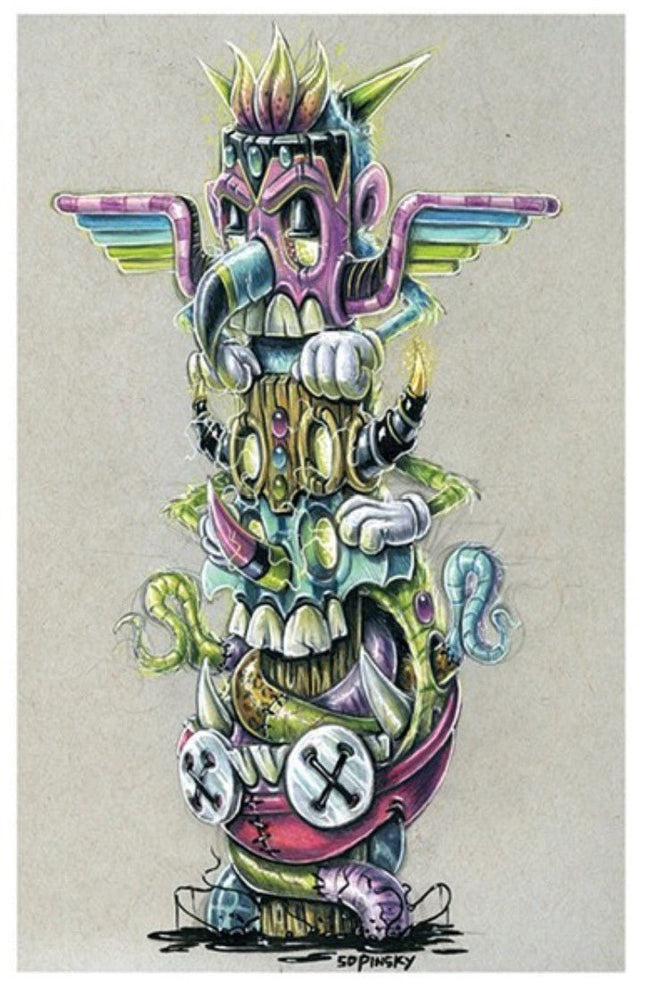
  • Totem Buddies Giclee Print by Brandon Sopinsky

    Brandon Sopinsky Totem Buddies Giclee Print by Brandon Sopinsky

    Totem Buddies Artwork Giclee Limited Edition Print on Fine Art Paper by Pop Culture Graffiti Artist Brandon Sopinsky.

    $134.00

Tribal Druid & Native Graffiti Street Pop Artwork
Tribal themes have been a source of inspiration for many artists throughout history, and this includes both graffiti art and pop art. Graffiti art has its roots in urban culture, while pop art emerged in the 1950s and 1960s as a response to the rise of mass consumerism and the popularization of advertising and media. In graffiti art, tribal themes are often used to convey a sense of cultural identity and heritage. Graffiti artists may draw on traditional tribal art styles and motifs to create their own unique works that speak to their individual experiences and perspectives. For example, a graffiti artist might incorporate patterns inspired by Maori or Native American designs into their work to express their own cultural heritage or pay homage to the traditions of others. Similarly, in pop art, tribal themes are often used to explore issues of identity and cultural exchange. Pop artists may draw on imagery from tribal cultures to create bold, colorful works that comment on the ways in which cultures intersect and influence one another. For example, pop artist Keith Haring often incorporated tribal motifs into his work to create a sense of universal human connection, while also exploring themes of power and oppression. Graffiti art has its roots in the hip-hop culture of the 1970s and 1980s, and it has since grown to become a global phenomenon. Graffiti artists often use tribal themes in their work as a way of expressing cultural identity and heritage. For example, a graffiti artist of Pacific Islander descent might incorporate traditional Polynesian designs into their work to pay homage to their cultural heritage. In addition, graffiti artists may also draw on tribal motifs to create a sense of community and belonging. Graffiti writers often form crews, or groups of like-minded individuals, and the use of tribal themes can serve as a way of visually representing this sense of shared identity and purpose. Pop art emerged in the 1950s and 1960s as a response to the rise of mass consumerism and the popularization of advertising and media. Pop artists often drew on imagery from popular culture to create bold, colorful works that commented on the changing nature of American society. Tribal themes were often used in pop art to explore issues of identity and cultural exchange. Pop artists such as Keith Haring and Jean-Michel Basquiat often incorporated tribal motifs into their work as a way of creating a sense of universal human connection. For example, Haring's "Radiant Baby" image incorporates elements of tribal art, but it is also a symbol of hope and innocence that transcends cultural boundaries. The use of tribal themes in graffiti art and pop art can serve as a means of exploring issues of identity, heritage, and cultural exchange. By drawing on traditional motifs and styles, artists can create works that speak to their own experiences while also bridging the gap between different cultures and communities.
Footer image

© 2025 Sprayed Paint Art Collection,

    • Amazon
    • American Express
    • Apple Pay
    • Bancontact
    • Diners Club
    • Discover
    • Google Pay
    • iDEAL
    • Mastercard
    • PayPal
    • Shop Pay
    • Visa

    Login

    Forgot your password?

    Don't have an account yet?
    Create account