United States USA & America

2 artworks

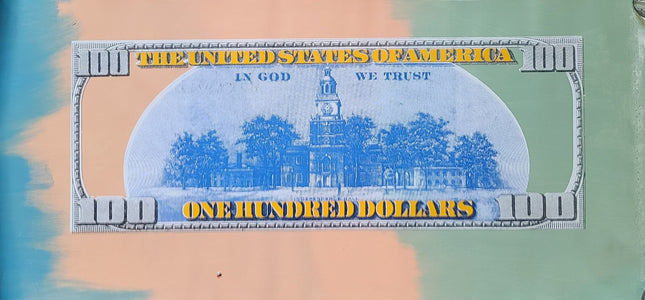
  • Sale -15% $100 Dollar Bill Backside HPM Serigraph Print by Steve Kaufman SAK

    Steve Kaufman SAK $100 Dollar Bill Backside HPM Serigraph Print by Steve Kaufman SAK

    $100 Dollar Bill- Backside Limited Edition Hand-Embellished Oil Paint HPM Silkscreen Print on Canvas by Steve Kaufman SAK Graffiti Street Artist Modern Pop Art. 1995 Signed & Numbered Limited Edition of 100 Artwork Size 34x15 Unstretched canvas, the image is in perfect condition. Back of the United States $100 dollar bill money from the 1990s. $100 Dollar Bill- Backside Limited Edition Hand-Embellished Oil Paint HPM Silkscreen Print on Canvas by Steve Kaufman The $100 Dollar Bill- Backside silkscreen print on canvas by Steve Kaufman is a striking example of street pop art and graffiti artwork that captures the essence of American consumer culture and wealth symbolism. Created in 1995, this signed and numbered hand-embellished oil paint HPM (Hand-Painted Multiple) is part of a limited edition of 100. Measuring 34x15 inches on unstretched canvas, this piece presents a visually compelling reinterpretation of the back of a 1990s United States $100 bill. Kaufman’s distinctive approach to printmaking, combined with his background in graffiti and modern pop art, makes this artwork a significant statement within the genre. Steve Kaufman’s Influence on Street Pop Art Steve Kaufman, often referred to by his initials SAK, was a pivotal figure in contemporary street pop art. As a former assistant to Andy Warhol, Kaufman developed his own signature style that blended commercial iconography with hand-painted elements. His work frequently centered on themes of capitalism, mass production, and American identity, utilizing recognizable imagery such as currency, famous celebrities, and consumer products. This piece, depicting the back of a $100 bill, is a prime example of his ability to elevate everyday symbols into fine art. By incorporating graffiti-inspired aesthetics with screen printing techniques, Kaufman transformed traditional art forms into something dynamic and relevant to the modern era. His ability to merge street culture with fine art galleries made him a bridge between two artistic worlds. This limited edition print, with its rich colors and textured embellishments, continues his legacy of challenging conventional notions of value, art, and commerce. The Symbolism of Money in Modern Pop Art The use of currency as a subject in modern pop art has deep historical roots, often serving as a critique of wealth, power, and societal values. Kaufman’s portrayal of the $100 bill’s backside takes a familiar object and recontextualizes it through color, scale, and artistic intervention. The presence of Independence Hall in the composition is particularly significant, symbolizing the intersection of American history and contemporary consumer culture. This piece is more than just a reproduction of money—it becomes a meditation on the influence of wealth and financial systems in art and daily life. Kaufman’s choice to hand-embellish each print adds a layer of uniqueness, reinforcing the idea that even in a world driven by mass production, individuality and artistic expression remain essential. The bold use of color and contrast amplifies the visual impact, making the print stand out as both a statement piece and a collector’s item. A Collector’s Piece with Lasting Impact This $100 Dollar Bill- Backside print holds a special place in the world of limited edition street pop art and graffiti artwork. As an unstretched canvas, it offers flexibility for framing and display, allowing collectors to showcase it in a way that best fits their aesthetic. Kaufman’s legacy as a groundbreaking artist continues to thrive, and his works are highly sought after for their cultural relevance and visual appeal. For art enthusiasts and collectors who appreciate the fusion of graffiti, pop culture, and fine art, this piece serves as a powerful representation of Kaufman’s vision. It encapsulates the bold, unapologetic nature of street pop art while remaining deeply tied to the broader narrative of American economic and artistic history.

    $1,917.00 $1,629.00

  • Lincoln Obama 15 President Barrack Vinyl Art Sculpture by Ron English

    Ron English- POPaganda Lincoln Obama 15 President Barrack Vinyl Art Sculpture by Ron English

    Lincoln Obama 15 President Barrack Vinyl Art Sculpture by Ron English- POPaganda Limited Edition Collectible Sculpture Figure Fine Artwork by Graffiti Pop Street Artist. 2008 Limited Edition of 50 Artwork Size 10x15 New In Box Stamped Vinyl Fine Art Toy Figure Sculpture. Ron English- POPaganda – Abraham Obama Vinyl Sculpture in Street Pop Art & Graffiti Artwork Ron English- POPaganda’s Abraham Obama vinyl art sculpture is one of the most audacious and conceptually layered pieces in the evolution of Street Pop Art & Graffiti Artwork. Created in 2008 during the height of President Barack Obama’s first campaign, this limited edition collectible (edition of 50) merges two of America’s most culturally significant presidents—Abraham Lincoln and Barack Obama—into a singular hybrid bust. Standing 10 inches tall by 15 inches boxed, and produced in vinyl by MINDstyle, this figure embodies Ron English- POPaganda’s signature approach: visual collision, political parody, and cultural remix, all filtered through the lens of pop surrealism and graffiti-inspired fine art. The sculpture presents Obama with Lincoln’s iconic facial hair and historical attire, challenging the viewer to reexamine not only the legacy of leadership but also the collective symbols of American hope and progress. The packaging reinforces this fusion with a bold, saturated yellow and green colorway and English’s graffiti-styled hand lettering. It’s equal parts street culture artifact and fine art satire. With this work, English transforms campaign-era idealism into a collectible statement piece, collapsing timelines and creating a new icon meant to provoke, amuse, and unsettle. Visual Satire and Political Remix in 3D Form This sculpture is more than a mashup—it’s a sculptural commentary on how America constructs its heroes. By merging Lincoln, the president who ended slavery, with Obama, the first Black president of the United States, Ron English- POPaganda uses Street Pop Art’s remix culture to speak directly to race, legacy, and the mythology of leadership. The fusion is visually seamless yet conceptually jarring, forcing viewers to ask whether America’s dreams of progress are genuine or simply surface-level branding. English has long employed pop culture icons in his work—Mickey Mouse, Ronald McDonald, superheroes—manipulating them into grotesque or exaggerated versions of themselves. In Abraham Obama, however, the satire is more refined, bordering on reverence while still critiquing the idealization of political figures. It questions whether Obama’s image was being mythologized in real time, turning him into an icon before history could judge the substance of his presidency. That complexity is central to graffiti and pop-infused art: using popular imagery not to worship, but to dissect. Street Culture Meets Designer Toy Aesthetic As part of the collectible art toy movement, Abraham Obama also bridges the gap between street-level art and gallery collectible culture. The piece follows a lineage of vinyl sculpture rooted in graffiti aesthetics, lowbrow art, and limited edition consumer drops. Much like street art stickers and mural culture, these figures carry the urgency of ephemera and rebellion—but rendered in high-quality materials with gallery-level craft. The use of vinyl makes the work accessible in both material and tone, a tactile evolution of street pop's visual ethos. These types of sculptures are the three-dimensional cousins of stenciled posters and wheatpasted satire, designed to occupy the same cultural headspace while entering private collections. Like a Banksy piece pulled from a wall, Abraham Obama is designed to be portable without losing its streetwise edge. Legacy of Political Pop in Urban Visual Culture Ron English- POPaganda’s Abraham Obama is one of the most definitive statements of political remix in the contemporary art landscape. It belongs to a genre that not only challenges political narratives but also reframes how visual culture mythologizes leadership. In the hands of a graffiti pop veteran like English, the sculpture becomes more than a novelty—it becomes an archive of American hopes, contradictions, and media-driven spectacle. Within the expanding lexicon of Street Pop Art & Graffiti Artwork, Abraham Obama stands as a hybrid icon—part toy, part bust, part satire, part prayer. It encapsulates the power of street-level aesthetics to shape and reflect the nation’s deepest cultural tensions, all while making it possible to hold a piece of visual revolution right in your hands.

    $500.00

United States USA & America Graffiti Street Pop Artworks

United States, USA & America in Street Pop Art & Graffiti Artwork

The United States—often referred to interchangeably as the USA or America—has been a foundational force in shaping the visual language, ethos, and cultural weight of Street Pop Art & Graffiti Artwork. From the subways of New York to the concrete expanses of Los Angeles, American cities have served as the birthplace, battleground, and gallery for some of the most influential visual movements of the last century. These terms—United States, USA, and America—carry complex meanings that artists across generations have embraced, questioned, and redefined through urban art. Whether used in patriotic celebration, critical commentary, or ironic juxtaposition, the image of America is constantly reframed through the spray can, stencil, wheatpaste, and print. Street Pop Art emerged from the streets of America during the post-war boom, most iconically in the 1960s with artists like Andy Warhol and Roy Lichtenstein, who elevated commercial and national symbols into high art. Their use of flags, dollar bills, celebrities, and consumer goods framed America as both an idea and a product. Meanwhile, graffiti art exploded in the 1970s and 1980s as a raw and unfiltered voice of the marginalized, especially in cities like New York. Artists like Jean-Michel Basquiat and Keith Haring harnessed the urgency of graffiti while integrating political and personal narratives about race, capitalism, and identity—all wrapped in American visual symbolism.

American Flags, Icons, and Symbols Reimagined

Few symbols have been manipulated as profoundly in Street Pop Art as the American flag. Artists from Shepard Fairey to Risk Rock to Futura have reworked its stars and stripes into statements about justice, protest, and unity. The flag becomes not just a national emblem but a canvas—a framework for storytelling and critique. Shepard Fairey’s RFK silkscreen print, for example, harnesses red, white, and blue to reframe historical memory into a call for present-day moral action. Similarly, Risk Rock’s Born on the 4th overlays the flag with lyrics and butterflies, confronting the viewer with the tension between national pride and personal struggle. Street artists also frequently appropriate figures like George Washington, Abraham Lincoln, and Lady Liberty—icons of America transformed into visual vehicles for commentary. Banksy, an outsider to the US, has even contributed to this visual discourse, parodying American military and political actions through stencil works around the world. In these reinterpretations, the terms USA and America move from static identity labels into layered concepts that reflect struggle, freedom, irony, and aspiration.

Graffiti as a Voice for the American Urban Experience

Graffiti in the United States began as a declaration of existence—namewriting on subway cars, rooftops, and walls. It was a rebellion against invisibility, particularly for young people in urban neighborhoods neglected by city planning and institutional power. What started as tagging grew into elaborate pieces, throw-ups, and eventually street-level murals that embodied both the spirit and contradictions of America. The use of bubble letters, wildstyle, and custom handstyles reflected American ingenuity and cultural fusion, with hip-hop culture becoming the sound and pulse of this visual revolution. As American cities evolved, so did the political urgency of graffiti. It became a form of protest—against police violence, systemic racism, economic inequality, and environmental collapse. Pieces painted during moments of national crisis, such as the civil rights movement, 9/11, or Black Lives Matter protests, serve as testament to how graffiti becomes America’s visual conscience, voiced not through media or policy, but directly through paint on public surfaces.

USA as a Living Canvas in Global Pop and Graffiti Culture

While the United States gave birth to many forms of street and pop art, it also became the template for global expansion. Artists from Brazil to Berlin have referenced American slang, branding, and aesthetics in their work, responding to the cultural exports of Hollywood, fast food, sneakers, and slogans. The very notion of America—as dream, empire, and contradiction—has become a universal theme. American street pop art doesn't just critique its nation; it reflects how the nation is seen by others and internalized around the world. The words United States, USA, and America remain central to the grammar of urban art. They signify a place of power and paradox, innovation and inequity, promise and protest. Through stencil, ink, collage, and aerosol, artists continue to redefine what these terms mean—turning them into layered, living expressions of identity, heritage, and resistance. Within the evolving language of Street Pop Art & Graffiti Artwork, America is not just a country. It is a canvas still being painted.

Footer image

© 2026 Sprayed Paint Art Collection,

    • Amazon
    • American Express
    • Apple Pay
    • Bancontact
    • Diners Club
    • Discover
    • Google Pay
    • iDEAL
    • Mastercard
    • PayPal
    • Shop Pay
    • Visa

    Login

    Forgot your password?

    Don't have an account yet?
    Create account