

Weapon
-
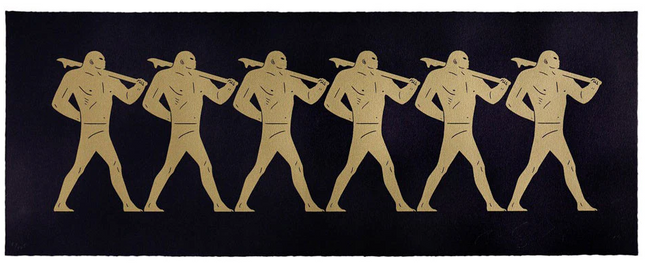
Cleon Peterson Marchers Black Silkscreen Print by Cleon Peterson
Marchers Black Silkscreen Print by Cleon Peterson 2 Color Hand-Pulled on Deckled Fine Art Paper Limited Edition Pop Street Art Artwork. 2016 Signed & Numbered Limited Edition of 125 Artwork Size 13x34 Silkscreen Print of Tribal Men Carrying Bloody Swords Marching In Line. Marchers Black by Cleon Peterson – Limited Edition Silkscreen in Street Pop Art & Graffiti Artwork Marchers Black is a 2016 hand-pulled 2-color silkscreen print by Cleon Peterson, an American artist acclaimed for his stark allegories of violence, dominance, and control. This limited edition work is printed on 13 x 34 inch deckled fine art paper and was released in an edition of 125, each one signed and numbered by the artist. The image features six identical, stylized figures walking in strict formation, each with a sword slung over the shoulder. The figures are rendered in gold on a deep matte black background, emphasizing their ritualistic presence and evoking both ancient procession and modern conformity. The figures’ nudity, musculature, and uniform posture strip them of individual identity, instead casting them as instruments of institutional force, frozen in a silent parade of aggression. Conformity, Power, and the Aesthetic of Ritual In Marchers Black, Cleon Peterson isolates the mechanisms of systemic violence and repetition. The identical figures advance in step, their gestures calm yet loaded with menace. The blood-smeared blades on their backs are symbolic rather than graphic, suggesting not the moment of action but the aftermath—the silent normalization of brutality. The lack of expression or differentiation among the figures speaks to the erasure of individuality under oppressive structures, whether they be military, political, or societal. Their forward momentum, fixed and unrelenting, reads as both a march toward power and a descent into complicity. The black background serves not just as negative space but as psychological weight, amplifying the intensity of the gold silhouettes and enforcing a sense of visual and emotional gravity. Cleon Peterson’s Signature Themes in Street Pop Art & Graffiti Artwork Cleon Peterson is a leading voice in Street Pop Art & Graffiti Artwork, known for merging graphic minimalism with confrontational narratives. His compositions channel ancient mural traditions, propaganda design, and dystopian storytelling into modern allegories. Marchers Black exemplifies this approach by simplifying form to maximize meaning. While many artists in the genre celebrate rebellion, Peterson exposes the systems behind it—the hierarchies, the ritualistic cycles of violence, the role of submission in maintaining order. His work is not decorative but declarative, challenging viewers to confront the undercurrents of cruelty that persist beneath polished surfaces. Marchers Black is not a depiction of chaos, but of order so rigid it becomes inhuman. It visualizes the seduction and horror of control through the repetition of figures whose purpose is not to question, but to obey. Material Execution and Collector Impact Printed on premium deckled fine art paper using a two-layer silkscreen process, Marchers Black merges street aesthetics with refined printmaking tradition. The gold pigment contrasts dramatically against the matte black background, delivering a visual impact that echoes the thematic weight of the piece. Each print is hand-pulled and signed by Cleon Peterson, reinforcing its position as a deliberate and enduring object. As a limited edition of 125, it holds significant value for collectors interested in Street Pop Art & Graffiti Artwork that critiques systems of power without relying on spectacle. Marchers Black is both a visual mantra and a warning—documenting the quiet march of institutional violence, masked in symmetry, strength, and silence.
$1,199.00
-
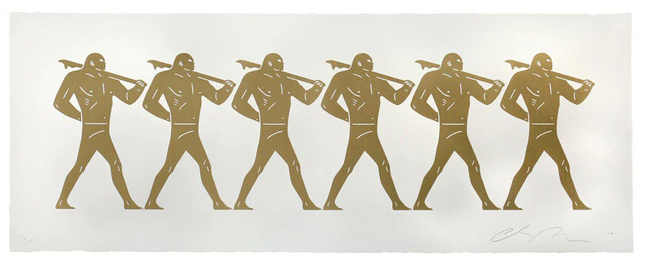
Cleon Peterson Marchers White Silkscreen Print by Cleon Peterson
Marchers White Silkscreen Print by Cleon Peterson 2 Color Hand-Pulled on Deckled Fine Art Paper Limited Edition Pop Street Art Artwork. 2016 Signed & Numbered Limited Edition of 125 Artwork Size 13x34 Silkscreen Print of Tribal Men Carrying Bloody Swords Marching In Line. Marchers White by Cleon Peterson – Limited Edition Silkscreen in Street Pop Art & Graffiti Artwork Marchers White is a 2016 hand-pulled 2-color silkscreen print by American artist Cleon Peterson. This signed and numbered limited edition of 125 was printed on deckled fine art paper and measures 13 x 34 inches. It features a procession of six stylized, muscular figures in a uniform line, each carrying a blood-streaked sword draped across their shoulders. The artwork is a graphic portrayal of conformity and violence, rendered in Peterson’s iconic flattened silhouette style. With clean lines and bold simplicity, the figures march in lockstep across a stark white background, forming a visual rhythm that mimics propaganda friezes and ancient relief carvings. The use of gold and red ink intensifies the contrast between elegance and brutality, a hallmark of Peterson’s visual language. Symbolism of Power, Violence, and Uniformity In Marchers White, Peterson explores the mechanization of power and the erosion of individuality within systems of control. Each figure appears identical, stripped of personal identity and locked in a hypnotic march. The red-tipped blades suggest recent violence or continuous bloodshed, reinforcing the idea that aggression has become routine, even ceremonial. The figures’ nudity, stylized musculature, and emotionless posture evoke primal force restrained within a ritual of obedience. The repeated form not only recalls ancient military parades or mythic processions, but also comments on contemporary structures of state, surveillance, and oppression. The absence of background or contextual setting forces viewers to focus entirely on the figures and their choreography, placing the act of violence and conformity at the center of the narrative. Cleon Peterson’s Allegorical Voice in Street Pop Art & Graffiti Artwork Cleon Peterson is known internationally for creating visual allegories that depict lawlessness, domination, and moral inversion. His works pull from classical art history, political propaganda, and modern editorial illustration to construct a world in collapse—where traditional boundaries between good and evil are blurred. Marchers White reflects Peterson’s ongoing examination of systemic violence and institutional complicity. While minimal in execution, the work functions as a complex statement on the banality of authoritarianism. It belongs squarely within the lineage of Street Pop Art & Graffiti Artwork, as it utilizes bold, graphic style to engage in socio-political critique. Peterson does not romanticize rebellion or glorify power—instead, he presents viewers with unfiltered snapshots of a dystopian order wrapped in seductive aesthetics. Printmaking Technique and Collector Value The Marchers White edition is crafted with the precision and attention to detail that characterizes Cleon Peterson’s fine art practice. Printed using a 2-color silkscreen method on heavyweight deckled fine art paper, the physical quality of the piece matches its conceptual weight. The crisp edges of the figures and the subtle texture of the ink application reflect a high standard of printmaking. Each print is individually signed and numbered, securing its authenticity and positioning it as a significant work within Peterson’s catalog. For collectors of Street Pop Art & Graffiti Artwork, Marchers White stands as a poignant artifact of modern discontent—a visually arresting and politically charged piece that underscores the silent march of violence accepted as structure.
$1,199.00