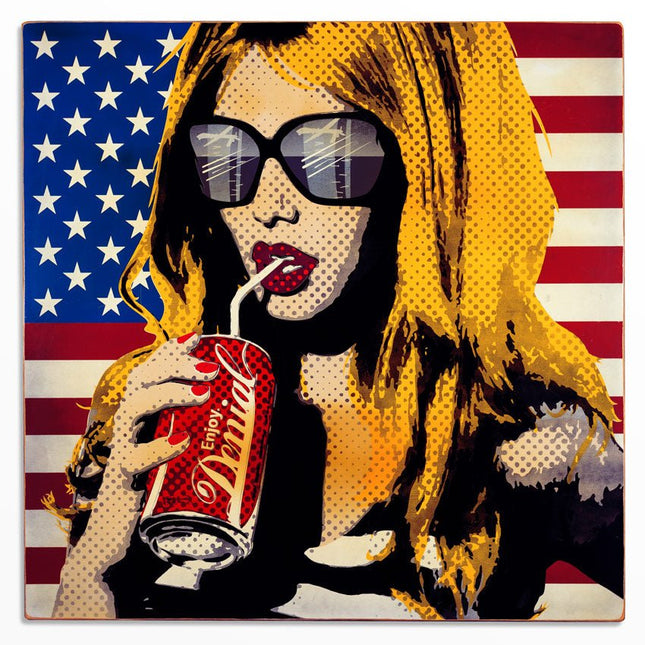
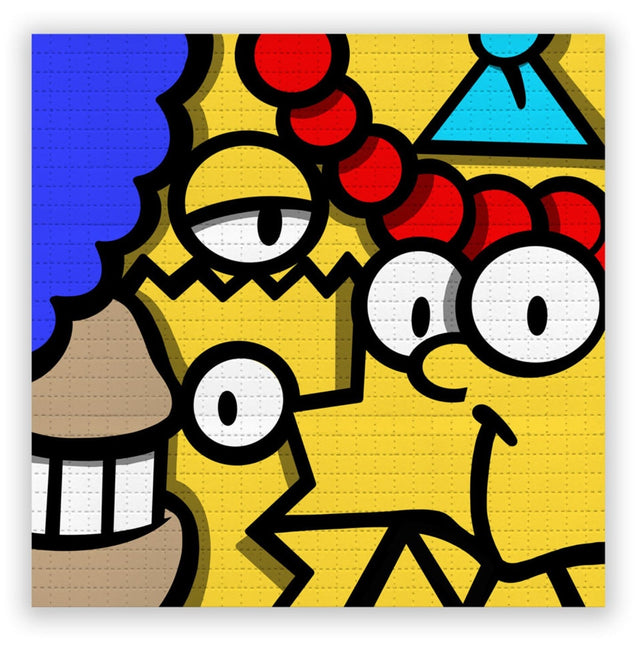
What Drones? Limited Edition Hand-Embellished Spray Paint, Acrylic, Stencil, Mixed Media On Cradled Wood Panel by Denial Graffiti Street Artist Modern Pop Art.
2015 Signed & Numbered Limited Edition of HPM Stencil 5 Artwork Size 48x30
Canadian artist Denial and Australian-born Ben Frost have joined forces in a bold exhibition of new work that explores the boundaries of appropriation, in confronting re-imaginings of our current dystopian society. Self-confessed ‘visual thieves’, both artists have had a long history of stealing and subverting the cultural icons that the advertising and consumerist world has thrust upon us, to create new and pertinent interpretations that are as confronting as they are humorous. Denial and Frost formed an instant friendship since their meeting in Canada in 2011 and have been creating engaging street and gallery work ever since. "Company of Thieves" sees their collaboration push further, with large and small-scale works that reference Pop Art, Graffiti, and the corporate world they rebel against.
Denial’s art is strongly political and social since the artist takes specific positions against issues, such as capitalism, consumer culture, and advertisements. More importantly, the artist is aware of his choices and motivations: “I like to think of myself as activist pop art. How I relate with cartoons and graphics is a lot easier than I do with photo-realistic stuff" Another aspect of Denial's work is humor. His work is satirical, which, by definition, means that it uses humor as a confronting mechanism.
The Luminous Intrigue of Yellow in Street Pop Art and Graffiti Artwork
Yellow's Vibrant Role in Urban Art Forms
Yellow, the color of sunlight and cheer, holds a place of distinction in the palette of street pop art and graffiti artwork. It is a color that can stop pedestrians in their tracks, a visual shout that can break through the gray of the urban sprawl. In the hands of artists who navigate the city's skin, yellow is a beacon, a bold statement of optimism, and an engagement tool. Whether it's the mustard yellows of a retro aesthetic or the neon yellows that seem to electrify the air around them, this color's presence in the street art scene is both a nod to the art form's pop culture roots and a reflection of its forward-thinking evolution.
Technique and Texture: Yellow's Versatility
On a technical level, yellow is a color that provides artists with a wide range of expressive possibilities. Its brightness can pierce through darker hues, bringing layers of depth to an image, while its lighter tints can offer a soft background that allows other colors to speak. The texture of yellow paint can vary dramatically, from sleek and smooth surfaces that reflect the hustle of city life to more complex, textured applications that invite the onlooker to pause and ponder the artwork's tactile narrative.
Cultural Connotations and Emotional Impact of Yellow
Culturally, yellow carries various connotations that street pop and graffiti artists deftly play upon. The color can signify everything from caution and physical warning to a sense of warmth and welcome. It's a color that can symbolize the energy and innovation of youth culture, as well as the nostalgia of bygone eras. In street pop and graffiti artwork, yellow often serves as a connective thread between the artwork and its audience, tapping into shared emotions and cultural memories.
Compositional Dynamics with Yellow
In composition, yellow offers a dynamic that energizes or balances an artwork. It's a hue that can work harmoniously within a monochromatic scheme or stand out in stark contrast against complementary colors like purple or blue. In street pop art, yellow can act as a highlighter, drawing the eye to key elements, while in graffiti artwork, it can serve as a foundational color that sets the tone for the entire piece.
Symbolism and Semiotics of Yellow in Urban Art
Symbolically, yellow is rich with meaning, and in street pop art and graffiti, these meanings are both played with and subverted. Yellow can represent caution or danger, a signal to viewers that the artwork contains a message that demands attention. It can also embody joy and playfulness, a reminder of the spontaneous and celebratory roots of these art forms. Artists use yellow not just for its visual appeal but for its capacity to communicate complex themes and evoke a spectrum of responses from viewers.
Future Trajectories: Yellow in the Artistic Urban Landscape
As we gaze into the future of urban art, the significance of yellow seems destined to grow. With its inherent ability to capture the zeitgeist of the times, yellow's use in street pop art and graffiti is likely to adapt to the changing cultural and social landscapes. New pigments and application techniques will expand the possibilities for artists, allowing them to explore the depths of yellow with even greater creativity and impact. Using yellow in street pop art and graffiti is not merely a choice of color; it's a strategic decision that encompasses cultural resonance, emotional impact, and visual effectiveness. It's a color that can transform a plain wall into a conversation, a passerby into an observer, and the city into a canvas of unlimited potential. As a critical component of the artist's palette, yellow continues to shine brightly, a testament to its enduring power and presence in the art world's most vibrant and accessible galleries—the streets.