

California
-

Ricky Powell Summer MCA G Spot Paul's Boutique LA 88 Archival Print by Ricky Powell
Summer MCA G Spot Paul's Boutique LA Los Angeles 1988 Archival Print by Ricky Powell x Kristin Farr Limited Edition on 290gsm Moab Entrada Fine Art Paper Pop Graffiti Street Artist Modern Artwork. 2019 Signed by Powell with COA & Numbered Print Limited Edition of 50 Artwork Size 13x9 Archival Pigment Fine Art of Beastie Boy Music Artist Hnagin Out at the Beach Sleeping Under a Stylized Sun. Ricky Powell's Mutual Respect is a Beautiful Thing Series. Summer MCA G Spot Paul's Boutique LA 1988 Archival Print by Ricky Powell x Kristin Farr The Summer MCA G Spot Paul's Boutique LA 1988 archival print by Ricky Powell and Kristin Farr is a visually striking piece that captures the essence of laid-back creativity and the cultural energy of the late 1980s. This limited-edition print, produced on 290gsm Moab Entrada Fine Art Paper, features a candid moment of Beastie Boys member Adam Yauch, also known as MCA, relaxing at the beach under a stylized sun. Signed by Ricky Powell and numbered as part of a 2019 release, this artwork is part of Powell's Mutual Respect is a Beautiful Thing series. With only 50 prints, this 13x9 archival pigment piece merges music, art, and Street Pop Art sensibilities. Ricky Powell: Chronicler of Urban Culture Ricky Powell, born and raised in New York City, was a celebrated street photographer whose lens captured the essence of 1980s and 1990s urban culture. Powell was known as the fourth Beastie Boy for his close relationship with the group and was present for some of the most iconic moments in their career. His photography documented not just the members of the Beastie Boys but also the broader cultural revolution they represented, including music, art, and street fashion. In collaboration with Kristin Farr, an artist known for her colorful geometric patterns, this piece combines Powell's knack for candid photography with Farr's bold artistic style. The stylized sun in the artwork adds a pop of vibrant color, contrasting with the black-and-white photograph and emphasizing the relaxed atmosphere of the scene. The Cultural Context of Paul's Boutique and Los Angeles The late 1980s marked a significant period for the Beastie Boys, particularly with the release of their album Paul's Boutique in 1989. Recorded in Los Angeles, the album reflected a departure from their earlier sound and embraced a more experimental, sample-heavy approach. The photo of MCA lounging on the beach is emblematic of this time, capturing the creative and carefree spirit that defined their work and lifestyle in Los Angeles. Including this moment in Powell's Mutual Respect is a Beautiful Thing series highlights the mutual admiration between Powell and the Beastie Boys. It also emphasizes the interconnectedness of music, art, and Street Pop Art during this era. The image is not just a portrait of a musician but a snapshot of a cultural movement that bridged East Coast hip-hop sensibilities with the laid-back vibes of the West Coast. Artistic and Collectible Appeal The Summer MCA G Spot Paul's Boutique LA 1988 print is a testament to the power of collaboration in contemporary art. The archival-quality materials ensure that the intricate details of the photograph and the vibrant colors of the geometric sun are preserved for years to come. The 13x9 size makes it an intimate yet impactful piece, perfect for collectors of Beastie Boys memorabilia, Ricky Powell's photography, or modern Street Pop Art. By combining Ricky Powell's and Kristin Farr's talents, this print stands as a unique representation of cultural history and artistic innovation. It celebrates the spirit of creativity that transcends mediums and highlights the enduring influence of the Beastie Boys and their creative circle. This piece is both a nostalgic reminder of a transformative era in music and a vibrant work of modern art that continues to resonate.
$550.00
-
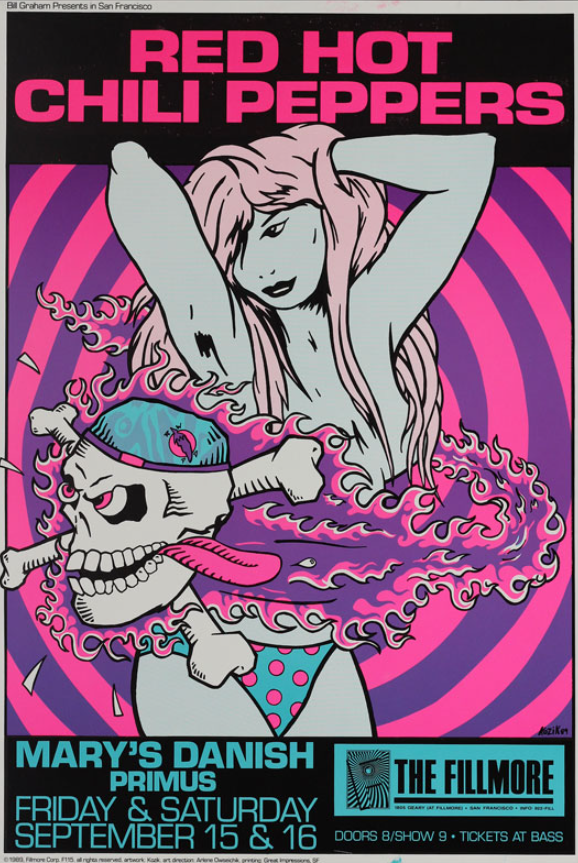
Frank Kozik Red Hot Chili Peppers 1989 Fillmore Silkscreen Print by Frank Kozik
Red Hot Chili Peppers Primus 1989 Fillmore Silkscreen San Francisco CA Print by Frank Kozik Hand-Pulled on Fine Art Paper Limited Edition Pop Street Art Artwork. 1989 Kozik Artwork Size 13x19 Silkscreen Print Band Gig Poster by Frank Kozik. Bill Graham San Francisco The Fillmore Poster F115 Red Hot Chili Peppers Mary's Danish Primus September 15 16, 1989 Red Hot Chili Peppers Primus 1989 Fillmore Silkscreen Print by Frank Kozik The Red Hot Chili Peppers Primus 1989 Fillmore silkscreen print by Frank Kozik is an iconic piece of Street Pop Art & Graffiti Artwork that embodies the rebellious energy of late 1980s underground music and poster culture. Created for the Red Hot Chili Peppers' performance at the legendary Fillmore in San Francisco, this 13x19-inch hand-pulled silkscreen print was commissioned as part of the Bill Graham Presents concert series. Featuring bold colors, surrealist imagery, and an unmistakable punk aesthetic, this piece captures the raw intensity of the era’s alternative rock movement. The inclusion of supporting acts Primus and Mary’s Danish further cements its significance as a relic of an explosive time in live music history. Visual Composition and Artistic Style Frank Kozik’s artistic style is instantly recognizable in this print, with its bold neon hues, high-contrast linework, and provocative subject matter. The composition features a flaming skeleton with an exaggerated grin, clad in a polka-dotted bikini bottom, with its tongue out in a defiant gesture. The presence of a stylized, curvy female figure in the background adds a surreal, almost psychedelic touch, reinforcing the wild, chaotic energy associated with the Red Hot Chili Peppers' music. The background consists of swirling patterns in bright pink and purple, creating a hypnotic effect that draws the viewer into the image. The heavy use of black outlines and exaggerated cartoonish elements reflect Kozik’s influence from underground comics, skate culture, and punk zine aesthetics. The typography follows a classic gig poster format, with large block lettering announcing the headlining act in bright pink against a dark background, while additional text in cyan provides details of the event. This mix of playful, irreverent imagery and structured design highlights Kozik’s mastery in blending controlled chaos with striking visual appeal. Street Pop Art & Graffiti Artwork Influence Frank Kozik’s work stands at the crossroads of Street Pop Art & Graffiti Artwork, merging countercultural aesthetics with fine art printmaking techniques. The poster's aggressive, high-contrast design is reminiscent of graffiti stencils, while the hand-pulled silkscreen process ensures that each print carries a unique, raw texture. The exaggerated punk-inspired figures, combined with psychedelic color palettes, align with the visual language found in 1980s street art and underground concert promotion. This piece reflects the DIY spirit of gig poster culture, where artists crafted promotional artwork that doubled as collectible art. Kozik’s ability to merge lowbrow sensibilities with high-impact design has made his prints some of the most sought-after in the gig poster scene. His background in self-published artwork and street-level design tactics translates into compositions that feel alive, rebellious, and unfiltered. Collectibility and Cultural Impact As an official Fillmore poster, this silkscreen print holds immense historical and artistic value. The late 1980s were a defining era for the Red Hot Chili Peppers, as they blended funk, punk, and rock to create a sound that would later dominate alternative music. The collaboration with Primus, a band equally known for its genre-defying sound, adds to the poster’s significance as a symbol of musical innovation. Frank Kozik’s gig posters have become highly collectible, with limited-edition prints from this era commanding high demand among both art collectors and music fans. The handcrafted nature of the silkscreen process ensures that each piece has its own unique character, reinforcing the authenticity and individuality of the work. Kozik’s influence continues to shape modern poster design, and this print remains a testament to his ability to translate the raw energy of live music into visually arresting artwork. This piece is not just a concert advertisement; it is a statement of the era, an artifact of underground culture, and a masterpiece within the world of Street Pop Art & Graffiti Artwork.
$750.00