



Doctor/Medical/Medicine
-
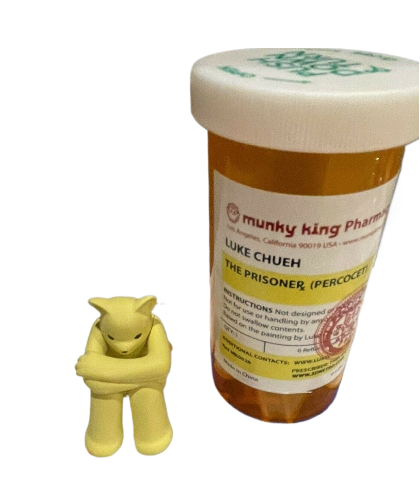
Luke Chueh Percocet The Prisoner Drug Bear Art Toy by Luke Chueh
Percocet The Prisoner Drug Bear Art Toy by Luke Chueh Limited Edition Vinyl Collectible Artwork by Street Graffiti Artist. 2018 Limited Edition Artwork of 500 with Cotton, Bag, and Tube. Based on Luke Chueh's original painting, The Prisoner ponders captivity in its many forms—physical, mental, or pharmaceutical. Post-traumatic stress disorder is a mental health problem that can develop after experiencing or witnessing a life-threatening event like combat, natural disaster, car accident, or sexual assault. And the dependency on prescription medications such as Percocet has led to widespread addiction problems. The Poignant Message Behind 'The Prisoner - Percocet' Art Toy by Luke Chueh 'The Prisoner - Percocet' is a limited edition vinyl art toy that delivers a powerful commentary on the grips of addiction and the confines of mental health struggles. Created by the acclaimed street graffiti artist Luke Chueh, this 2018 artwork, limited to a series of 500, delves into the concept of captivity through physical bars and the often invisible chains of pharmaceutical dependence. This piece is based on Chueh's original painting, "The Prisoner," which portrays the sad reality that many individuals face post-traumatic stress disorder (PTSD) and prescription medication addiction, particularly to potent drugs like Percocet. Chueh's art toy is thought-provoking and captures the essence of street pop art and graffiti artwork. It reflects the raw, unfiltered nature of the street art scene while addressing complex societal issues. The figure is meticulously displayed with cotton, a bag, and a tube, encapsulating the presentation of prescription medication and subtly pointing to the clinical nature of drug distribution. The Artistic Approach to a Modern-Day Plight Luke Chueh's approach to art is often characterized by the use of stark, compelling images that evoke a sense of empathy and contemplation. With 'The Prisoner - Percocet,' Chueh confronts the viewer with the reality of pharmaceutical captivity—a condition where medication meant for healing becomes a source of prolonged suffering. The vinyl figure, with its downcast eyes and clasped hands, becomes a symbol of the countless individuals who find themselves battling the dual demons of PTSD and addiction. The art toy is more than a collectible; it is a visual discourse on the pervasive issue of substance abuse linked to prescription drugs. Chueh's work is a bridge between art and advocacy, offering insight into the psychological and emotional turmoil that accompanies dependency. This piece, in particular, embodies the critical narrative that street pop art and graffiti artwork often undertake, highlighting urgent, real-world problems through artistic expression. 'The Prisoner - Percocet' in the Context of Collectible Art Collectors of 'The Prisoner - Percocet' hold a piece of art that is poignant, evocative, and starkly relevant. Including a metal card of authenticity with each figure ensures the artwork's legitimacy and special status within the limited series. Luke Chueh's signature style—simple yet profound—is on full display, making the piece a sought-after artifact within contemporary street pop art. Owning this piece is to acknowledge and appreciate the depth and potential for street art to transcend traditional canvases and become a medium for social commentary. The collectible stands as a testament to the power of art to spark conversation and to the artist's role as a commentator on the human condition. It is an invitation to reflect on the complex relationship society has with medication and the often-hidden struggles that accompany its use. In the broader context of street pop art, 'The Prisoner - Percocet' art toy by Luke Chueh stands out for its ability to communicate a profound message succinctly and symbolically. It is a powerful intersection of artistry and advocacy, encapsulating the struggle that defines the lives of many individuals in a single, silent figurine. For the discerning collector, it is not just a vinyl figure but a conversation starter, an emblem of awareness, and a striking piece of graffiti that holds significant cultural and artistic weight.
$336.00
-
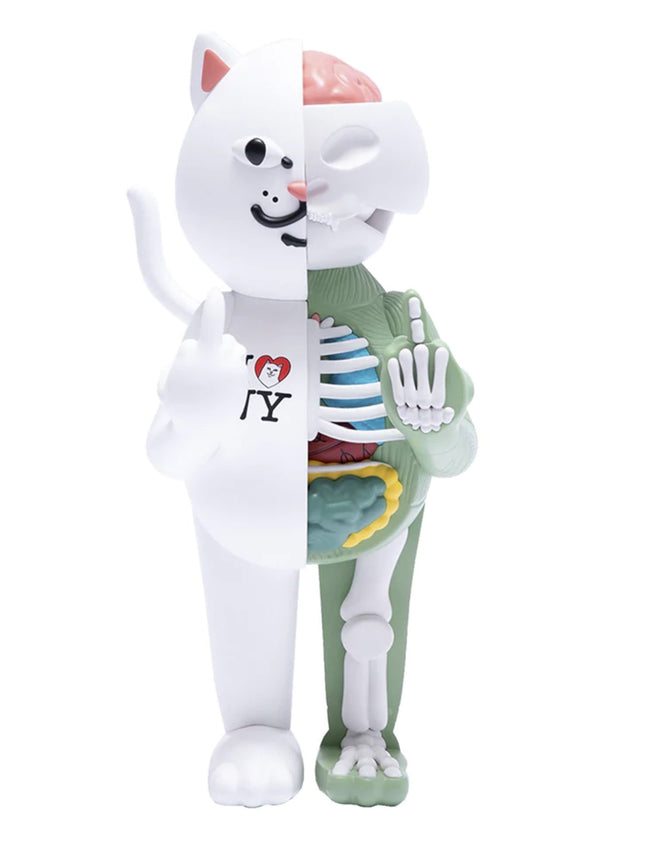
Rip N Dip I Heart NY Nerm Nermal Art Toy Figure by Rip N Dip
I Heart NY Nerm Nermal Limited Edition Anatomy Vinyl Art Toy Collectible Artwork by Street Brand Artists Rip N Dip. 2022 Limited Edition of 150 Size 14-inch Nerm Nermal Vinyl Figure I Heart NY Dissected Art Toy. New In Box. 14 inch I Heart NY Lord Nermal Vinyl Figure Created To Celebrate Our New NYC Flagship Store Opening I Heart NY Heart printed on chest and Bottom Of Foot
$347.00
-
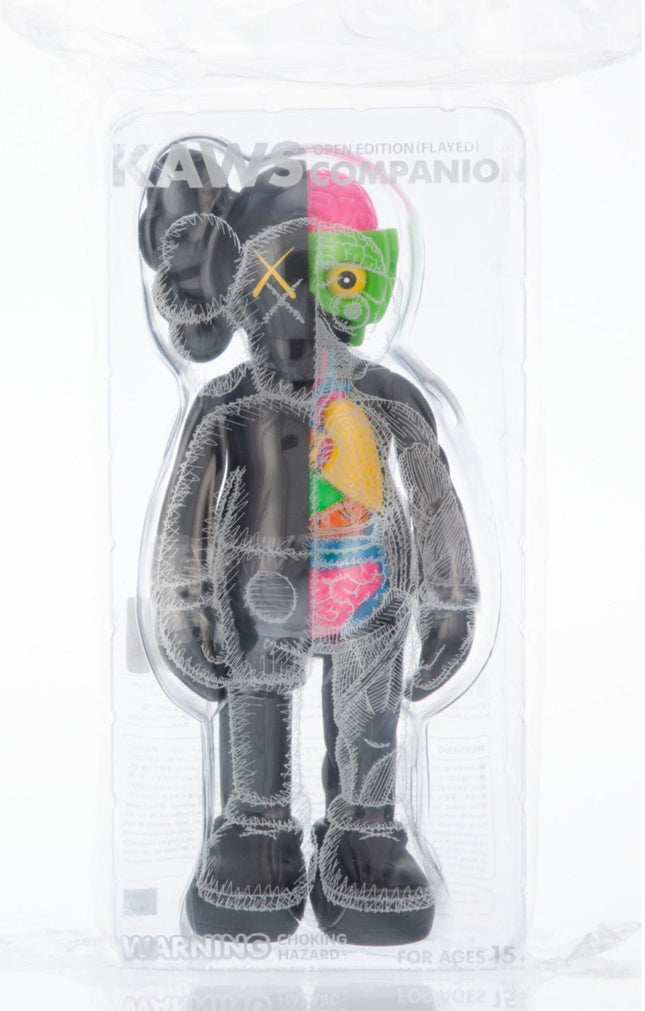
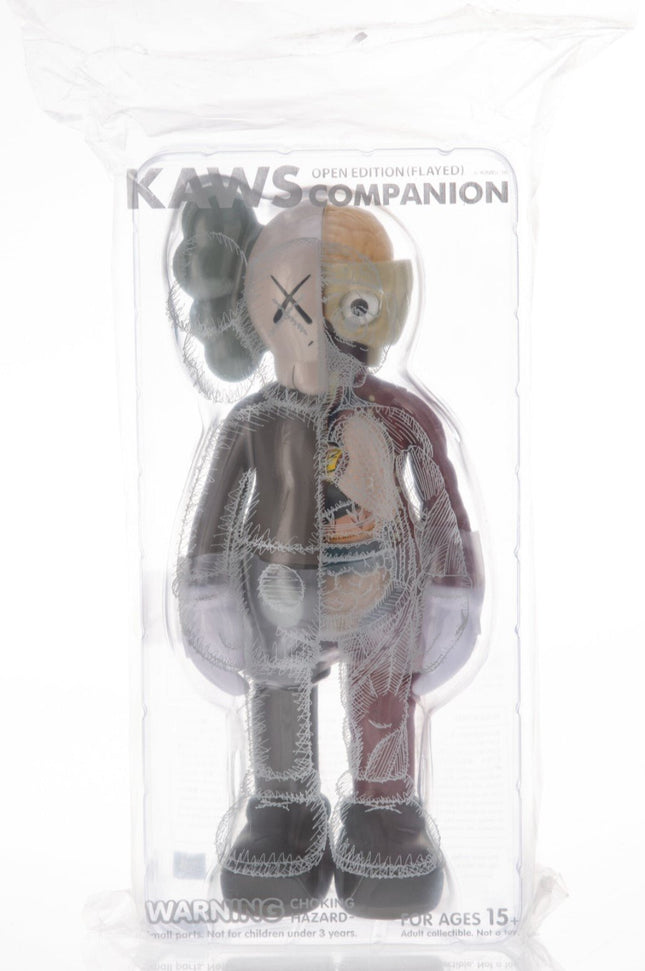
Kaws- Brian Donnelly Companion Flayed- Black Fine Art Toy by Kaws- Brian Donnelly
Companion Flayed- Black Limited Edition Vinyl Art Toy Collectible Artwork by Modern Pop Artist Kaws. 2016 Unopened Package Limited Open Edition 10.5 X 4.5 X 2.5 / 16.7 X 11.4 X 6.4 CM The Companion Flayed: An Icon of KAWS' Street Pop Art Legacy The Companion Flayed Black Limited Edition Vinyl Art Toy embodies the pinnacle of KAWS' influence in modern pop and street pop art. Unveiled in 2016, this piece is a profound iteration of the most recognizable figure in KAWS' artistic arsenal, the Companion. The artist has reimagined the Companion multiple times, each version laying bare a new facet of its symbolic resonance. The flayed version, particularly in its stark black form, invites viewers to peer beneath the surface, literally and metaphorically, into the layers composing this contemporary icon. Measuring 10.5 x 4.5 x 2.5 inches, the Companion Flayed stands as a testament to KAWS' ability to manipulate form and content to produce artworks that speak to a generation conversant in the visual language of design, pop culture, and street aesthetics. This series, including full-bodied and flayed versions of the classic character, was released in conjunction with KAWS's exhibition "Where The End Starts" in Fort Worth, Texas. Standing 11 inches tall, the figures were made available through KAWSONE, MoMA, and the Modern Art Museum of Fort Worth, marking a significant moment in the intersection of street art and institutional recognition. Companion Flayed's Role in the Dialogue of Street Pop Art KAWS' Companion Flayed is more than a collectible; it's a conversation piece that delves into the dialogue of what Street Pop Art and Graffiti Artwork can be. It's a manifestation of KAWS' unique ability to traverse the spectrum of visual art, from anonymous street tags to globally recognized sculptures. The flayed version, with its exposed internal vibrancy, can be seen as a deconstruction of the character itself and the culture from which it originates. The black color of the figure contrasts with the colorful internal details, creating a visual dialogue between the seen and unseen, the external persona, and the internal complexity. The release of this series through prominent art institutions and KAWS' platform, KAWSONE, reflects the evolving landscape where street-inspired art is as much at home in the museum as on the urban wall. It underscores the fluidity of KAWS' art, capable of eliciting a sense of familiarity while challenging perceptions with its dissected form. This feature has become a recurrent theme in his work. KAWS' Impact on the Art Toy Movement and Beyond The Companion Flayed Black Limited Edition Vinyl Art Toy is emblematic of KAWS' impact on the burgeoning art toy movement. This movement sees the toy as a canvas for artistic expression, a medium that allows the artist to explore form, concept, and accessibility in new ways. Through figures like the Companion Flayed, KAWS has been pivotal in pushing the boundaries of this movement, garnering attention not only from the realms of Street Pop Art and Graffiti Artwork but also from the wider art community and popular culture. The release of this collectible in a limited open edition signifies the democratizing vision KAWS has for art. While each piece holds the allure of exclusivity, the forthcoming edition format ensures it remains within reach for a diverse audience, aligning with the ethos of street art's accessibility. With its distinctive cross-eyed face and x-ed-out eyes, the Companion Flayed has transcended its role as mere merchandise to become an essential touchstone in contemporary art, embodying the interplay between mass culture and high art that defines KAWS' oeuvre.
$2,424.00
-
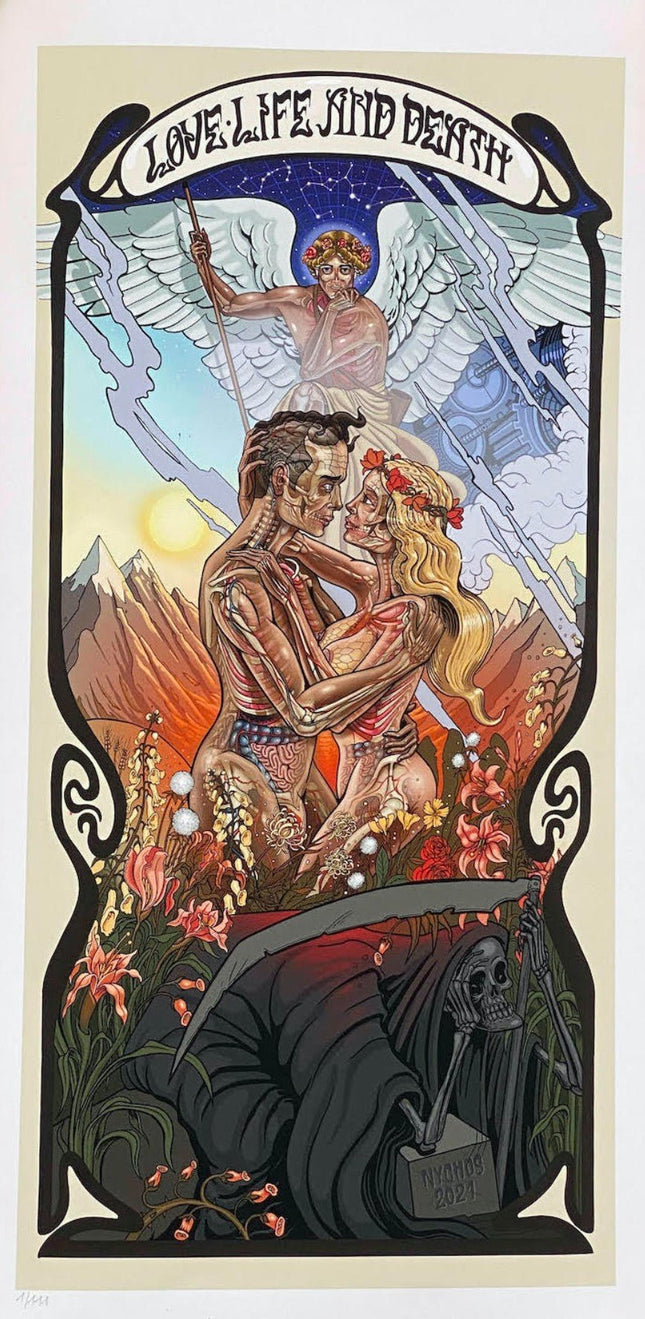
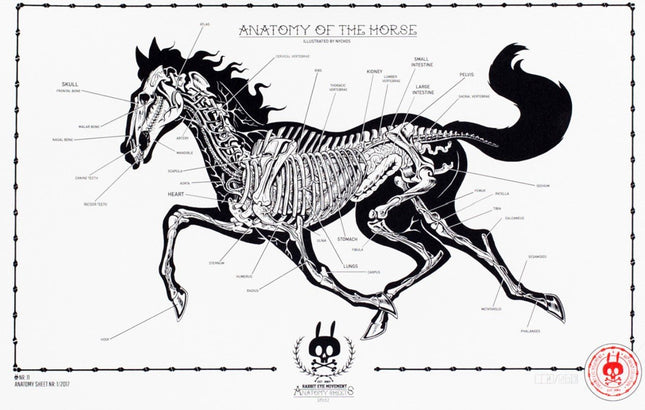
Nychos Love Life And Death Archival Print by Nychos
Love Life And Death Archival Pigment Fine Art Limited Edition Print on Velvet Cotton Fine Art Paper by Artist Nychos, Street Pop Art Graffiti Legend. 2021 Signed & Numbered Size: 32,5 x 60,9 cm // 12.8 x 24 inch Fine art print by NYCHOS Limited Edition of 111 Velvet Fine Art cotton fiber paper Hand-signed & numbered Love Life And Death by Nychos Love Life And Death is a limited edition archival pigment print by Austrian street art pioneer Nychos, released in 2021 as a signed and numbered edition of 111. Printed on velvet cotton fine art paper, the work measures approximately 12.8 x 24 inches (32.5 x 60.9 cm). Known for his anatomical cross-sections and visceral storytelling, Nychos presents a vertically framed composition that fuses romance, mortality, and transcendence into a single, highly detailed tableau. Anatomy of Love and Mortality At the center of the composition, two anatomically exposed lovers embrace, their skeletal and muscular forms rendered with scientific precision and emotional intensity. Above them, a winged figure hovers like a guardian or cosmic witness, while below, Death waits patiently with a scythe, partially concealed among flowers and earth. The work visually maps the continuum of existence, from desire and connection to decay and inevitability. By revealing what lies beneath the skin, Nychos strips love and death down to their shared biological truth, suggesting that intimacy and impermanence are inseparable forces. Nychos and the Cycle of Existence Love Life And Death is emblematic of Nychos’ broader practice, which blends street art, medical illustration, and classical allegory. His work often challenges viewers to confront uncomfortable realities through beauty, precision, and scale. In this piece, the ornate framing and mythic symbolism elevate the subject beyond shock value, positioning it as a meditation on the balance between creation and destruction. As both a fine art print and a continuation of his mural-based narratives, the work stands as a powerful statement on the fragility of life and the inevitability of death, rendered with reverence rather than fear.
$375.00
-
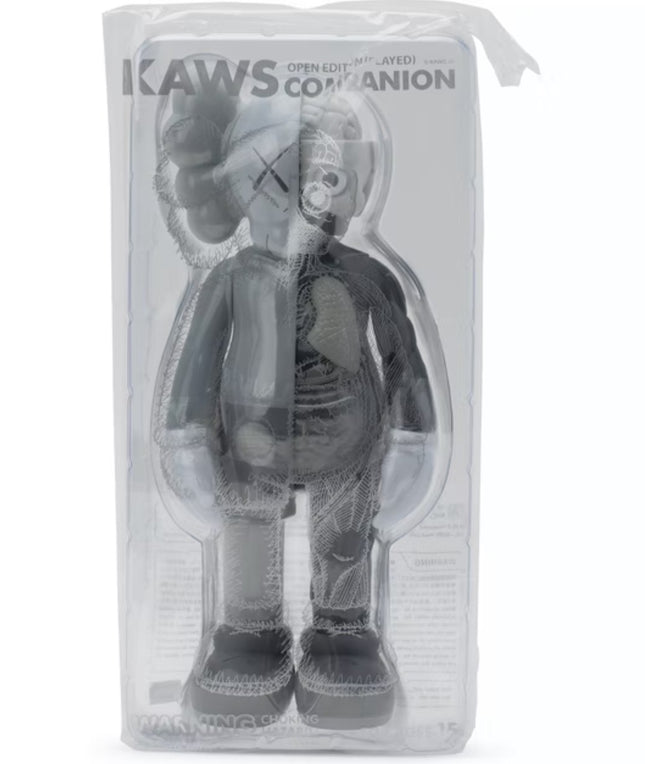
Kaws- Brian Donnelly Companion Flayed- Brown Fine Art Toy by Kaws- Brian Donnelly
Companion Flayed- Brown Limited Edition Vinyl Art Toy Collectible Artwork by Modern Pop Artist Kaws. 2016 Unopened Package Limited Open Edition 10.5 X 4.5 X 2.5 / 16.7 X 11.4 X 6.4 CM Unveiling the Companion Flayed Brown by KAWS The Companion Flayed Brown Limited Edition Vinyl Art Toy Collectible is a distinctive artifact in the oeuvre of KAWS, an artist whose influence permeates the worlds of modern pop art, street pop art, and graffiti artwork. Released in a highly anticipated series in 2016, this piece showcases the flayed version of KAWS' Companion character. This icon has been reinterpreted across many mediums over the years. Encased in its original, unopened packaging, the figure is presented in a limited open edition, measuring 10.5 x 4.5 x 2.5 inches. The Companion series is, arguably, the most recognizable aspect of KAWS' work, embodying the cross-pollination of street culture and fine art. The flayed versions, such as this brown edition, offer a visceral look at the internal complexity of the character, juxtaposing vulnerability with the toy's stoic posture. Standing at 11 inches tall, the figures were released in conjunction with KAWS' "Where The End Starts" exhibition in Fort Worth, Texas, through various esteemed outlets, including KAWSONE, MoMA, and the Modern Art Museum of Fort Worth. The Companion Flayed Brown in the Context of Street Pop Art The Companion Flayed Brown emerges as a sought-after collectible and a significant commentary within street pop art and graffiti artwork. It continues KAWS' exploration of his characters' emotional and narrative depths, a theme consistent throughout his body of work. The figure's brown hue resonates with the earthiness and authenticity often associated with street art, grounding the otherwise ethereal character in the reality of the physical world. Like its counterparts, this edition offers a tangible connection between the artist's beginnings in graffiti and his ascension into the global art market. The release of such a piece through prominent cultural institutions underscores the recognition and acceptance of street-inspired art within formal art circles. The Companion Flayed Brown thus serves as both a milestone for KAWS and a symbol of the evolving perceptions of street pop art in contemporary culture. KAWS and the Evolution of Art Toys KAWS' Companion Flayed Brown symbolizes the evolution of the art toy movement, blurring the lines between plaything and high art. The careful crafting of this collectible, from its conceptual underpinnings to its meticulous production, highlights the artist's commitment to challenging the boundaries of traditional art forms. The flayed aesthetic invites viewers to confront identity's constructed nature and the layers comprising our public personas. The 2016 series of Companions, including the Brown Flayed edition, marks a pivotal moment in the history of art toys, propelling them into the realm of legitimate artistic collectibles. KAWS' approach to the Companion series reflects a nuanced understanding of the art toy as a medium capable of conveying complex themes akin to those found in street pop art and graffiti artwork. Through works like the Companion Flayed Brown, KAWS cements his status as an innovator who continuously redefines the interplay between commercial and fine art.
$1,904.00
-

Luke Chueh Kuma OG Chase Flocked Amarillo Verde Prisoner Art Toy by Luke Chueh
Kuma OG Chase Flocked Amarillo Verde The Prisoner Drug Bear Kickstarter Art Toy by Luke Chueh Limited Edition Vinyl Collectible Artwork by Street Graffiti Artist. 2017 Limited Edition Artwork of 62 with Cotton, Bag, and Tube. Based on Luke Chueh's original painting, The Prisoner ponders captivity in its many forms—physical, mental, or pharmaceutical. Ultra Rare Kickstarter Exclusive Chase Flocked Edition. Kuma OG Chase Flocked Amarillo Verde The Prisoner by Luke Chueh: Ultra Rare Emotional Artifact in Street Pop Art & Graffiti Artwork Kuma OG Chase Flocked Amarillo Verde The Prisoner is an ultra rare vinyl art toy by Luke Chueh, released in 2017 as a Kickstarter exclusive. Limited to only 62 pieces, this special edition is a flocked version of the Amarillo Verde Kuma OG figure, making it one of the most sought-after variants in The Prisoner series. Packaged in a green translucent prescription-style container with printed labeling, cotton interior, and protective bag, the figure mimics both the aesthetic and implication of medical confinement. The Prisoner, originally based on Chueh’s emotionally resonant painting, contemplates psychological, physical, and pharmaceutical imprisonment. Rendered in a mossy textured green flocking, the bear’s soft tactile surface contrasts dramatically with its somber pose—arms wrapped tightly around its knees, seated and emotionally closed off. This contrast emphasizes the disconnect between exterior softness and internal suffering, a hallmark of Street Pop Art & Graffiti Artwork. Flocking as Texture for Trauma and Visual Irony What distinguishes this edition is the flocking—a velvety texture that adds an uncanny softness to an otherwise emotionally heavy piece. This tactile surface transforms the object into something that feels almost comforting to touch, even while it visually portrays pain, dependency, and confinement. The figure’s colorway, a vivid Amarillo Verde green, echoes the medical cannabis dispensary aesthetic, subtly referencing alternative forms of chemical escape. The labeled container marks the strain as Kuma OG, a fictionalized nod to both cannabis culture and the ongoing dialogue around self-medication. By placing the bear in a tube labeled as a product and strain, Chueh uses humor and stark visual metaphors to dissect how trauma and emotional pain are commodified. These layered meanings, delivered through minimalist sculptural forms and smart packaging, place this piece firmly within the canon of Street Pop Art & Graffiti Artwork. Luke Chueh’s Quiet Revolution in Designer Art Toys Luke Chueh, a Los Angeles-based artist known for his distinctive character design and emotional storytelling, has redefined the role of designer toys in contemporary art. His work draws heavily from personal experiences with mental health, cultural identity, and psychological conflict. The bear figure featured in The Prisoner series is a signature motif that Chueh uses to convey raw, unspoken emotion. Through posture and minimal expression, the bear becomes an avatar for the fragile states people often endure in silence. This flocked version adds an additional layer of irony and depth, turning a painful emotional narrative into a soft and seemingly huggable object. Chueh’s fusion of toy design, sculpture, and emotional realism continues to influence the Street Pop Art & Graffiti Artwork movement by proving that vulnerability can be conveyed through the smallest, most deceptively simple forms. Kickstarter Exclusivity and Cultural Significance As one of only 62 pieces produced, the Kuma OG Chase Flocked Amarillo Verde edition holds exceptional cultural and collector value. Its release through Kickstarter ties the work directly to the support of fans and collectors who align with the deeper message of The Prisoner series. The prescription-themed packaging serves as more than a protective shell—it is part of the narrative structure, symbolizing institutional control, pharmaceutical normalization, and the quiet despair of chemically managed pain. This edition does not just exist as a display item; it exists as a statement. It represents the intersection of mental health, medication culture, and consumer aesthetics in modern society. Within the framework of Street Pop Art & Graffiti Artwork, Luke Chueh’s limited editions become small-scale monuments to the emotional complexity of human experience—objects of art that carry as much weight in meaning as they do in cultural presence.
$525.00 $473.00
-
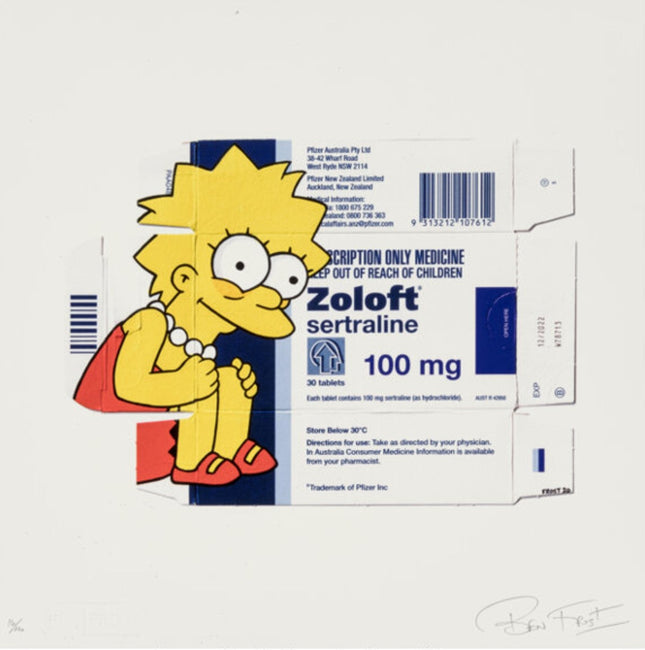
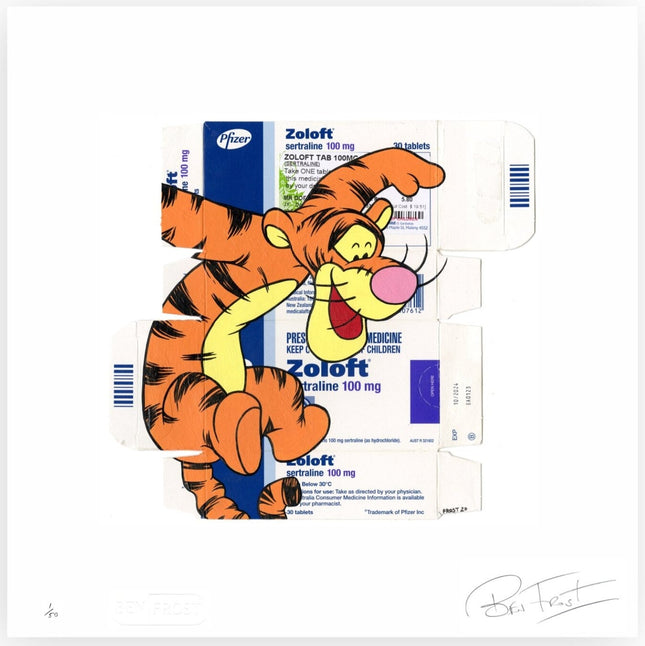
Ben Frost Social Distancing Archival Print by Ben Frost
Social Distancing Simpsons Archival Pigment Fine Art Limited Edition Print on 310gsm Bauhaus Cotton Rag Paper by Artist Ben Frost, Street Pop Art Graffiti. 2020 Signed & Numbered Limited Edition of 40 Artwork Size 12x12. Ben Frost (b. 1975) Social Distancing, 2020 Archival digital print on Bauhaus Cotton Rag Stock paper 12 x 12 inches (30.5 x 30.5 cm) (sheet) Ed. 40 is signed and numbered in pencil along the lower edge and published by the artist. Intersecting Pop Culture and Social Commentary Ben Frost's "Social Distancing Simpsons" archival pigment fine art print is a piercing examination of contemporary society through the lens of street pop art and graffiti. This limited edition print, numbered and signed, reflects Frost's unique and often controversial approach to his art, blending pop culture icons with subversive messaging. Created in 2020, "Social Distancing Simpsons" is a compelling artwork set against the backdrop of a global pandemic, a time when social distancing became a ubiquitous part of life. By incorporating a familiar character from "The Simpsons," Frost taps into the collective consciousness and comments on the impact of societal changes on popular culture. The choice of using archival digital print on Bauhaus Cotton Rag Stock paper, a high-quality material, ensures that the vibrancy of the piece and the precision of its details are preserved. The image of the Simpson's character juxtaposed with a pharmaceutical label indicates Frost's style, often involving the fusion of disparate elements to create a jarring yet thought-provoking visual statement. This 12 x 12 inches print is a perfect square that captures the essence of Frost's artistic statement: a critique of consumerism, mental health, and the pharmaceutical industry. Ben Frost's Signature Style Frost's work is characterized by his unflinching willingness to confront and challenge viewers with uncomfortable truths about modern life. In "Social Distancing Simpsons," the collision of the cartoon world with the stark reality of medication speaks to a generation that finds solace in nostalgia while grappling with present-day anxieties. With its limited edition of 40, the artwork becomes a collector's piece, a snapshot of an era defined by isolation and the search for connection. Reflection of Street Pop Art and Graffiti Frost's art is a reflection of street pop art and graffiti in its directness and its utilization of visual language that is immediate and accessible. Incorporating street art aesthetics into fine art prints blurs the lines between high art and more democratic expressions in urban environments. "Social Distancing Simpsons" is a testament to the power of this genre to communicate beyond words, offering a visual critique that is both universal and deeply personal. In summary, "Social Distancing Simpsons" by Ben Frost is more than just an artwork; it is a commentary on the times, a mirror held up to the complexities and contradictions of contemporary life. Through his expert blending of pop culture references with cutting social commentary, Frost solidifies his place as a significant voice in street pop art and graffiti artwork. This piece, in particular, stands as a poignant reminder of 2020, capturing the essence of a moment that has left an indelible mark on society.
$684.00 $616.00
-
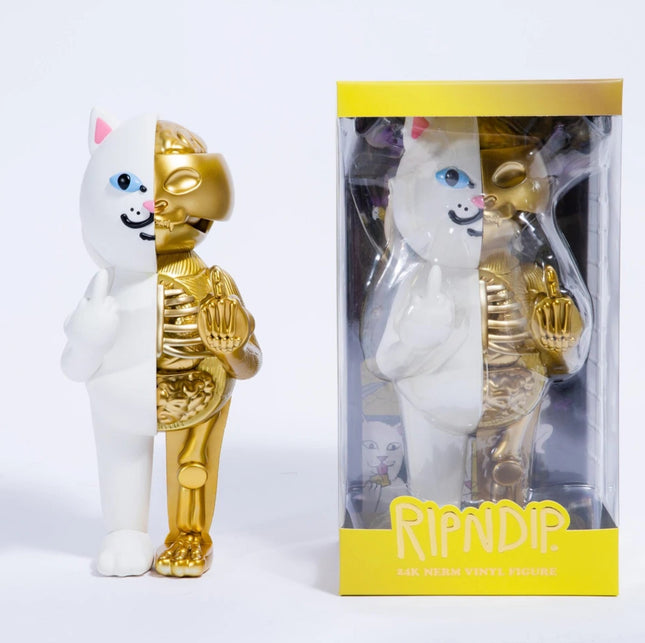
Rip N Dip 24k Gold Nerm Nermal Art Toy Figure by Rip N Dip
24k Gold Nerm Nermal Limited Edition Anatomy Vinyl Art Toy Collectible Artwork by street graffiti artist Rip N Dip. 14 inch 24K Gold Lord Nermal Vinyl Figure Only 500 made Dissected Art Toy.
$289.00
-
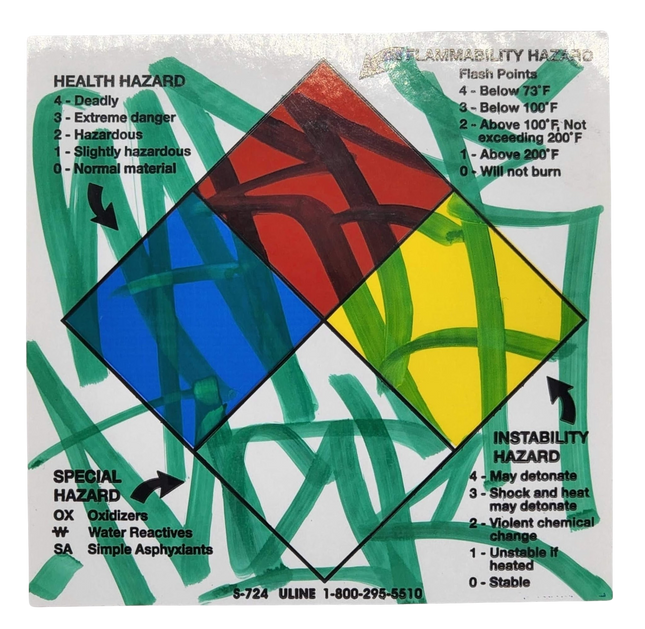
Saber Health Hazards Slap-Up Label Sticker Original Tag Art by Saber
Health Hazards Slap-Up Label Sticker Original Tag Art by Saber Original Permanent Marker Art Drawing on Mailing Glossy Warning Sticker by Graffiti Artist Modern Street Artwork. 2020 Signed Original Slap Up Graffiti Art Tag 4x4 Marker Tagged on Health Flammability Special Instability Hazard Warning Label Uline S-724 Sticker. Slap Up In Perfect Condition. Artistic Alchemy on Hazardous Grounds The transformation of ordinary objects into visual spectacles is a hallmark of Street Pop Art and Graffiti Artwork. In this vein, the "Health Hazards Slap-Up Label Sticker" by Saber, real name Ryan Weston Shook, from the United States, stands out as a captivating fusion of warning label iconography and graffiti artistry. Created in 2020, these pieces symbolize how graffiti artists repurpose everyday items, such as health flammability and particular instability hazard warning label stickers, to make bold statements through art. Saber's original permanent marker art drawings on these glossy arrow stickers testify to the genre's ingenuity and ability to imbue commonplace materials with new life and meaning. Symbolism and Significance in Saber's Work Saber's art on hazard warning stickers is particularly poignant. The stickers' inherent message of caution and danger is juxtaposed with Saber's tags' freeform and expressive nature. This contrast is not merely aesthetic but symbolic, alluding perhaps to the inherent risks and hazards of graffiti creation. In the urban jungle, the graffiti artist is both a creator and a transgressor, and Saber's work captures this duality perfectly. The use of bright, contrasting colors over the hazard symbols does not obscure the warning but instead invites the viewer to reflect on the layers of meaning within the piece. Reflections of 2020 in Street Pop Art 2020 was not just another year in the annals of history but a turning point for societies worldwide. The original slap-up graffiti art tags on these health and hazard stickers by Saber reflect a year marked by global upheaval and a reevaluation of what is considered safe and dangerous. In his 4x4 marker-tagged creations, Saber captures the spirit of an era where the world grappled with health crises and societal instability. By signing each piece, Saber not only claims authorship but also anchors the artwork in time and place, offering a permanent marker — literally and figuratively — of a moment in time through the lens of Street Pop Art and Graffiti Artwork.
$16.00
-
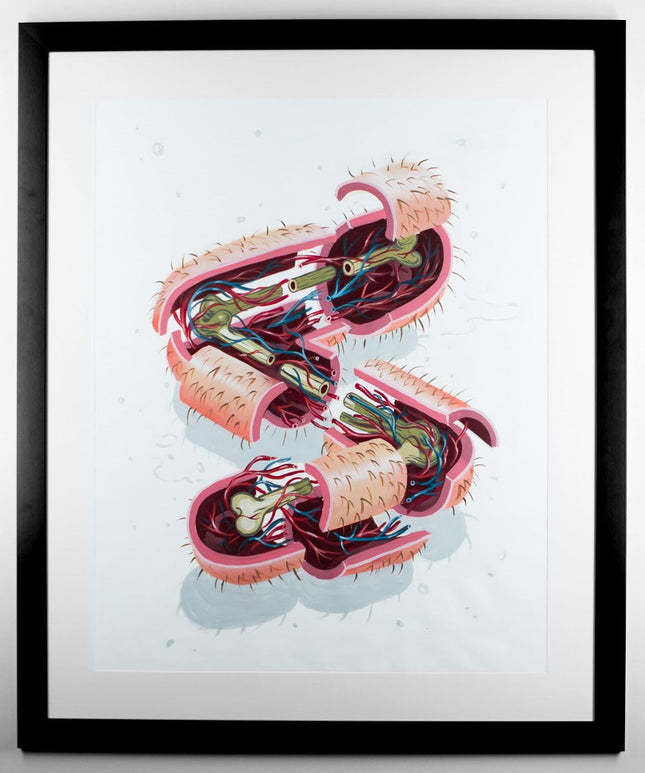
Nychos Dissection Of The Letter S Original Acrylic Painting by Nychos
Dissection Of The Letter S Original Painting Mixed Media Framed On Paper by Nychos Graffiti Street Artist Modern Pop Art. 2013 Signed Original Mixed Media Acrylic Spray Paint Painting Artwork Size 40x48.5 “My dad and my grandpa were traditional Austrian hunters, so I think that is where some of my interest in anatomy comes from. Seeing a deer dissected for the first time was very inspiring for me. Seeing all the guts and intestines drop out, it was a bit crazy at first,” Nychos told Hypebeast while painting at the world’s premiere street art festival Pow Wow Hawaii earlier this year. “Using all of this anatomy I think have found something I can stick with and really go crazy on. It’s staying fresh for me because I am always finding new ways to do it.” -Nychos
$2,168.00
-
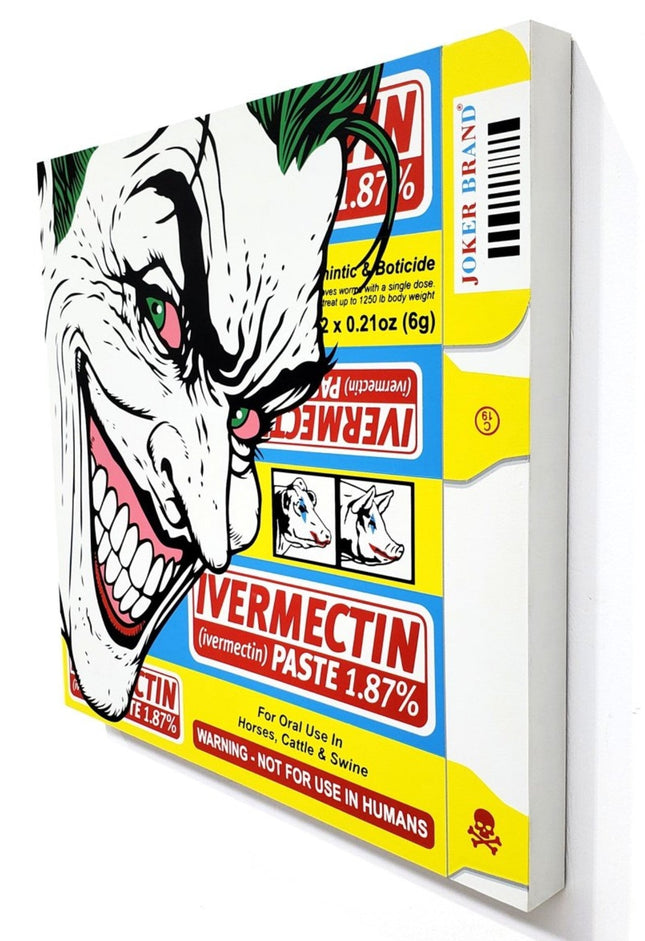
Ben Frost Joker Brand- Green Pink Original Spray Paint Acrylic Painting by Ben Frost
Joker Brand- Green Pink Original One of a Kind Mixed Media Acrylic & Spray Paint Painting Artwork on Cradled Wood by Popular Street Graffiti Artist Ben Frost. 2022 ‘Joker Brand’ - Acrylic and spray paint on board - Green/Pink variant 60cm x 60cm (23.5 x 23.5 inches) Signed, titled and dated on the reverse
$5,190.00
-
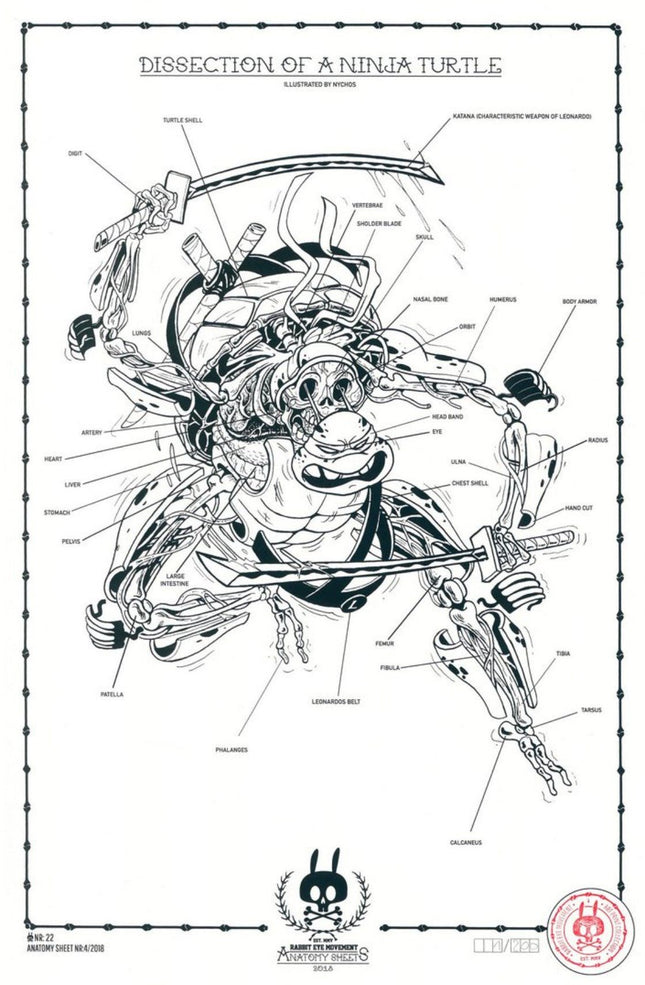
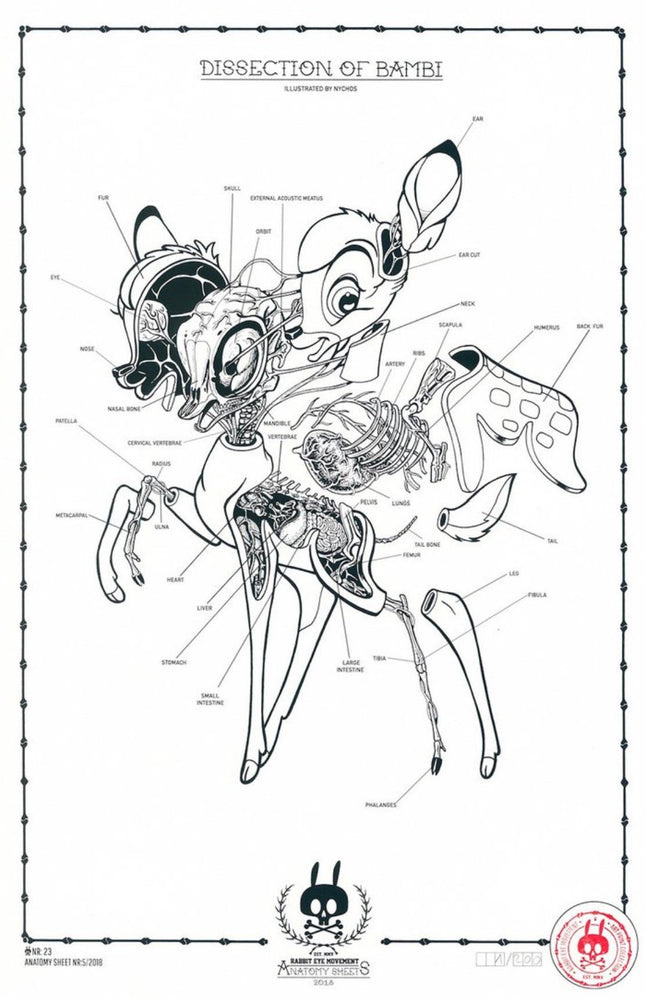
Nychos Dissection of Ninja Turtle Anatomy Sheet No 22 Silkscreen Print by Nychos
Dissection of Ninja Turtle- Anatomy Sheet No 22 Hand-Pulled 1-Color Limited Edition Silkscreen Print on 300gsm Munken Pure Paper by Medical Pop Artist Nychos. 2018 Signed & Numbered Limited Edition of 200 11x17 Illustrated by NYCHOS 1-color Screen Print on 300 g/m² Munken Pure Paper Size: 11 x 17 Inches / 27,94 x 43,18 cm Limited Edition of 200 Year: 2018 Imprint & stamp of authenticity Numbered and signed by the artist The REM Anatomy Sheets focus on the anatomy of pop culture cartoon characters. In this new collection of black and white limited edition screenprints, Nychos lets the viewer engage with details of the anatomy of toons.
$217.00
-
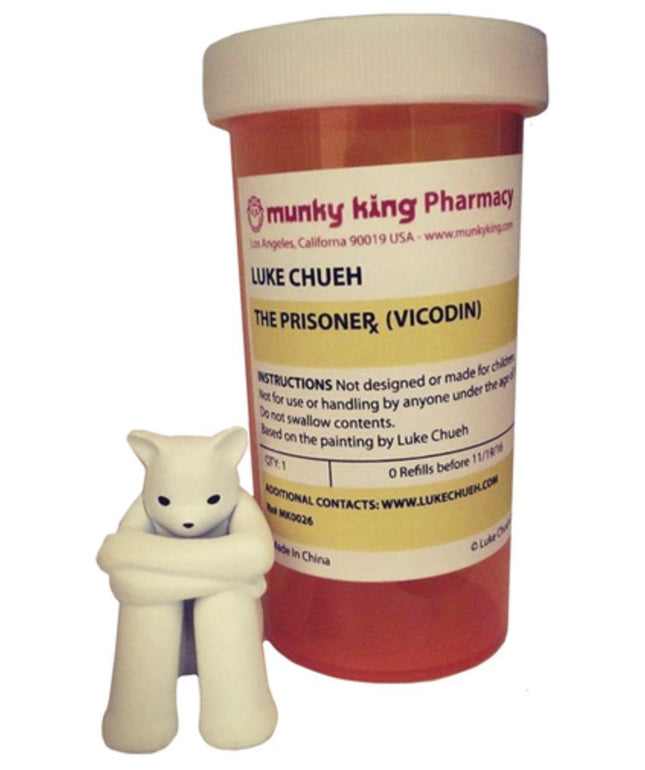
Luke Chueh Vicodin The Prisoner Drug Bear Art Toy by Luke Chueh
Vicodin The Prisoner Drug Bear Art Toy by Luke Chueh Limited Edition Vinyl Collectible Artwork by Street Graffiti Artist. 2016 Limited Edition Artwork of 500 with Cotton, Bag, and Tube. Based on Luke Chueh's original painting, The Prisoner ponders captivity in its many forms—physical, mental, or pharmaceutical. Post-traumatic stress disorder is a mental health problem that can develop after experiencing or witnessing a life-threatening event like combat, natural disaster, car accident, or sexual assault. And the dependency on prescription medications such as Percocet has led to widespread addiction problems. Vicodin The Prisoner Drug Bear by Luke Chueh: Vinyl Manifestation of Pharmaceutical Despair in Street Pop Art & Graffiti Artwork Vicodin The Prisoner is a 2016 limited edition vinyl art toy by Luke Chueh, issued in a run of 500 pieces and packaged with a cotton pouch, prescription-style tube, and custom labeling. This stark and introspective collectible was inspired by Chueh’s original painting The Prisoner, a body of work that dives into the concept of captivity in multiple forms: psychological, emotional, and pharmaceutical. The figure depicts a small white bear, arms tightly clasped around bent knees, body hunched in a defensive posture. Packaged inside a mock prescription pill bottle labeled as Vicodin, the bear becomes a physical metaphor for dependency and the numbing of trauma through chemical means. Positioned within the language of Street Pop Art & Graffiti Artwork, this figure embodies the raw realities often glossed over by polished consumer narratives. Pharmaceutical Packaging as a Vessel for Emotional Truth Luke Chueh’s decision to enclose the figure in a standard orange pharmacy bottle transforms the toy into a symbolic sculpture. This packaging is not merely aesthetic—it is part of the art itself. The orange plastic container is commonly associated with healing and regulated care, but here it acts as a prison, locking the character in emotional silence. Labeled under the name Vicodin, a widely prescribed yet highly addictive opioid, the piece forces viewers to consider the thin line between treatment and entrapment. The bear’s blank expression and slouched body language amplify the emotional burden behind dependency. Minimalistic in execution yet powerful in message, the figure’s placement within Street Pop Art & Graffiti Artwork challenges the notion that toys must be joyful or harmless. Instead, Chueh offers an object that speaks to trauma, medication, and the often invisible emotional pain that comes with both. Luke Chueh’s Visual Language of Suffering and Identity Luke Chueh, an American artist based in Los Angeles, has become known for using simple, iconic figures to address themes of mental illness, personal pain, and societal pressure. His characters often appear soft and subdued, but they carry an immense emotional weight. In Vicodin The Prisoner, the white color of the bear reflects both clinical sterility and emotional numbness. Chueh’s approach is grounded in honesty and vulnerability, distilling complex experiences into forms that resonate widely. His influence within Street Pop Art & Graffiti Artwork comes from this ability to speak directly through sculpture, illustration, and narrative-driven toy design. Chueh’s bear functions not just as a character but as a stand-in for anyone struggling with emotional paralysis, depression, or the grip of addiction. The Prisoner Series as Commentary and Collector Artifact This limited edition release of 500 includes not just the vinyl bear, but a presentation designed to immerse collectors in its commentary. The pill bottle packaging, custom-labeled for Vicodin, mirrors the controlled environments from which many seek escape, but also become trapped. The cotton bag adds an additional layer of clinical detachment, as if the piece were a regulated prescription item rather than an expressive artwork. As part of The Prisoner series, this version adds to the ongoing discussion around trauma and pharmacology within the framework of Street Pop Art & Graffiti Artwork. It transforms a collectible into a statement, where the cute and the uncomfortable coexist, creating a powerful tension that defines the work of Luke Chueh. The bear sits still, silent, and confined—but its presence speaks volumes about a culture that medicates pain without always understanding it.
$280.00
-
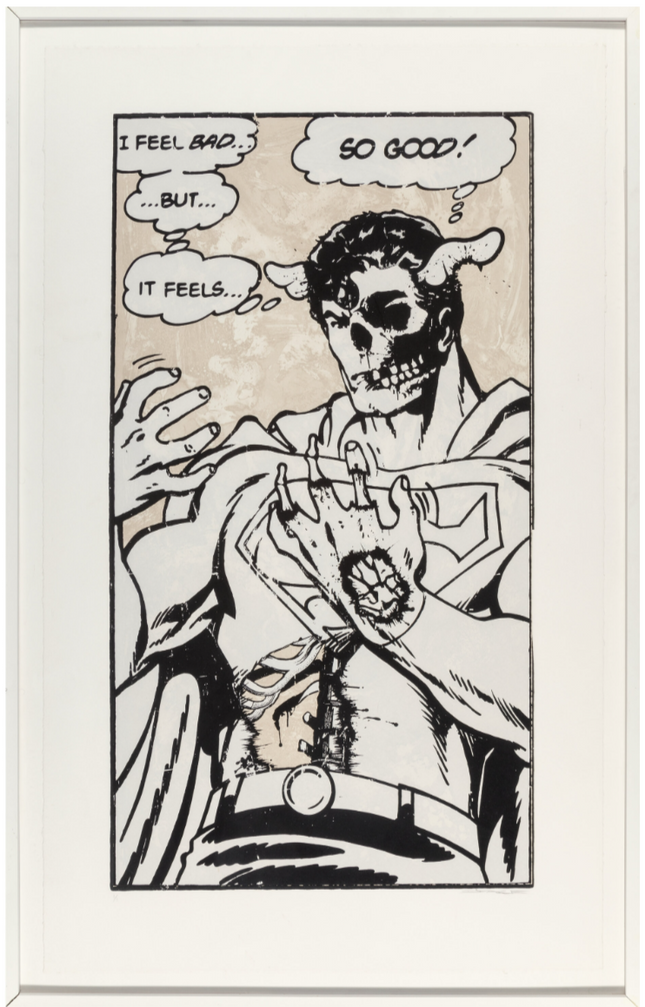
D*Face- Dean Stockton Feels So Good Original Silkscreen Etching Print by D*Face- Dean Stockton
Feels So Good Original Silkscreen Etching Print by D*Face- Dean Stockton Hand-Pulled on Wove Fine Art Paper Limited Edition Pop Street Art Artwork. 2009 Signed & Numbered Limited Edition of 1 Original Artwork Size 33x54 Silkscreen Etching Print Custom Framed D*Face (b. 1978) Feels So Good, c. 2009 Etching and screenprint in colors on wove paper 54 x 33 inches (137.2 x 83.8 cm) (sheet) Ed. 1/1 Signed and numbered in pencil along the lower edge. No apparent condition issues. Floated and framed under acrylic. Framed Dimensions 59 X 37.5 Inches
$10,822.00
-
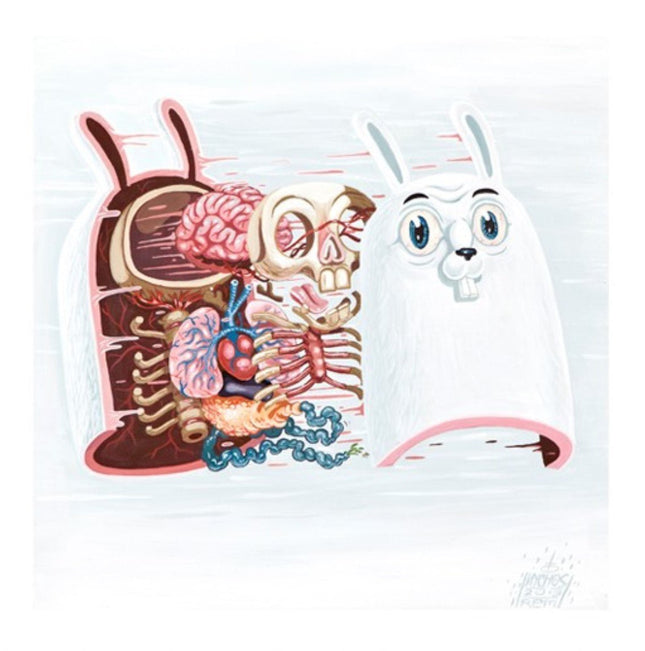
Nychos Dissection Of The White Rabbit AP Archival Print by Nychos
Dissection Of The White Rabbit Limited Edition Archival Pigment Print on 300gsm Museum Natural Fine Art Paper by Nychos Graffiti Street Artist Modern Pop Art. AP Artist Proof 2013Signed & Marked AP Artwork Size 16x16 "I painted this piece in January of this year, right before I went to Hawaii for Pow Wow. It was also featured in my recent solo show in Italy, showcasing some of my recent dissections. The concept is based on the graphical graffiti throw-up I have been doing since around 2005, but I had to do a dissection of this one! The image is now Rabbit Eye Movement's main (REM) logo. REM started as a street art concept based in Vienna, but I always saw the Rabbit Eye Movement as an homage to all the "rabbits" out there being" active in the urban art movement; it doesn't matter what mission they are following. The movement grew, and REM expanded to establish the REM ARTSPACE. This place addresses national and international artists from genres like graffiti, urban illustration, street art, lowbrow, and pop culture imagery. It allows individual and collective creativity to open minds and cultivate passionate inspiration." - Nychos. Nychos' "Dissection of The White Rabbit": A Modern Pop Art Phenomenon In the contemporary urban landscape, few art pieces have captured the imagination as vividly as "Dissection of The White Rabbit" by Nychos, the illustrious graffiti street artist. This limited edition archival pigment print on 300gsm Museum Natural Fine Art Paper stands as a hallmark of modern pop art and a defining piece within the street pop art and graffiti artwork genre. Created as an artist proof (AP) in 2013, this 16x16 artwork weaves complex narratives of biology, mythology, and urban culture into a single, striking, and thought-provoking canvas. Nychos: Anatomical Explorations and Urban Narratives Nychos, renowned for his unique approach to street art, employs a distinctive technique of anatomical dissection in his work. "Dissection of The White Rabbit" is a prime example, presenting a rabbit split down the middle to reveal the intricate workings of its internal organs. This piece was conceived in January of that year, just as Nychos was preparing to attend Pow Wow in Hawaii, and subsequently became a centerpiece in his solo show in Italy. Nychos's work delves into the layers that compose living beings, reflecting a deep fascination with what lies beneath the surface. By marrying the graphic energy of graffiti throw-ups with the precise detail of dissections, Nychos has forged a new path in street pop art. The artwork also functions as the emblem for the Rabbit Eye Movement (REM), a concept originating from the streets of Vienna. Nychos envisions REM as a tribute to the 'rabbits' of the urban art movement, symbolizing the active participants in this burgeoning cultural scene, regardless of their mission. REM has since evolved to establish the REM ARTSPACE. This creative hub celebrates a variety of genres, from graffiti and urban illustration to street art, lowbrow, and pop culture imagery. This space is dedicated to fostering individual and collective creativity and serves as a bastion for the free exchange of ideas, ensuring the progression and inspiration of artists worldwide. The Impact and Legacy of Nychos' Work The influence of "Dissection of The White Rabbit" extends beyond its visual impact. It embodies Nychos' profound effect on the street art scene, illustrating the transformative power of visual arts in urban spaces. The work is a representation of the artist's technical prowess and a symbol of his commitment to challenging the traditional boundaries of street pop art and graffiti artwork. As the primary logo for the Rabbit Eye Movement, it has become synonymous with a global network of artists dedicated to advancing the cause of street art. Through his work and the establishment of REM ARTSPACE, Nychos has played a pivotal role in shaping the dialogue around street art and its place in the broader spectrum of contemporary art. In essence, "Dissection of The White Rabbit" is more than just a piece of art; it is a cornerstone of Nychos' artistic and cultural contribution. This piece encapsulates the dynamism and versatility of street pop art and graffiti artwork, demonstrating how such works can simultaneously educate, inspire, and provoke thought. As Nychos' fame continues to rise and his works continue to captivate audiences around the globe, the legacy of his white rabbit, dissected and displayed, stands as an enduring symbol of the power and potential of street art.
$279.00
-
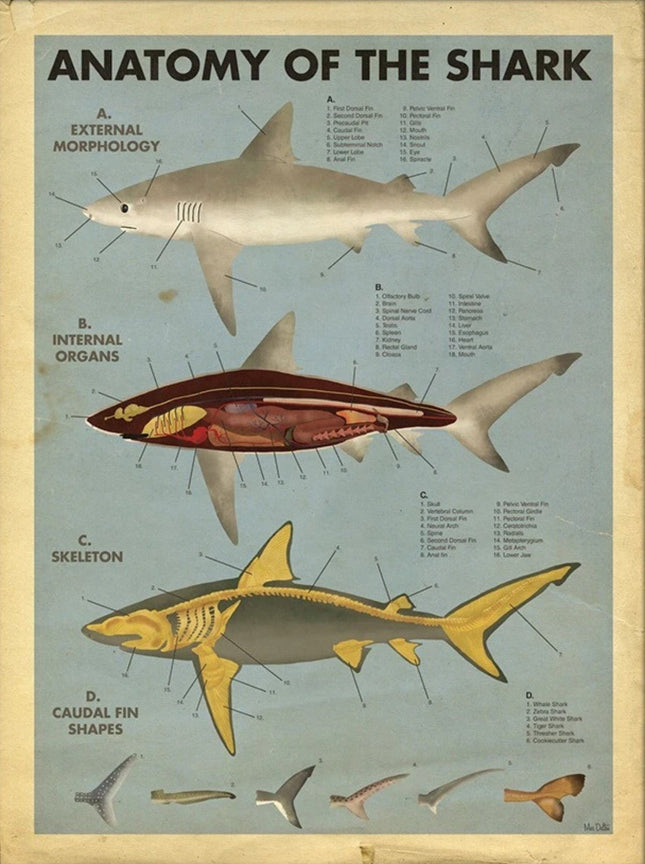
Max Dalton Anatomy of the Shark Giclee Print by Max Dalton
Anatomy of the Shark Artwork Giclee Limited Edition Print on Hot-Press Italian Watercolor Paper by Pop Culture Graffiti Artist Max Dalton. Printed Oceans is PangeaSeed Foundation's fine art print program that raises awareness and educates about pressing marine environmental issues through the lens of some of today's most respected creative minds. Since 2012, we have released over 100 original fine art print editions that highlight endangered marine species and ocean habitats. These stunning editions help to bring important conservation stories into homes and workspaces the world over creating critical dialogue and inspiring positive action. Through the purchase of these carefully hand-crafted, limited edition artworks, you are not only powering the groundbreaking work of PangeaSeed Foundation in communities across the globe but also contributing to the livelihoods of our supporting ARTivists. Together, via art and activism, we can help save our oceans. PangeaSeed's second annual summer series of the groundbreaking Sea Walls: Murals for Oceans festival July 17-26 2015 in Cozumel, Mexico. Sea Walls: Murals for Oceans is the first movement of its kind helping to save our seas via public art and activism (ARTivism). PangeaSeed's second annual summer festival will feature over 25 renowned contemporary artists from across the globe collaborating to shine a greatly needed spotlight on pressing ocean environmental issues - while helping to educate and inspire individuals and communities to protect the planet's most important ecosystem: the ocean.
$214.00
-
Kaws- Brian Donnelly Companion Flayed- Grey Fine Art Toy by Kaws- Brian Donnelly
Companion Flayed- Grey Limited Edition Vinyl Art Toy Collectible Artwork by Modern Pop Artist Kaws. 2016 Unopened Package Limited Open Edition 10.5 X 4.5 X 2.5 / 16.7 X 11.4 X 6.4 CM Exploring the Companion Flayed Grey by KAWS The Companion Flayed Grey by KAWS is a significant piece in the trajectory of street-inspired art. As a modern pop artist, KAWS has redefined the boundaries of street pop and graffiti artwork, bringing it into high art and collectible design. This 2016 limited open edition piece is a prime example of his artistry. It is encapsulated in a 10.5 x 4.5 x 2.5-inch figure that has remained in its pristine, unopened package, catering to art collectors and enthusiasts alike. KAWS' Companion has become a hallmark within his expansive portfolio, showcasing the character in various forms and mediums. The flayed version strips the character to its skeletal essence and speaks to the vulnerability and underlying complexity that street art often seeks to convey. Released with his "Where The End Starts" exhibit in Fort Worth, Texas, the Companion Flayed Grey has been distributed through KAWSONE, MoMA, and the Modern Art Museum of Fort Worth, standing tall at 11 inches. Significance of the Flayed Companion in Street Pop Art The Grey Flayed Companion is a testament to the evolving narrative of street pop art. By presenting a figure that is traditionally whimsical and playful in a dissected form, KAWS invites viewers to ponder the intersection of life's fragility and the often robust, vibrant nature of street art. The grey hue of this particular figure adds a somber tone to the piece, possibly reflecting the concrete jungle that street art often inhabits. Yet, it stands not as a mere representation of street art but as an artifact that bridges the gap between collectible toys and meaningful art. This figure is significant for its aesthetic and role in the more extensive dialogue of what constitutes art in the public realm. By elevating the Companion to a museum-worthy piece while maintaining its roots in street culture, KAWS challenges and expands the definition of street pop art. Through its release in prestigious venues, the Companion Flayed Grey underscores the permeable lines between commercial art and the fine art sector. KAWS' Companion Series: A Reflection on Modern Collectibles The Companion series, especially the Flayed Grey edition, reflects the burgeoning interest in art toys as legitimate collectibles. KAWS' ability to capture the collective imagination with his Companion figures has elevated the status of art toys, placing them on the same pedestal as traditional artworks. The meticulous design and production of the Flayed Companion Grey, with its detailed anatomy visible beneath a translucent exterior, showcase KAWS' dedication to craftsmanship and conceptual depth. Released in an open edition, the Companion Flayed Grey makes KAWS' work accessible to a broader audience, aligning with the democratic nature of street art. It embodies a fusion of street pop art aesthetics with the collectibility and desirability of limited edition pieces. As such, the Companion Flayed Grey is not jus a cultural icon that captures the essence of KAWS' impact on the art world and his pioneering role in the street art movement.
$1,904.00
-
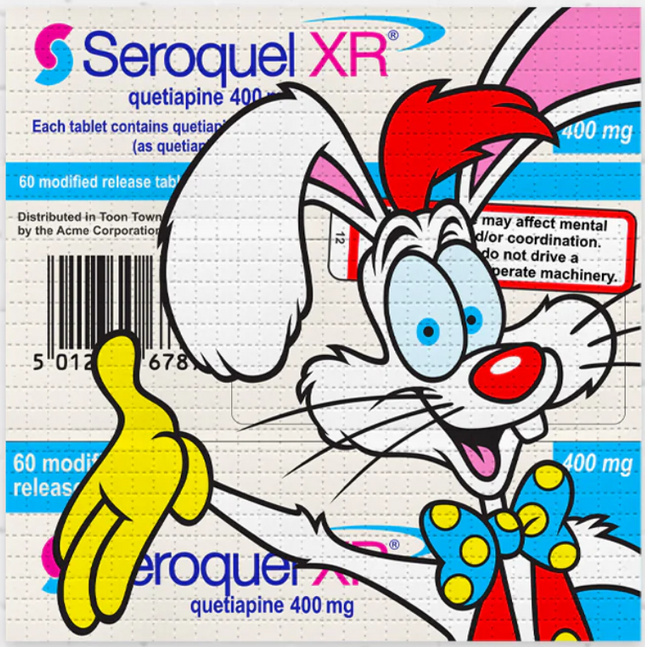
Ben Frost Who Fried Roger Rabbit? Seroquel Blotter Paper Archival Print by Ben Frost
Who Fried Roger Rabbit? Seroquel Blotter Paper Archival Print by Ben Frost Limited Edition Fine Art Archival Pigment Print Art on Perforated Blotter Paper. 2025 Signed & Numbered Limited Edition of TBD Archival Pigment Print on Perforated Blotter Paper Size: 7.5 x 7.5 Inches Release: April 19, 2025 Limited blotter editions are hand-perforated by Zane Kesey. Cartoon Madness Meets Pharmaceutical Culture Who Fried Roger Rabbit? Seroquel Blotter Paper Print by Ben Frost reimagines the iconic animated character Roger Rabbit within the framework of modern pharmaceutical branding. Released as part of Frost’s 2025 collection, this 7.5 x 7.5 inch limited edition archival pigment print on perforated blotter paper explores the collision of pop culture and medication packaging with satirical precision. Featuring the animated character smiling manically beside a Seroquel XR layout, the print is hand-perforated by Zane Kesey and produced in a signed and numbered edition. This work critiques how society normalizes mental health struggles through branding and questions how animation, nostalgia, and pharmaceuticals can coexist in a single visual message. Satirical Branding and Medicinal Irony Frost fuses Roger Rabbit’s over-the-top personality with Seroquel, a medication used to treat mood disorders, to amplify the surreal effects of overstimulation and sedation. By transforming the clinical appearance of a pharmaceutical box into a playful, chaotic canvas for a cartoon figure, Frost blurs the line between treatment and escapism. His use of quetiapine packaging language is precise, including dosage information and warnings, yet subverted by Roger Rabbit’s erratic demeanor. The underlying message reflects on how medication is commercialized in a culture that commodifies both mental illness and childhood nostalgia. Material Subversion in Blotter Format The blotter paper format is integral to the conceptual thrust of the piece. Traditionally associated with LSD distribution, blotter prints evoke a psychedelic lineage and hint at an altered perception of reality. By placing a cartoon character on a faux-medication backdrop, Frost disrupts the expectation of serious pharmaceutical design with absurdity. The perforation physically fragments the image, echoing the fragmentation of consciousness and emotion in both medicated and animated experiences. This format enables the artwork to comment simultaneously on drug culture, entertainment media, and mental health marketing. Ben Frost’s Visual Provocation Australian artist Ben Frost has made a name for himself by appropriating advertising, pharmaceutical logos, and mass-market cartoons into biting social commentary. His Street Pop Art & Graffiti Artwork unpacks consumer psychology through bold color, recognizable imagery, and pointed juxtapositions. Who Fried Roger Rabbit? is a standout example of this method—merging the aesthetics of childhood with the clinical detachment of adult medicalization. Frost confronts viewers with contradictions they may overlook in daily life, drawing humor and tension from the unsettling marriage of cartoon madness and prescribed stability. It’s not just visual stimulation—it’s a question wrapped in a package we’re told to trust.
$550.00 $495.00
-
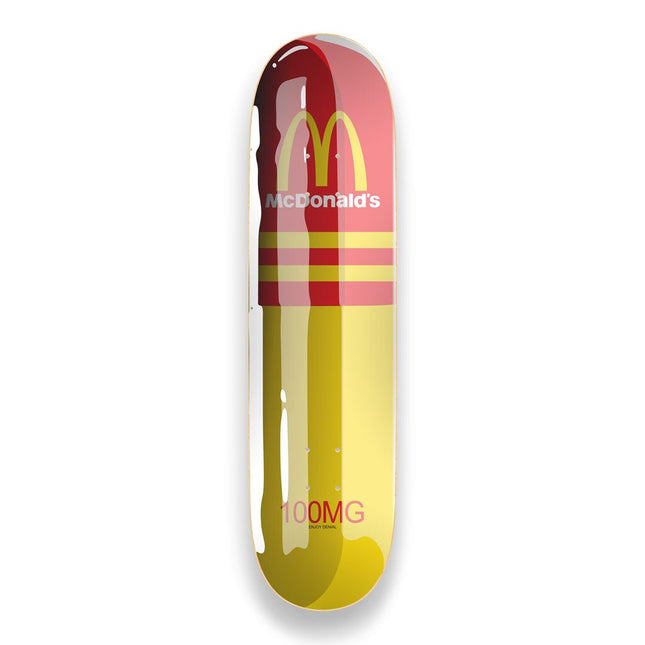
Denial- Daniel Bombardier McDonald Archival Skateboard Deck by Denial- Daniel Bombardier
McDonald Limited Edition Archival Pigment Print Transfer on Cold Pressed Steep Natural Skate Deck art by street pop culture artist Denial. 2019 Limited Edition of 50 In 2000 he adopted the moniker ‘DENIAL’ as a means of poking fun at advertising, politics, and media messages that contemporary society is often ‘in denial’ about. Since then he has maintained an ongoing global street-campaign of over 500, 000 stickers, placards, and murals, using the alpha-numeric characters ‘D3N!@L’. Denial is a Canadian artist who experiments with aerosol and stencil art, while his main fields of interest are consumerism, politics and the human condition in today’s society. Since the culture of graffiti was gaining more and more popularity in the US and Europe, the taggers had to be increasingly original in order to stand out. The signatures became bigger, more stylized and more colorful.
$505.00 $455.00
-
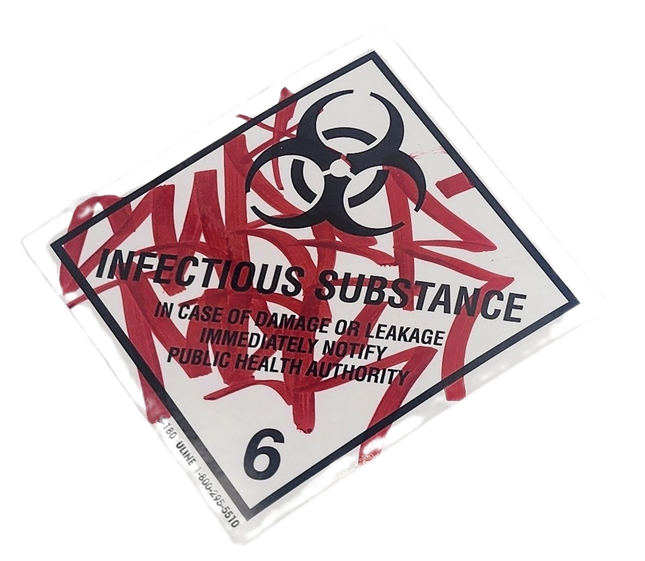
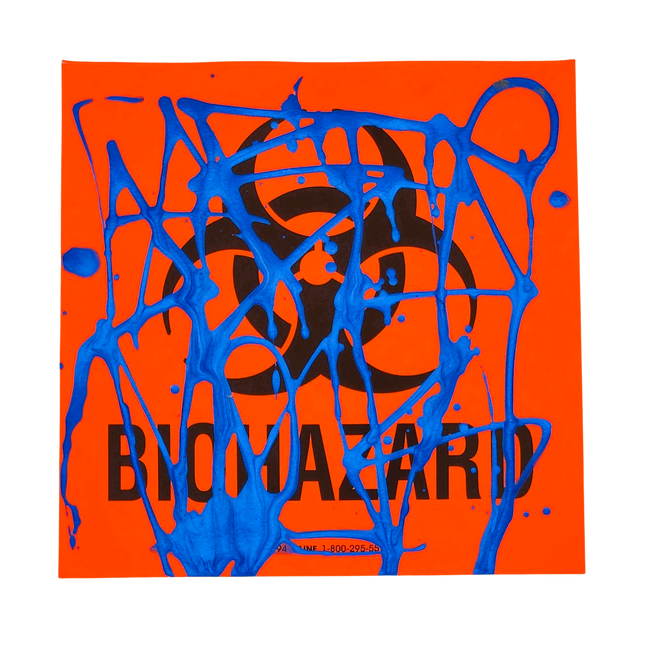
Saber Infectious Substance Slap-Up Label Sticker Original Tag Art by Saber
Infectious Substance Slap-Up Label Sticker Original Tag Art by Saber Original Permanent Marker Art Drawing on Mailing Glossy Biohazard Sticker by Graffiti Artist Modern Street Artwork. 2020 Signed Original Slap Up Graffiti Art Tag 4x4 Marker Tagged on Infectious Substance Warning Bio-Hazard Label Uline S-180 Sticker. Slap Up In Perfect Condition. Reframing Perception through Street Pop Art Street pop art and graffiti artwork, characterized by their vibrant immediacy and cultural resonance, have a way of capturing the zeitgeist of the era in which they were born. The "Infectious Substance Warning Bio-Hazard Label Uline S-180 Sticker" series by graffiti artist Saber, whose real name is Ryan Weston Shook, exemplifies this phenomenon. With his 2020 collection of signed original slap-up graffiti art tags, Saber converges the world of hazardous material warnings with the rebellious spirit of street art. Each 4x4 marker-tagged piece carries his unique interpretation, transforming the ominous implications of the bio-hazard symbol into a canvas that speaks to the broader impact of what is genuinely infectious in our societies. Saber's Artistic Intervention on Bio-Hazard Symbols Saber's choice of the bio-hazard label as a substrate for his art is particularly telling. The symbol, designed to alert to dangerous pathogens, is recontextualized in his work to question the infectious nature of ideas, the virulence of art, and the power of expression to permeate and affect the public psyche. The contagious substance label, meant to protect by warning, is overlaid with Saber's tags that neither obscure the message nor dilute its significance. Instead, they add a layer of meaning, an artist's signature that challenges the viewer to question the boundaries between safety, censorship, public health, and public discourse. Modern Street Artwork as Social Commentary In modern street artwork, Saber's creations are a powerful testament to the artist's role as a social commentator. His work on the Uline S-180 stickers is a visual metaphor for 2020, a period marked by global health crises and a heightened awareness of biological hazards. By tagging these stickers, Saber connects the dots between the literal infectious agents the labels warn against and the metaphorical contagion of fear, misinformation, and societal unrest that characterized the year. The permanence of the marker on the glossy sticker mirrors the lasting impact of the year's events on the collective consciousness, ensuring that while the hazards may be contained, the dialogue they incite is not. In every line and color choice, Saber's art on the bio-hazard stickers demands engagement and reflects the unyielding nature of Street Pop Art and Graffiti Artwork. As a documented figure in the graffiti community, Saber's American roots and contributions continue to shape the conversation around the power of street art to reframe our perception of the symbols that dominate our public spaces. Each tag is a deliberate reclamation, a declaration that even the most exemplary of symbols can become a medium for enduring artistic expression.
$16.00
-
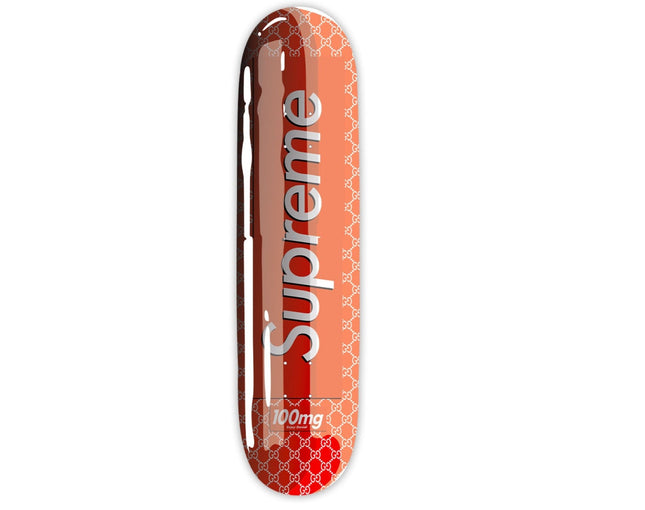
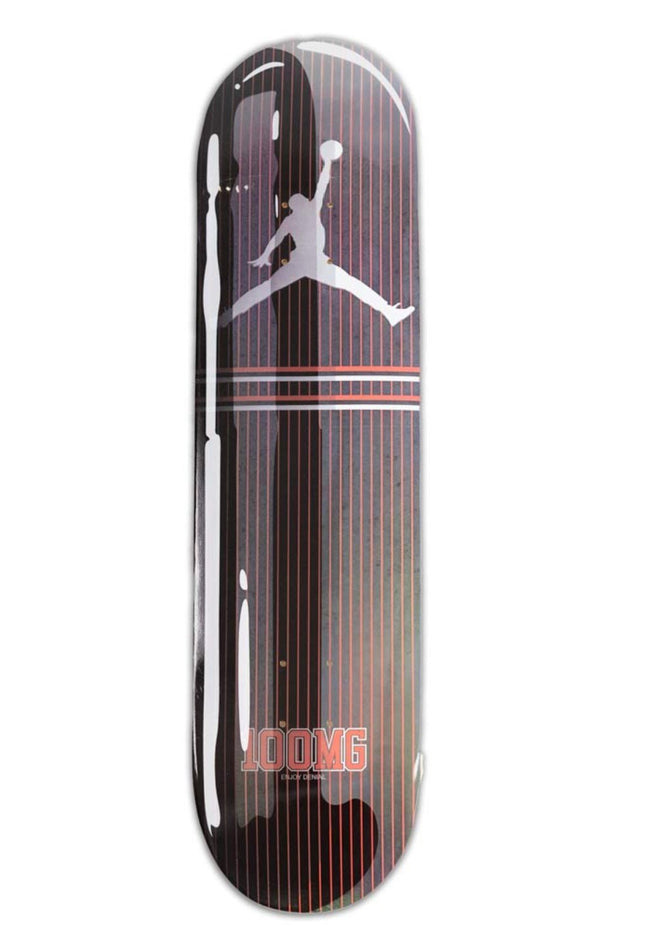
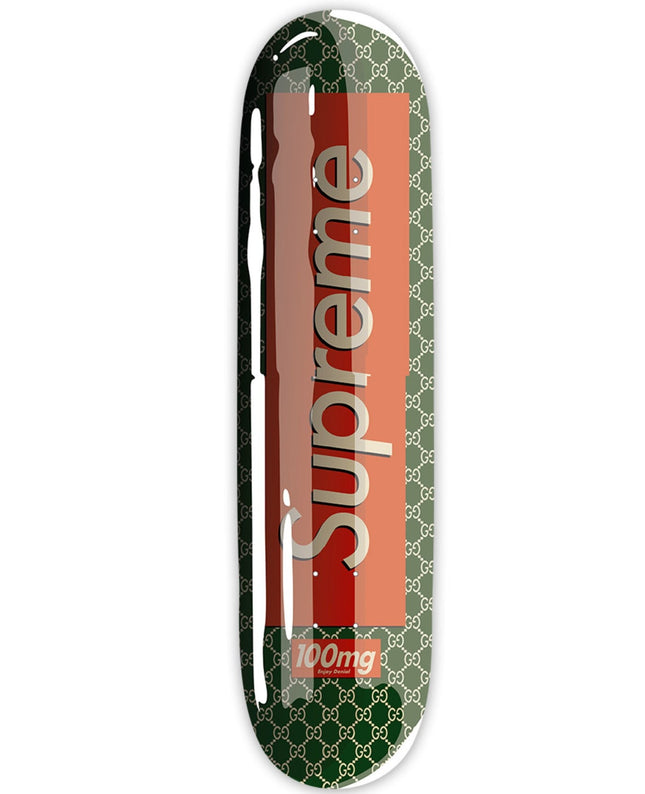
Denial- Daniel Bombardier Supreme Gucci Smashup Pill Red Skateboard Deck by Denial- Daniel Bombardier
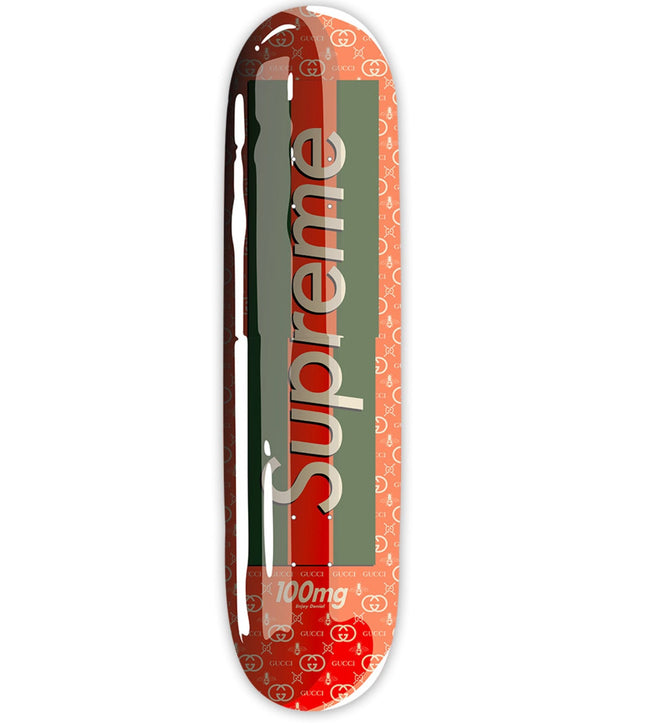
Supreme Gucci Smashup Pill- Red Fine Art Limited Edition Archival Pigment Print Transfer on Cold Pressed Steep Natural Skateboard Deck by Street Artwork Graffiti Artist Denial- Daniel Bombardier. 2022 Numbered Limited Edition of 100 Skateboard Artwork Size 8.25x32 Archival Pigment Print Transfer on Cold Pressed Steep Natural Skate Deck Size: 8.25 x 31.875 Inches Release: June 28, 2022 From the Gucci logo, Louis Vuitton & Supreme to Channel perfumes and credit cards, he is utilizing such cultural products with the intention to make a statement against the system, which gave birth to them. As a result, he re-contextualizes them and transforms them from commercial products to his cultural legacy.
$466.00
-
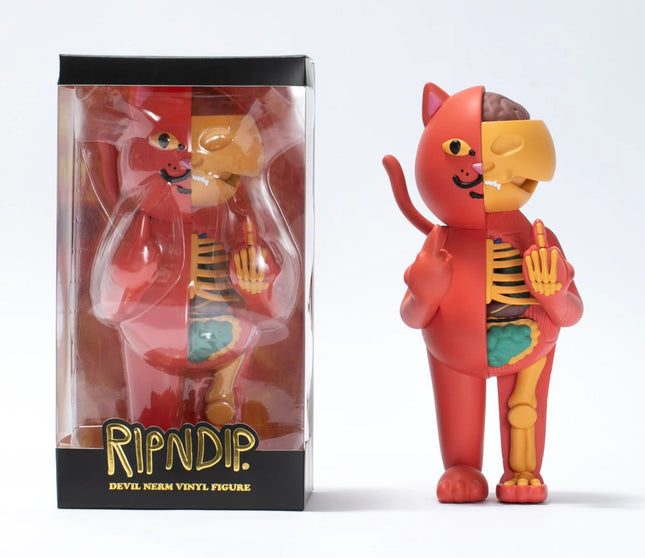
Rip N Dip Devil Nerm Nermal Art Toy Figure by Rip N Dip
Devil Nerm Nermal Limited Edition Anatomy Vinyl Art Toy Collectible Artwork by street graffiti artist Rip N Dip. 2022 Limited Edition of 500 Size 14-inch Devil Nerm Nermal Vinyl Figure Terminator Dissected Art Toy.
$299.00
-

Luke Chueh Kuma Kush The Prisoner Cannabis Drug Bear Art Toy by Luke Chueh
Kuma Kush The Prisoner Cannabis Drug Bear Art Toy by Luke Chueh Limited Edition Vinyl Collectible Artwork by Street Graffiti Artist. 2017 Limited Edition Artwork of 300 with Cotton, Bag, and Tube. Based on Luke Chueh's original painting, The Prisoner ponders captivity in its many forms—physical, mental, or pharmaceutical. Post-traumatic stress disorder is a mental health problem that can develop after experiencing or witnessing a life-threatening event like combat, natural disaster, car accident, or sexual assault. And the dependency on prescription medications such as Percocet has led to widespread addiction problems. Kuma Kush The Prisoner by Luke Chueh: Cannabis and Emotional Captivity in Street Pop Art & Graffiti Artwork Kuma Kush The Prisoner is a limited edition vinyl art toy created by Los Angeles-based artist Luke Chueh in 2017. Produced in a run of 300 pieces, each figure comes housed in a green translucent prescription-style container with a cotton bag and printed label that mimics cannabis dispensary packaging. This collectible is part of Chueh’s The Prisoner series, which adapts his original painting into three-dimensional vinyl form. The figure features a seated bear, legs folded, arms wrapped tightly around its knees, and head lowered in a pose of silent withdrawal. This turquoise green edition—nicknamed Kuma Kush—shifts the narrative focus toward cannabis as a coping mechanism, inviting reflection on the psychological implications of alternative medication and emotional dependency. Deeply rooted in the language and symbolism of Street Pop Art & Graffiti Artwork, this piece turns a seemingly cute figure into a deeply evocative emotional sculpture. Color, Form, and Packaging as Social Commentary The choice of a green plastic tube traditionally associated with cannabis storage turns the bear into a commentary on escapism, self-medication, and the search for relief from psychological pain. The strain title, Kuma Kush, plays off both pop culture and medical terminology, combining a playful exterior with a serious undertone. Chueh’s bear figure, rendered in a mint green hue, is static and introspective, trapped in both its physical posture and the symbolic enclosure of the container. The aesthetic is clean, minimal, and emotionally weighted. This visual restraint is a core part of the artwork’s impact—Chueh uses silence and stillness to speak volumes. The bear is not a mascot but a vessel, representing the emotional burden many carry in silence. By situating the toy inside medical-themed packaging, Chueh makes the container an extension of the piece, turning object presentation into a narrative device consistent with the provocative nature of Street Pop Art & Graffiti Artwork. Luke Chueh and the Art of Emotional Exposure Luke Chueh has become a leading voice in contemporary pop and street-influenced art through his exploration of mental health, addiction, and vulnerability. His iconic bear figures have become universal symbols of struggle, designed to elicit empathy without the need for words. In Kuma Kush The Prisoner, Chueh introduces cannabis culture into his ongoing narrative about emotional suppression and dependency. This is not a celebration or condemnation of cannabis but an observation on how individuals turn to substances—legal or otherwise—to cope with trauma, anxiety, and post-traumatic stress disorder. Chueh’s approach is neither cynical nor romanticized. It exists within the gray areas where emotion, coping, and survival intersect, which places his work at the forefront of Street Pop Art & Graffiti Artwork that engages social issues through emotionally resonant design. The Prisoner Series as Art Object and Cultural Reflection Kuma Kush The Prisoner functions as both a collectible and a statement, its limited release of 300 making it both rare and conceptually potent. The figure, while small in scale, delivers a message that expands far beyond its dimensions. It sits not just in display cases but in the minds of viewers, acting as a quiet companion to those navigating emotional heaviness. Through minimalist form and emotionally charged symbolism, Luke Chueh elevates the collectible vinyl toy to a piece of psychological sculpture. As part of the Street Pop Art & Graffiti Artwork movement, the Prisoner series—and this Kuma Kush edition in particular—demonstrates how visual art can confront difficult truths about medication, trauma, and human vulnerability without sacrificing aesthetic simplicity or emotional clarity.
$368.00
-
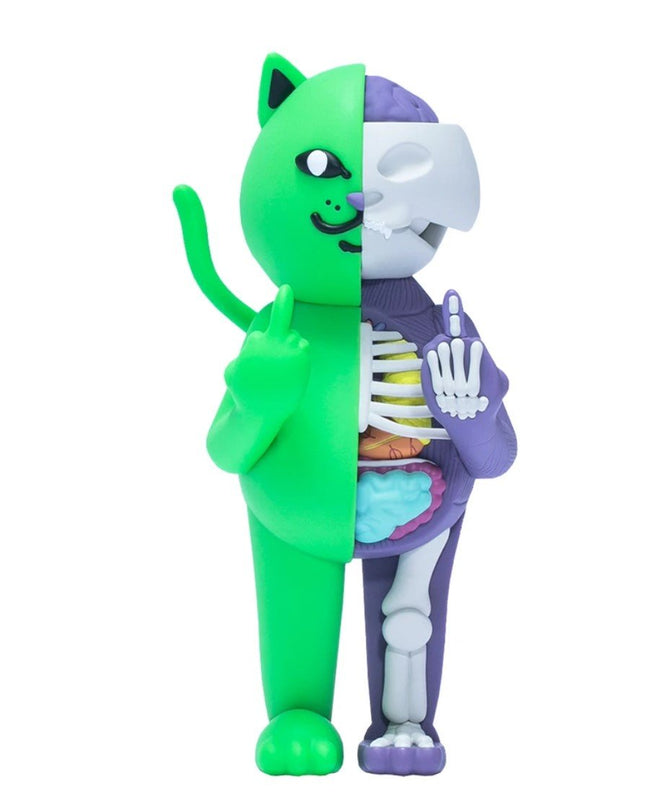
Rip N Dip DropX Nerm Nermal Art Toy Figure by Rip N Dip
DropX Nerm Nermal Limited Edition Anatomy Vinyl Art Toy Collectible Artwork by Street Brand Artists Rip N Dip. 2022 Limited Edition of 150 Size 14-inch Nerm Nermal Vinyl Figure Terminator Dissected Art Toy. New In Box The DropX Nerm Nermal vinyl figure is an intriguing embodiment of contemporary pop art's intersection with street culture, produced in a limited edition by the renowned streetwear brand Rip N Dip. This 2022 collectible stands 14 inches tall, capturing the playful yet provocative spirit of the brand's aesthetic. Limited to just 150 pieces, the vinyl art toy offers a unique twist on the character of Nermal, the brand's iconic cat mascot. Here, Nermal is reimagined through an "anatomical dissection," a design approach that lays bare the inner skeletal structure of the figure on one side while maintaining the smooth, playful exterior on the other. This juxtaposition creates a striking visual narrative, reflecting themes of duality and transparency that resonate deeply in street art and pop culture. This artwork, still in its original packaging, is as much a piece of art as a commentary on the modern collectibles market, where items are often valued more for their mint condition than for the artistic statement they make. The dissected aesthetic of the figure, a style popularized in the art toy community, aligns with a fascination with what lies beneath the surface—in terms of the figure's design and, metaphorically, regarding the persona and culture it represents. The exclusive nature of this limited edition release underscores the intersection of art and commerce, a theme prevalent in street art's evolution into gallery spaces and consumer markets. In this context, the Nerm Nermal vinyl figure is not merely a collectible but a tangible slice of the ethos that drives the street art scene, immortalizing the irreverent and often satirical spirit that has long defined both Rip N Dip and street art as a whole.
$347.00
-
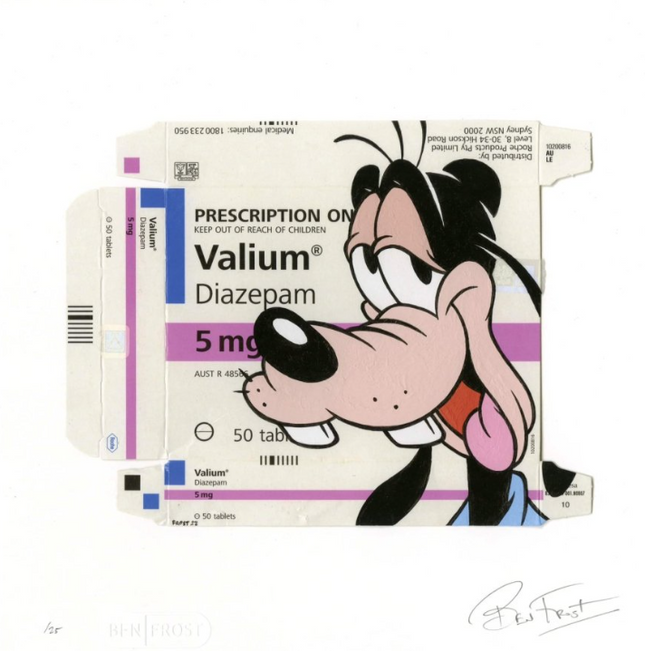
Ben Frost Goof Ball Archival Print by Ben Frost
Goof Ball Archival Print by Ben Frost Limited Edition on 310gsm Cotton Photographique Fine Art Paper Pop Graffiti Street Art Artist Modern Artwork. 2023 Signed & Numbered Print Limited Edition of 25 Artwork Size 11.7x11.7 Archival Pigment Fine Art by Ben Frost Ben Frost is an Australian artist whose oeuvre is a scintillating fusion of pop art, street art, and graffiti art. Renowned for his visually striking and thought-provoking pieces, Frost’s work often incorporates iconic imagery from mainstream media and consumer culture. His subversive art is characterized by the juxtaposition of these symbols with themes of excess, addiction, and the superficiality and wastefulness of consumer culture. Infused with a critical edge and often laced with dark humor, his paintings, prints, and installations defy conventional aesthetics and present a chaotic and relentless assault on the senses. Goof Ball Archival Print by Ben Frost is an exemplary representation of the mélange between pop art and street art that has been taking the art world by storm. Ben Frost, an Australian artist renowned for his juxtaposition of commercial imagery and his own iconic style, often draws inspiration from the relentless bombardment of visual stimuli that constitutes the modern world. He has a predilection for utilizing vibrant colors and satirical commentary, which can be seen in the Goof Ball Archival Print. This piece specifically combines the aesthetic sensibilities of pop art, a movement characterized by its fascination with popular culture and consumer goods, with the edgy, raw, and often subversive nature of street art. Frost's Goof Ball Archival Print is captivating in its visual immediacy and use of iconic characters and logos. The inclusion of popular cultural symbols makes it relatable, while its brazen critique of consumer culture, inherent in the juxtapositions, lends it a certain depth. With the audacious strokes reminiscent of graffiti art, the work strikes a balance between the refined and the rebellious. It is a high-quality archival print, which ensures the longevity and preservation of the vivid colors that are a hallmark of Frost’s work. As a seminal piece in the contemporary fusion between pop, street, and graffiti art, Goof Ball Archival Print is an invitation to not just glance, but to analyze and introspect on the commentary it makes about our culture. This artistic gem, thus, warrants appreciation from both art aficionados and casual observers alike.
$621.00 $559.00
-
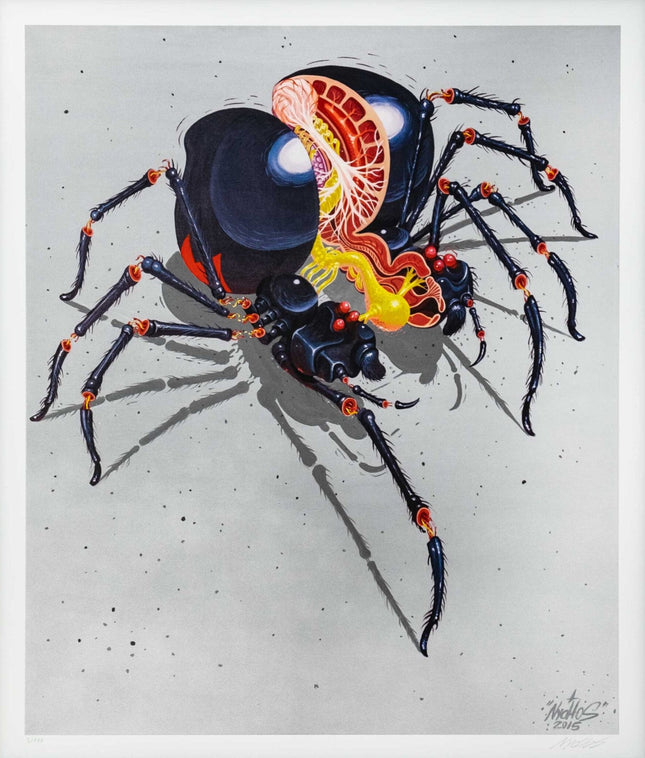
Nychos Dissection Of A Black Widow Giclee Print by Nychos
Dissection Of A Black Widow Pop Artwork Limited Edition Giclee Print on Fine Art Paper by Modern Artist Nychos. 2021 Signed & Numbered Limited Edition of 111 Size 20.4x24. This Artwork Is Based On The Mural 'Dissection Of A Black Widow" & Can Be Admired Since 2014 In Hamburg's Gängeviertel. Intersection of Science and Street Pop Art "Dissection of a Black Widow" is a standout piece in the oeuvre of Nychos, a modern artist renowned for his intricate pop artwork and deep roots in street and graffiti art. This limited edition giclée print on fine art paper captures the essence of the original mural imposed in Hamburg's Gängeviertel since 2014. The work, numbered and signed, with only 111 editions, measures 20.4x24 inches and exemplifies the artist's fascination with anatomical dissection in a style that merges biological precision with urban artistry. Nychos's approach to the black widow dissection is both clinical and creative, revealing the layers of anatomy in a style reminiscent of medical textbooks yet transformed through a pop art lens. His use of vibrant colors to illustrate the innards of the black widow against the stark contrast of its dark exterior invites a dialogue between the often-opaque nature of street art and the vivid, transparent qualities of scientific illustration. Technique and Craftsmanship in Nychos's Work The artist's "Dissection of a Black Widow" technique is a meticulous layering of color and form that showcases his deft hand and deep understanding of the subject matter and the medium. The giclée printing process, known for its ability to capture the nuance of the original artwork, perfectly complements Nychos's detailed work, preserving the mural's dynamic range of textures and hues. The transition of "Dissection of a Black Widow" from a large-scale mural to a collectible print represents the fluidity with which Street Pop Art and graffiti Artwork can traverse different spaces and contexts. Nychos's art not only graces urban landscapes but also finds a place within the intimate setting of personal collections, bringing the raw energy of the streets into harmony with the cultivated environment of modern art enthusiasts. The black widow, a symbol often associated with danger and charisma, is recontextualized in Nychos's work, becoming a canvas for exploring the complexity of life forms. This piece goes beyond mere representation; it explores the hidden intricacies that lie beneath surfaces, a theme that resonates with the layered nature of graffiti and street art. Legacy of "Dissection of a Black Widow" "Dissection of a Black Widow" is a testament to Nychos's legacy in Street Pop Art and graffiti Artwork. The limited edition print holds an esteemed position, reflecting the evolution of street art into a form that transcends the boundaries of outdoor spaces and enters the realm of fine art collectibles. Nychos's work, particularly this piece, is a testament to the transformative power of street art and its ongoing dialogue with pop culture and contemporary art movements. "Dissection of a Black Widow" is a visual spectacle and an invitation to delve deeper into the intersections of art, science, and the urban landscape, encouraging a reevaluation of what constitutes modern art in our collective consciousness.
$298.00
-
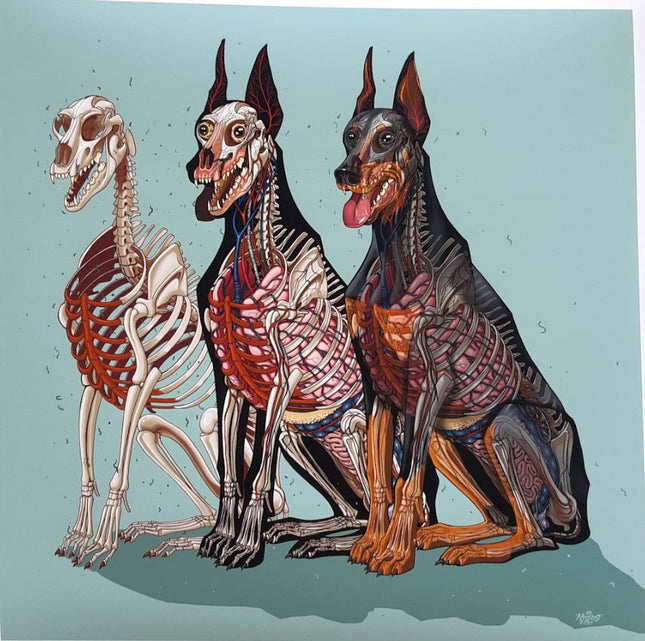
Nychos Dobermann Anatomy Archival Print by Nychos
Dobermann Anatomy Archival Pigment Fine Art Limited Edition Print on Velvet Cotton Fine Art Paper by Artist Nychos, Street Pop Art Graffiti Legend. 2021 Signed & Numbered 24 x 24 inch / 61 x 61 cm Fine art print by NYCHOS Limited Edition of 111 Velvet Fine Art cotton fiber paper Hand-signed & numbered Nychos, an iconic figure in the world of street pop art and graffiti, presents a striking depiction of the Dobermann breed in his artwork titled "Dobermann Anatomy." Renowned for his unique anatomical explorations, Nychos delivers a layered perspective that delves deep into the physical structure of the canine, unravelling the layers from skeletal to muscular and finally the full-bodied representation of the Dobermann. The result is a captivating piece that marries scientific precision with artistic flair. Set against a muted teal backdrop, the sequential progression of the Dobermann from bone to flesh provides a detailed insight into the intricate anatomy of the dog. The vivid colors used to distinguish between the muscles, organs, and bones capture the viewer's attention, offering a visual treat that blurs the lines between educational illustration and pop art. The meticulously crafted details are a testament to Nychos's dedication to his craft, further establishing him as a master of his genre. Crafted in 2021, this fine art print stands as a testament to the evolution of street art, pushing the boundaries of what is traditionally expected from the medium. Measuring 24 x 24 inches, the artwork is printed on velvet fine art cotton fiber paper, ensuring longevity and a rich texture that complements the depth of the piece. As a limited edition release, there are only 111 pieces available, each of which is hand-signed and numbered by Nychos himself. For enthusiasts of street art, graffiti, or simply those fascinated by anatomy, this artwork offers a unique fusion of all, making it a valuable addition to any collection.
$631.00 $568.00
-
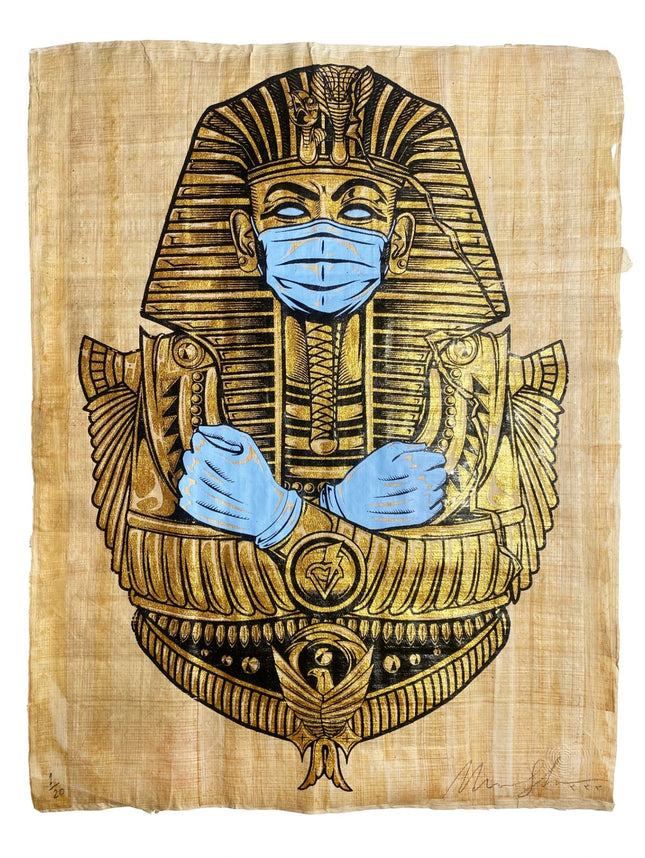
Marwan Shahin The Masked Pharaoh Silkscreen Print by Marwan Shahin
The Masked Pharaoh 3-Color Hand-Pulled Diamond Dust Limited Edition Silkscreen Print on Egyptian Papyrus Paper by Marwan Shahin Rare Street Art Famous Pop Artwork Artist. 2022 Signed & Numbered Limited Edition of 20 Size 14x17.5 & "NFT" "Shahin Studios is delighted to present The Masked Pharaoh Papyrus by Marwan Shahin, The Artwork was first to be created in lockdown during the Covid-19 pandemic, imagining TutAnkhAmoun staying safe and protecting himself against the modern-day plague. this edition of the artwork is interpreted with hand-pulled Silkscreen print on Authentic Egyptian Papyrus, and each print is intricately arranged with a filigree of black Diamond Dust, to produce visually intoxicating kaleidoscope-like effects. contains an NFT crypto-chip by the Fine Art Ledger. Each print is Authenticated and registered on the blockchain by The Fine Art Ledger comes with a digital Certificate of Authenticity containing its cryptographic stamp." -Marwan Shahin
$748.00 $673.00
-
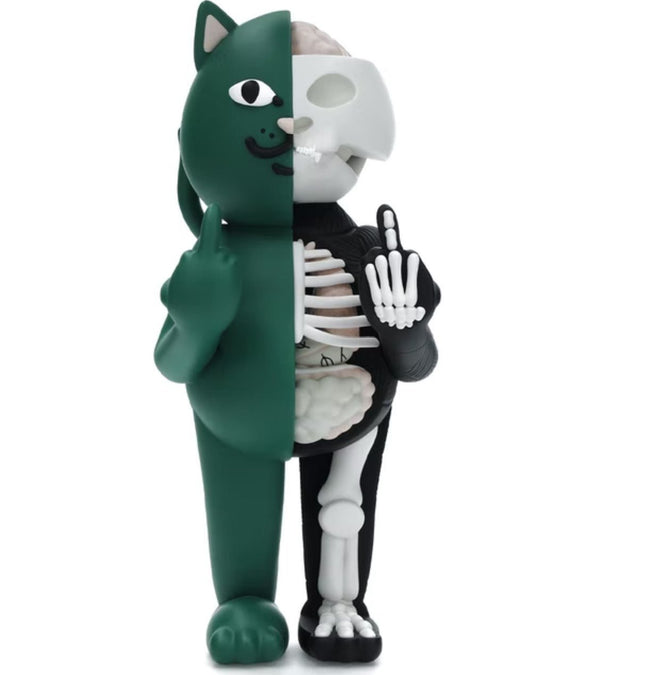
Rip N Dip Radioactive R Nerm Æ-09 Nermal Art Toy Figure by Rip N Dip
Radioactive R Nerm Æ-09 Nermal Limited Anatomy Vinyl Art Toy Collectible Artwork by street graffiti artist Rip N Dip. 14 inch R NERM Æ-09 VINYL FIGURE Glow In The Dark
$269.00
-
Denial- Daniel Bombardier Alternative Medicine Archival Skateboard Deck by Denial- Daniel Bombardier
Alternative Medicine Fine Art Limited Edition Archival Pigment Print Transfer on Cold Pressed Steep Natural Skateboard Deck by Street Artwork Graffiti Artist Denial. Archival Pigment Print Transfer on Cold Pressed Steep Natural Skate Deck Size: 8.25 x 31.875 Inches Release: July 14, 2021 Denial has evolved as one the most prominent figures of contemporary pop artists, who nonetheless, continue to stay relevant and is interested in generating thought-provoking commentary. He has a long history of exploring the boundaries of appropriation, which he uses as a means of subverting the value of cultural products, imprinted in the collective memory of the Western civilization. His work, in other words, is inviting the viewer to re-imagine our dystopian society as a way of confronting it, with humor and irony as the biggest tools of the artist.
$466.00
-
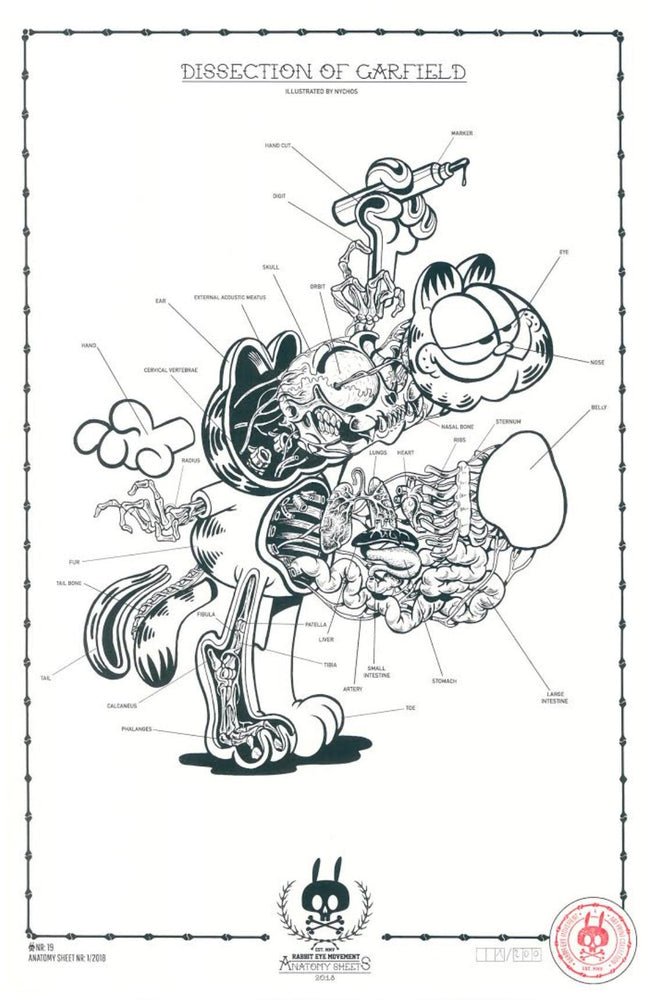
Nychos Dissection of Garfield Anatomy Sheet No 19 Silkscreen Print by Nychos
Dissection of Garfield- Anatomy Sheet No 19 Hand-Pulled 1-Color Limited Edition Silkscreen Print on 300gsm Munken Pure Paper by Medical Pop Artist Nychos. 2018 Signed & Numbered Limited Edition of 200 11x17 Illustrated by NYCHOS 1-color Screen Print on 300 g/m² Munken Pure Paper Size: 11 x 17 Inches / 27,94 x 43,18 cm Limited Edition of 200 Year: 2018 Imprint & stamp of authenticity Numbered and signed by the artist The REM Anatomy Sheets focus on the anatomy of pop culture cartoon characters. In this new collection of black and white limited edition screenprints, Nychos lets the viewer engage with details of the anatomy of toons.
$159.00
-
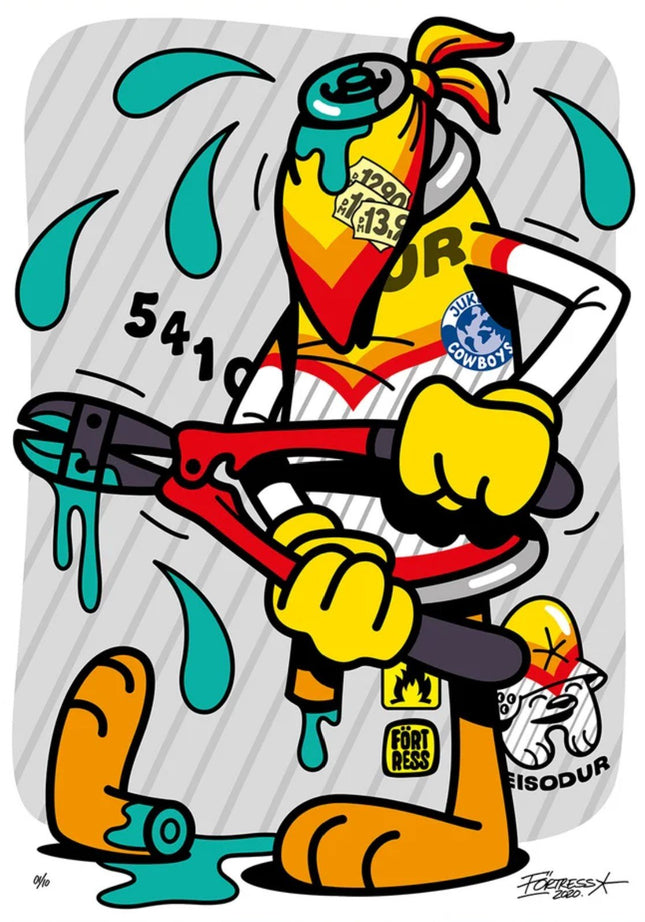
Flying Fortress Rasselbande II Chopped Eisodur Archival Print by Flying Fortress
Rasselbande II- Chopped Eisodur Archival Pigment Fine Art Limited Edition Print on 300gsm Satin Matte White Paper by Artist Flying Fortress, Street Pop Art Graffiti Legend. 2020 Signed & Numbered Limited Edition of 10 Size 16.5x23.4 Artwork
$631.00 $568.00
-
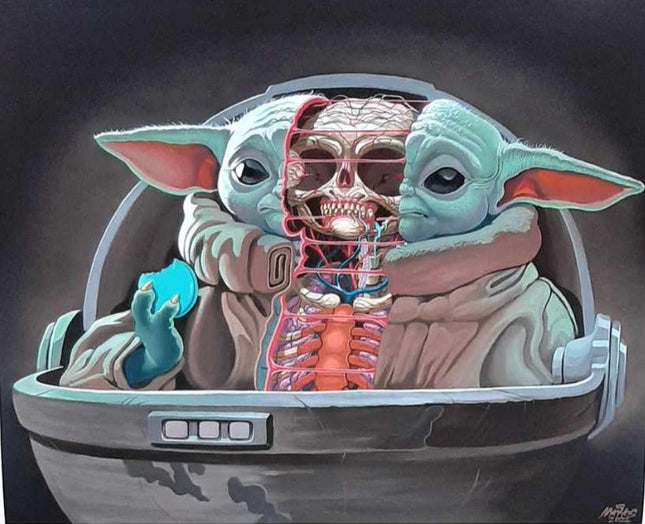
Nychos Dissection of Grogu 24x20 Archival Print by Nychos
Dissection of Grogu- 24x20 Archival Pigment Fine Art Limited Edition Print on Velvet Cotton Fine Art Paper by Artist Nychos, Street Pop Art Graffiti Legend. 2021 Signed & Numbered Fine art print by NYCHOS Size: 24 x 19,7 inch / 61 x 50 cm Limited Edition of 111 Velvet Fine Art cotton fiber paper Hand-signed & numbered Nychos Dissection of Grogu Archival Pigment Print Dissection of Grogu is a 2021 signed and numbered limited edition archival pigment print by Austrian street art legend Nychos. Measuring approximately 24 x 19.7 inches (61 x 50 cm), this fine art edition was produced on velvet cotton fiber paper in a run of 111. Hand-signed and numbered, the print exemplifies Nychos’ internationally recognized “dissection” style within contemporary street and pop surrealist art. Anatomy Meets Pop Culture Iconography In this striking composition, Nychos applies his signature anatomical cross-section technique to the beloved pop culture character Grogu. The figure is split vertically, revealing a detailed internal structure of skull, musculature, organs, and vascular systems beneath the familiar outer form. The contrast between the cute, wide-eyed exterior and the exposed anatomical interior creates a compelling tension—balancing humor, science illustration, and subversive commentary. The precision of the internal rendering reflects Nychos’ fascination with biology and layered visual storytelling. Street Art Craftsmanship on Velvet Cotton Paper Printed as a high-quality archival pigment edition on velvet fine art cotton paper, Dissection of Grogu captures the smooth gradients and intricate detailing central to Nychos’ work. Limited to just 111 hand-signed examples, this 2021 release stands as a collectible piece that bridges graffiti culture, fine art printmaking, and contemporary pop icon reinterpretation. Bold, technically refined, and unmistakably Nychos, the artwork continues his legacy of transforming familiar characters into complex anatomical studies.
$500.00
-
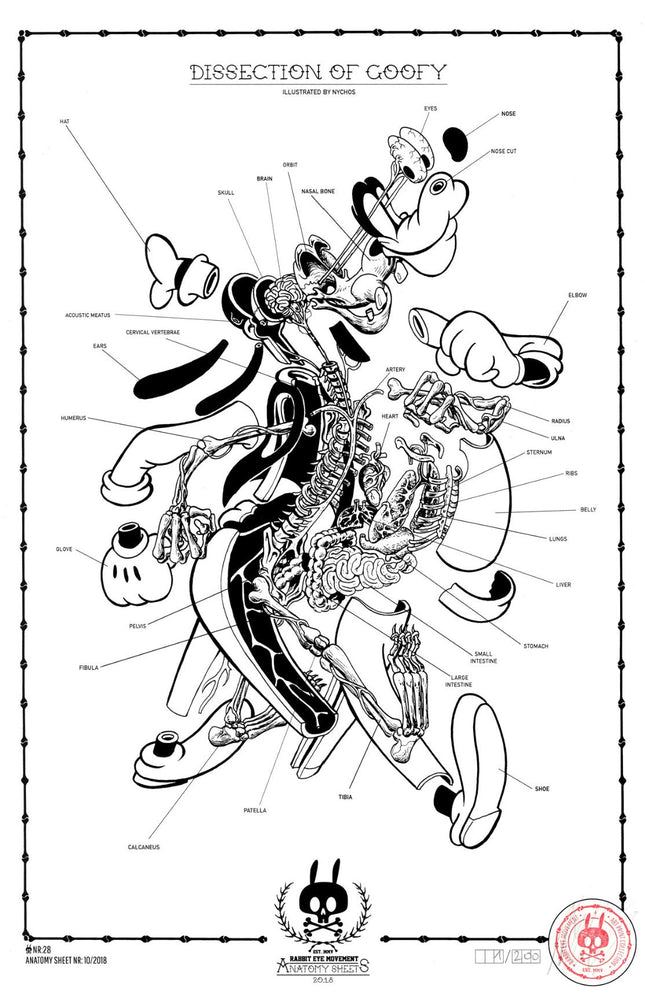
Nychos Dissection of Goofy Anatomy Sheet No 28 Silkscreen Print by Nychos
Dissection of Goofy- Anatomy Sheet No 28 Hand-Pulled 1-Color Limited Edition Silkscreen Print on 300gsm Munken Pure Paper by Medical Pop Artist Nychos. 2018 Signed & Numbered Limited Edition of 200 11x17 Illustrated by NYCHOS 1-color Screen Print on 300 g/m² Munken Pure Paper Size: 11 x 17 Inches / 27,94 x 43,18 cm Limited Edition of 200 Year: 2018 Imprint & stamp of authenticity Numbered and signed by the artist The REM Anatomy Sheets focus on the anatomy of pop culture cartoon characters. In this new collection of black and white limited edition screenprints, Nychos lets the viewer engage with details of the anatomy of toons.
$159.00
-
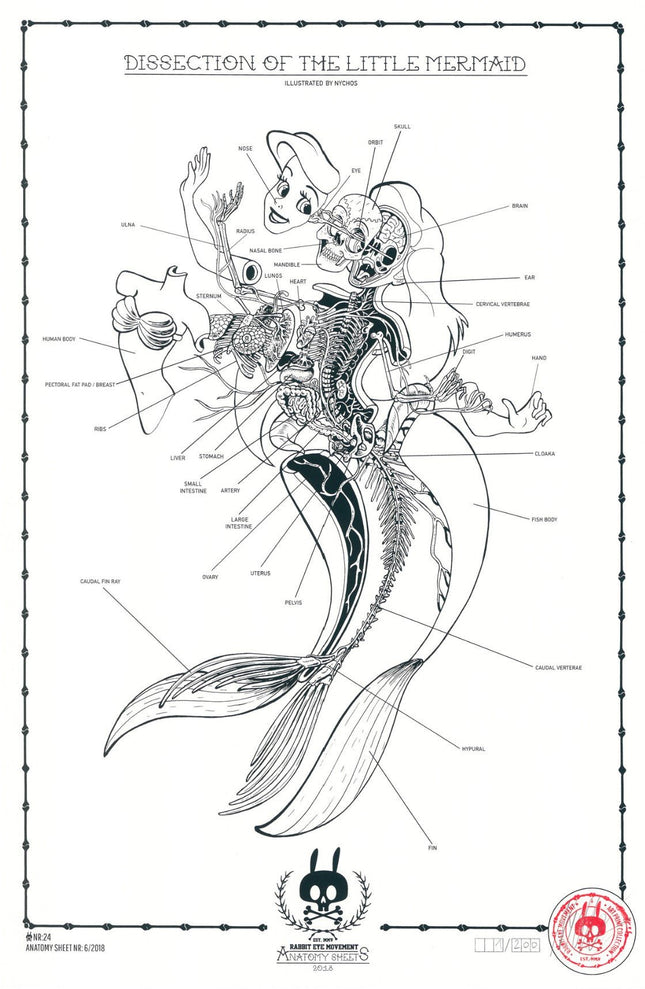
Nychos Dissection of Little Mermaid Anatomy Sheet No 24 Silkscreen Print by Nychos
Dissection of Little Mermaid- Anatomy Sheet No 24 Hand-Pulled 1-Color Limited Edition Silkscreen Print on 300gsm Munken Pure Paper by Medical Pop Artist Nychos. 2018 Signed & Numbered Limited Edition of 200 11x17 Illustrated by NYCHOS 1-color Screen Print on 300 g/m² Munken Pure Paper Size: 11 x 17 Inches / 27,94 x 43,18 cm Limited Edition of 200 Year: 2018 Imprint & stamp of authenticity Numbered and signed by the artist The REM Anatomy Sheets focus on the anatomy of pop culture cartoon characters. In this new collection of black and white limited edition screenprints, Nychos lets the viewer engage with details of the anatomy of toons.
$159.00
-
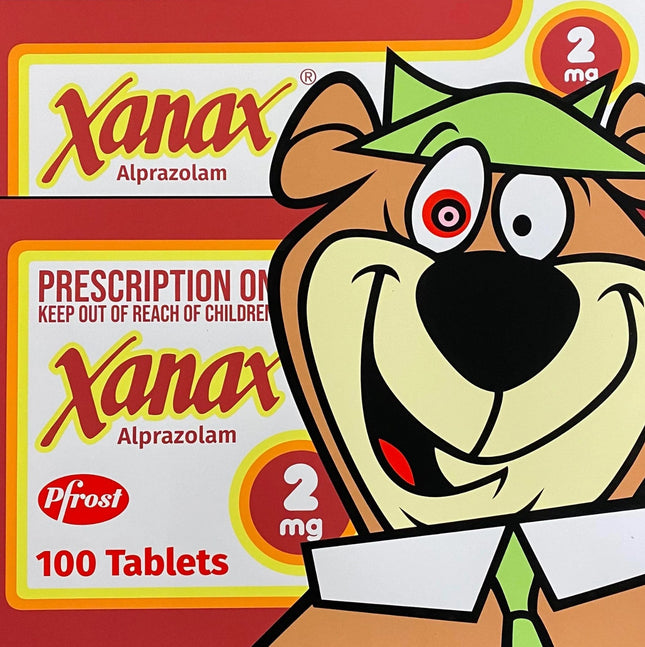
Ben Frost Yogi on Xanax Silkscreen Print by Ben Frost
Yogi on Xanax 9-Color Hand-Pulled Limited Edition Silkscreen Print on Mohawk Superfine UltraWhite Paper by Ben Frost Rare Street Art Famous Pop Artwork Artist. 2022 Signed & Numbered Ben Frost Yogi on Xanax, 9-color Hand-Pulled Screen Print on Mohawk Superfine UltraWhite, 160 lb Cover 24 x24 in., 61 x 61 cm Edition of 50, signed & numbered by the artist Printed by POP!NK Editions Yogi on Xanax by Ben Frost – Consumer Critique in Street Pop Art & Graffiti Artwork Yogi on Xanax is a 2022 limited edition 9-color hand-pulled screen print by contemporary Australian artist Ben Frost, printed on 160 lb Mohawk Superfine UltraWhite cover stock in a 24 x 24 inch format. Signed and numbered in an edition of 50, this bold silkscreen work was produced by POP!NK Editions, renowned for their meticulous craftsmanship in contemporary art print production. The piece combines pharmaceutical packaging design with nostalgic cartoon imagery to produce a visually explosive and conceptually loaded commentary on modern consumer culture. Frost inserts the wide-eyed face of Yogi Bear into the unmistakable layout of a Xanax prescription label, transforming an innocent animated figure into a symbol of medication culture, psychological sedation, and branded addiction. Pharma Design Meets Cartoon Chaos Ben Frost is internationally known for his provocative use of pop culture iconography, and Yogi on Xanax exemplifies his strategy of visual collision. The imagery reappropriates the familiar Xanax box, typically associated with clinical calm, and injects it with the erratic energy of Yogi Bear’s wide grin and hypnotic spiral eye. The polished pharmaceutical layout clashes with the expressive cartoon illustration, creating a moment of visual and conceptual tension. Frost’s technique exposes the strange intersection between happiness, dependence, and entertainment. By overlaying humor onto something serious, he invites viewers to question how commercial products—from children's cartoons to anxiety medications—are embedded into cultural behavior and identity. This blend of absurdity and critique is central to Street Pop Art & Graffiti Artwork, where language and imagery from mass culture are subverted for public commentary. Material Precision and Production Integrity The print’s execution on Mohawk Superfine UltraWhite paper ensures a pristine, high-fidelity surface that supports the layered ink of the 9-color silkscreen process. The heavyweight 160 lb cover stock provides durability and a gallery-quality finish, elevating the piece from poster to collectible artwork. Each color is individually hand-pulled, resulting in rich, solid applications that enhance the saturation and intensity of Frost’s bold graphics. The print’s 24 x 24 inch dimensions offer a perfect square composition, aligning the clinical symmetry of packaging design with the oversized personality of Yogi Bear’s warped cartoon form. Frost’s decision to preserve the integrity of the Xanax design while inserting his own subversive visuals makes this work a standout example of pop art precision with street-level satire. Ben Frost and the Visual Language of Commercial Rebellion Ben Frost continues to be a defining voice in Street Pop Art & Graffiti Artwork, using the language of branding, packaging, and iconography to reflect the contradictions of contemporary life. In Yogi on Xanax, he exploits the comfort of nostalgia to highlight uncomfortable truths. The cartoon becomes the messenger for a culture that medicates joy and aestheticizes control. Frost’s unique visual style—bold lines, saturated colors, and razor-sharp layout—presents a clear but distorted mirror to viewers, forcing them to reconcile the ridiculous with the real. His work does not ask for passive admiration; it demands a response. Yogi on Xanax stands as a satirical totem of consumer anxiety, wrapped in packaging that feels as familiar as it is jarring. This print does not just exist in the world of contemporary pop—it defines what it looks like when pop turns critical.
$917.00 $825.00
-
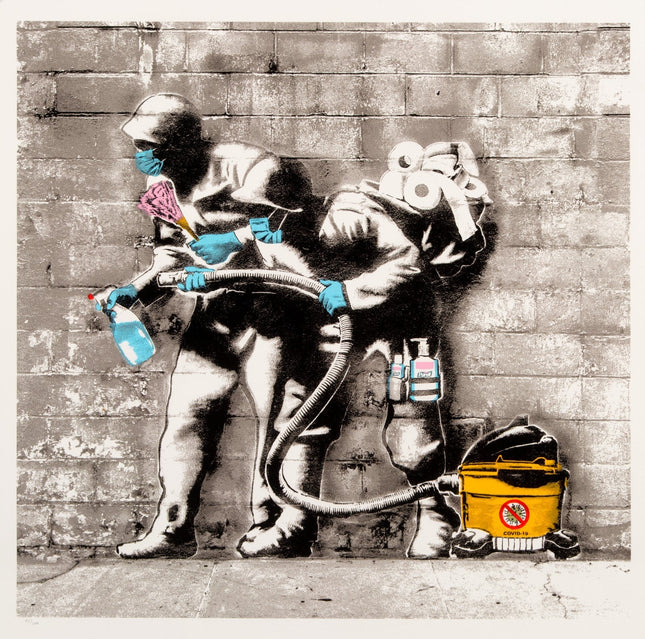
Hijack Pandemonium Silkscreen Print by Hijack
Pandemonium Hand-Pulled Deckled Color Silkscreen Print on Fine Art Paper by Desirable Artist Hijack Limited Edition Pop Art Artwork. 2020 Hand Numbered & Artist Stamped Limited Edition of 100 Hand-Deckled Artwork Size 22x22. Global Food Bank Covid Charity Print by Hijack. Introducing "Pandemonium" by Hijack: A Street Pop Art Reflection on Global Crisis Crafted amid the tumultuous era marked by the COVID-19 pandemic, the artwork "Pandemonium" by the street artist Hijack seizes the collective consciousness of a world grappling with uncertainty and upheaval. This piece is a hand-pulled, deckled color silkscreen print on fine art paper, embodying the artist's poignant response to the pandemic's impact on society. Hijack, whose real name remains part of his enigmatic persona, has become a notable figure in the contemporary street pop art and graffiti art scene, with works that often delve into the commentary on current events and social issues. The limited edition artwork, sized 22x22 inches, is a visual statement and a philanthropic endeavor, with its proceeds aimed at supporting global food banks during the pandemic. As a part of a limited run of 100 pieces, each hand-numbered and stamped by the artist, "Pandemonium" becomes a collectible piece of history, immortalizing the zeitgeist of the early 2020s. Symbolism and Technique in Hijack's "Pandemonium" "Pandemonium" exudes a striking balance between the immediacy of graffiti art and the calculated precision of pop art silkscreen printing. The image portrays a figure in protective gear, the silhouette and posture reminiscent of a healthcare worker and a biohazard cleaner. This duality highlights the frontline reality of the pandemic. The use of bright colors against the monochrome background draws attention to the subject and infuses the piece with a sense of vibrancy amidst the darkness, a hallmark of street pop art's capacity to find beauty and meaning in the grim and mundane. The fine art paper serves as the urban canvas for Hijack, much like the walls and alleyways of the cityscape serve other graffiti artists. The deckled edges of the paper echo the often rough and transient nature of street art, offering a contrast to the permanence that the limited edition print signifies. It is this interplay of the brief with the enduring that Hijack navigates through "Pandemonium," reflecting on the fleeting nature of the pandemic while capturing a moment in time that will be indelibly etched in history. The Cultural Resonance of "Pandemonium" in Street Art Discourse In the broader discourse of street pop art and graffiti artwork, "Pandemonium" resonates as a cultural artifact, a beacon of the times. The work emulates how street artists have historically used public spaces and accessible mediums to reflect societal sentiments, provoke thought, and inspire action. Hijack's choice to contribute to a global charity through his art reflects a tradition within street art to not only comment on social issues but also actively participate in societal change. The image's depiction of the character with a spray bottle labeled "COVID-19" evokes a sense of action and responsibility, an acknowledgment of the collective efforts to 'cleanse' the world of the viral threat. This representation goes beyond mere aesthetics; it is a rallying cry, a nod to the resilience of humanity in the face of a global crisis, and a testament to the role of art in documenting, responding to, and healing communal traumas. As a piece of street pop art, "Pandemonium" stands out for its ability to capture the essence of an unprecedented global event while maintaining the stylistic and thematic elements that define the genre. Hijack's work is not just an artistic response to a pandemic; it is a historical record and a commentary on the human condition, a reminder of the tumult and triumph that characterize our times. In the legacy of street art, "Pandemonium" will be remembered as a poignant reflection of the era it was created in, a testament to the power of art to encapsulate complex emotions and narratives. It is a visual dialogue between the artist and the world, a piece that speaks to the fear, hope, and indomitable spirit that has defined the human response to the COVID-19 pandemic. Through "Pandemonium," Hijack contributes to the rich tapestry of street pop art and graffiti artwork, which continues to evolve and resonate as a voice of the people in the public domain.
$1,044.00
-

Jermaine Rogers Damaged Bear 72 Original Marker Drawing by Jermaine Rogers
Damaged Bear 72 Original Color Marker Drawing by Jermaine Rogers on Wove Fine Art Paper Modern Street Pop Artwork. 2007 Signed Original Marker Ink Drawing Size 6.5x10. "Something is very wrong with me: I am falling apart...'" Damaged Bear 72 by Jermaine Rogers – Psychological Symbolism in Street Pop Art & Graffiti Artwork Damaged Bear 72 is a 2007 original marker ink drawing by American artist Jermaine Rogers, executed on wove fine art paper and measuring 6.5 x 10 inches. Signed by the artist, the piece is an emotionally raw and visually haunting entry in Rogers’s ongoing exploration of vulnerability, identity, and collapse. The drawing features a wide-eyed bear figure rendered in loose, expressive linework with patches of red that appear as wounds or signs of decay. Numbered 72 on its forehead and accompanied by hand-lettered text reading Something is very wrong with me: I am falling apart, the artwork merges character design with psychological confession. This bear is not a mascot or a toy—it is a vessel for emotional trauma, painted with urgency, humor, and existential dread. The piece exists as a stark and poignant work within the world of Street Pop Art & Graffiti Artwork, where imagery speaks louder than exposition. Visual Language of Inner Collapse The bear figure is a recurring character in Jermaine Rogers’s visual universe, often used to explore themes of innocence broken and identity under pressure. In Damaged Bear 72, the character’s sagging posture and panicked eyes suggest disorientation and surrender. Red ink blots mark its body like open wounds, and its blank, swirling irises indicate an emotional unraveling. The text above the figure reads like a journal entry or whispered confession, turning the drawing into a narrative fragment that blends visual and literary anxiety. Rogers uses minimal color—mostly black, pink, red, and cyan—but every mark contributes to the sense of urgency and internal fragmentation. The simplicity of materials contrasts the complexity of message, a method that aligns with the unfiltered nature of Street Pop Art & Graffiti Artwork. Marker Drawing as Emotional Broadcast Executed entirely in marker on fine art wove paper, the drawing reflects immediacy and tactile presence. The lines are loose, intentional, and flawed in a way that enhances their sincerity. Rogers’s use of bleeding ink and uneven pressure brings a sense of performance to the act of drawing, capturing not just form but emotional atmosphere. The paper holds every smudge and hesitation, turning what could be a sketch into a finished emotional document. The bear’s open expression, numbered forehead, and decaying appearance resonate as symbols of individuality lost in systemic tension. In the context of graffiti and pop character traditions, Rogers’s bear stands apart by leaning into fragility instead of bravado. Jermaine Rogers and the Anatomy of Emotional Resistance Damaged Bear 72 represents Jermaine Rogers at his most exposed, offering a piece that is both a visual statement and a confessional artifact. His work operates where emotion meets iconography, turning cartoonish figures into messengers of truth and despair. In the world of Street Pop Art & Graffiti Artwork, this piece is not about street dominance or design flash—it is about the quiet, painful moments that define human experience. Rogers’s ability to inject philosophical and emotional gravity into character-driven imagery places him among the most nuanced voices in the genre. This bear does not roar—it pleads, stares, and disintegrates in front of the viewer, offering no solutions, only honesty. That honesty is what transforms Damaged Bear 72 from a sketch into a relic of modern anxiety, drawn in lines that refuse to lie.
$750.00 $675.00
-
Rip N Dip Freedom Nerm Nermal Art Toy Figure by Rip N Dip
Freedom Nerm Nermal Limited Edition Anatomy Vinyl Art Toy Collectible Artwork by Street Brand Artists Rip N Dip. 2022 Limited Edition of 150 Size 14-inch Fourth of July Nerm Nermal Vinyl Figure Terminator Dissected Art Toy. New In Box
$347.00
-
Ravi Amar Zupa In This Together Woodblock Print by Ravi Amar Zupa
In This Together Woodblock Print by Ravi Amar Zupa Hand-Pulled on Reclaimed Wood Panel Limited Edition Artwork. 2020 Signed & Numbered Limited Edition of 40 Artwork Size 4x5.75 Woodblock Print on Ready To Hang Slightly Distressed Wood Panel Depicting a Jolly Roger Skull and Cross Bones with Crown. Artwork Says: Social Distancing With Love 2020 In This Together. "In This Together" is a profound woodblock print by Ravi Amar Zupa, an artist known for his intricate hand-pulled prints on reclaimed wood panels. This limited edition artwork, part of a collection of only 40, reflects a moment defined by the global pandemic and encapsulates the ethos of solidarity and resilience. Measuring 4x5.75 inches, the piece is a compact yet powerful statement, ready to hang and slightly distressed, which adds to its raw appeal. The print features the iconic Jolly Roger skull and crossbones, crowned, a symbol historically associated with piracy but recontextualized here to signify unity in adversity. Symbolism and Technique in Zupa's Work Ravi Amar Zupa's choice of imagery and text in "In This Together" is evocative and timely. Paired with a crown, the skull and crossbones traditionally symbolize death and power. However, in the context of this artwork, they take on a new meaning, representing the collective struggle and the need to 'reign' over the crisis with compassion, as suggested by the phrase "Social Distancing With Love." The woodblock print technique, a traditional form of printmaking, lends a sense of timelessness and connects the work to a long history of artistic expression. At the same time, the reclaimed wood panel serves as a reminder of sustainability and resourcefulness. Cultural Resonance of the Artwork The cultural resonance of "In This Together" within the street pop art and graffiti artwork scene is significant. It captures a shared sentiment that transcended borders during the pandemic—solidarity. Zupa's work often explores themes of social and political significance, and this piece is no exception. It speaks to the heart of street art's social role: to comment, unite, and inspire. This artwork is not just a reflection of the times but also a rallying cry, a statement of support and empathy that resonated deeply during a time of global uncertainty. Collectability and Impact on Contemporary Art The collectability of "In This Together" lies in its limited edition status, signed and numbered by Zupa, which adds an element of exclusivity. The work's size makes it accessible, while its message and craftsmanship make it a significant addition to any collection of contemporary street pop art and graffiti artwork. The piece's impact is further enhanced by its medium—woodblock printing on wood panel—which bridges traditional art-making techniques with modern themes, thus appealing to a wide range of art enthusiasts and collectors. "In This Together" by Ravi Amar Zupa is a compelling piece of contemporary art that resonates with the communal spirit of street pop art and graffiti artwork. Through traditional woodblock printing on reclaimed wood, Zupa creates an artwork that is both a testament to the times and a timeless piece of artistry. It stands as a symbol of unity and love in a year marked by separation and uncertainty, offering a message of hope and togetherness that is as universal as it is powerful.
$226.00
-
Denial- Daniel Bombardier Supreme Gucci Smashup Pill Inverse Skateboard Deck by Denial- Daniel Bombardier
Supreme Gucci Smashup Pill- Inverse Fine Art Limited Edition Archival Pigment Print Transfer on Cold Pressed Steep Natural Skateboard Deck by Street Artwork Graffiti Artist Denial- Daniel Bombardier. 2022 Numbered Limited Edition of 50 Skateboard Artwork Size 8.25x32 Archival Pigment Print Transfer on Cold Pressed Steep Natural Skate Deck Size: 8.25 x 31.875 Inches Release: June 28, 2022 From the Gucci logo, Louis Vuitton & Supreme to Channel perfumes and credit cards, he is utilizing such cultural products with the intention to make a statement against the system, which gave birth to them. As a result, he re-contextualizes them and transforms them from commercial products to his cultural legacy.
$595.00 $536.00
-
Nychos Pineal Gland Archival Print by Nychos
Pineal Gland Archival Pigment Fine Art Limited Edition Print on Velvet Cotton Fine Art Paper by Artist Nychos, Street Pop Art Graffiti Legend. 2020 Signed & Numbered 18.2x24 Fine art print by NYCHOS Limited Edition of 111 Velvet Fine Art cotton fiber paper Hand-signed & numbered The pineal gland seems to have eye-like functions. It contains structures similar to the photoreceptors of our eyes. The entrance of light has an impact on the gland’s activity, including the hormonal regulation of our sleep and waking cycle. This involves brain wave changes. During meditative states, the pineal gland is similarly active as during nighttime. It helps the mind to enter a more relaxed state. -Nychos Pineal Gland by Nychos Pineal Gland is a limited edition archival pigment print by Austrian street art and anatomical art pioneer Nychos, released in 2020 as a signed and numbered edition of 111. Printed on velvet cotton fine art paper, the work measures 18.2 x 24 inches and exemplifies Nychos’ signature fusion of medical illustration, street art precision, and philosophical inquiry. The composition presents a clean profile view of a female figure, rendered as a detailed anatomical cross-section that exposes the brain, spine, and internal systems with surgical clarity. The Third Eye and Inner Perception At the conceptual core of the artwork is the pineal gland, often referred to as the “third eye.” Nychos highlights its central placement within the brain, emphasizing its symbolic and biological role as a regulator of circadian rhythms, consciousness, and altered states of awareness. The exposed neural pathways and skeletal structure transform the human head into a visual map of perception itself. By removing the external surface, Nychos invites the viewer to consider how light, thought, and inner awareness shape human experience beyond what is immediately visible. Nychos’ Intersection of Science and Spirituality Pineal Gland reflects Nychos’ ongoing exploration of the boundary between empirical science and metaphysical belief. While rooted in accurate anatomical detail, the work extends into themes of meditation, consciousness, and mental states associated with rest and introspection. The calm upward tilt of the subject’s face suggests transcendence and inner focus rather than clinical detachment. As with much of Nychos’ work, the piece challenges viewers to confront the complexity of the human body while also acknowledging the intangible forces that influence thought, awareness, and identity.
$450.00
-
Denial- Daniel Bombardier Covid No 19 Bleue Archival Print by Denial- Daniel Bombardier
Covid No 19- Bleue Limited Edition Archival Pigment Print on 290gsm MOAB Fine Art Paper by Graffiti Pop Art and Street Artist Denial. 2021 Signed & Numbered Limited Edition of 19 Bleue Covid19 Chanel Hand Sanitizer Virus Variant. Numbered, Signed, Stamped on Reverse Archival Pigment Print on MOAB Fine Art Paper 290 GSM Size 18" x 24" Denial’s COVID No. 19: Luxury Branding in the Age of Global Crisis Denial’s COVID No. 19 is a striking archival pigment print released in 2021 as a limited edition of 19, each hand-signed, numbered, and stamped on 290gsm MOAB fine art paper. The work appropriates the form of a Chanel No. 5 perfume bottle, replacing its iconic label with a fictional product name: COVID No. 19 Hand Sanitizer. Rendered with hyper-clean digital precision, the image reconfigures the aesthetics of high fashion to comment on the absurdities of pandemic-era consumerism. The hand sanitizer bottle is presented with all the visual authority of a luxury good, transforming an object of necessity into a parody of status and desire. At the core of this piece is a brutal cultural observation: during a global health emergency, everyday tools of survival—like sanitizer and masks—were elevated to symbols of identity, fashion, and economic access. Denial’s rebranding of Chanel’s perfume into a virus-era commodity confronts this shift head-on. The artwork doesn’t merely lampoon luxury—it reveals how systems of marketing can absorb trauma, repackage it, and sell it back to the public. The Chanel-style labeling is clinical yet elegant, a nod to how visual minimalism often masks corporate manipulation. Commercial Aesthetics as Subversive Weaponry Denial’s artistic strategy centers on the theft and recontextualization of commercial language. With COVID No. 19, the use of vector-sharp line work, realistic light reflections, and exacting product design mimics advertising to the point of deception. This imitation is intentional. The viewer is meant to initially read the image as authentic—something from a fashion magazine or cosmetics campaign—before the irony of the label snaps into focus. The dissonance between form and content invites a critique of the capitalist tendency to aestheticize suffering. This visual methodology ties directly into the ethos of Street Pop Art & Graffiti Artwork. Denial’s roots in unauthorized public messaging and subcultural image disruption remain present, even as the work exists in a fine art format. The absence of spray drips or rough textures does not diminish the rebellion. Instead, it retools the graphic language of commercial persuasion to undermine itself from within. What looks like a product pitch is, in fact, a visual accusation. The pandemic is not the subject—it is the branding of the pandemic that comes under fire. Street Pop Art as Pandemic Documentation COVID No. 19 operates as both satire and historical record. It captures a cultural moment when survival tools became luxury statements, when scarcity was linked to exclusivity, and when branding extended even to medical supplies. Denial’s artwork speaks to the way modern crises are not only experienced but marketed—how the fear of illness was filtered through the same systems that sell beauty, fashion, and lifestyle. The sanitizer bottle becomes a symbol not of protection, but of consumption. By fusing the iconography of fashion with the reality of a global pandemic, Denial forces the viewer to reconsider the boundaries between design and ethics, branding and survival. The visual simplicity of COVID No. 19 hides a layered indictment of how quickly commercial aesthetics can strip events of meaning. In the tradition of Street Pop Art & Graffiti Artwork, this piece turns familiar symbols against themselves, exposing the fragility of culture’s glossy surfaces when confronted with real human urgency.
$313.00
-
Saber Biohazard Slap-Up Label Sticker Original Tag Art by Saber
This Biohazard Neon Orange Slap-Up Label Sticker Original Tag Art by Saber Original Acrylic Paint Art Drawing on Biohazard Label Sticker by Graffiti Artist Modern Street Artwork. 2020 Signed Original Slap Up Graffiti Art Tag 6x6 Acrylic Paint Tagged on Medical Biohazard Label Sticker. Neon High Visibility Orange Biohazard Symbol Uline label #S-20794. Exploring the Fusion of Street Pop Art and Graffiti Artwork In the dynamic sphere of contemporary visual culture, street pop art and graffiti artwork stand out as potent forms of expression that encapsulate urban life's rhythm and raw sentiments. Among the luminaries of this genre is the renowned graffiti artist Saber, known for his striking contributions to the street art panorama. The piece under scrutiny is a vibrant example of his ingenuity—a 6x6 acrylic or marker piece tagged on a medical biohazard label sticker featuring a neon high visibility orange biohazard symbol from Uline label #S-20794. Distinctive Aesthetic of Saber's Tag Art Saber's original permanent marker art drawing on a mailing glossy arrow sticker presents a striking visual paradox. The neon orange of the biohazard symbol evokes a sense of caution, typically used to warn of dangerous substances. Contrasted with the blue drips of paint that appear haphazardly splashed across the surface, there is intentional defiance and palpable tension between structure and chaos. This work is a signed 2020 original slap-up graffiti art tag that showcases not just the artist's signature style but also his ability to transform ordinary objects into powerful statements. The choice of a biohazard label as a canvas is a commentary on the infectious nature of art and ideas. Saber effectively takes a symbol that denotes hazard and contamination and recontextualizes it within the aesthetic of street pop art. By doing so, he challenges the viewer to reconsider the connotations of biohazards, not just in the physical sense but in the metaphorical contagion of art in public spaces. Impact and Significance in Modern Street Art Saber is an American artist whose real name has been as influential in the graffiti community as the images he creates on walls and in galleries. His use of a mailing label as a medium is a nod to the guerrilla tactics of early street art culture, where quick, impactful statements were essential, and materials were often repurposed or found objects. This sticker art, often called a 'slap-up,' is a form of street art that is quickly applied, or 'slapped up,' onto a surface in a public space. It allows for transient yet assertive communication, echoing urban life's fast-paced and often impermanent nature. The neon orange and blue artwork transcends its simple components, becoming a canvas for a larger discourse on visibility, legality, and the permanence of art. As a form of street pop art, it retains the accessibility and mass appeal of pop culture while embedding itself in the more subversive and counter-cultural roots of graffiti. This duality is where its power lies; it is both a bold declaration and a subliminal whisper, a fixture on the streets that can be as quickly removed as it is noticed. In the context of graffiti artwork, Saber's biohazard label sticker becomes an artifact of the streets, a testament to the artist's ability to command attention and communicate through symbols and color. With its saturated hues and deliberate drips, the piece resonates with the energy of the streets and the people's voices. It is a piece that marks a physical space and stamps a moment in time, encapsulating the essence of street pop art in its ability to capture the pulse of contemporary urban life. The interplay of color, symbol, and medium in this piece illustrates the innovative potential of street pop art. Saber's work disrupts the monotony of urban environments, offering passersby a moment of aesthetic arrest amidst the concrete canvas of the city. In modern street artwork, such interventions are not just decorative but are vital narratives that articulate the identity and the undercurrents of a city's cultural dialogue. Through works like this, Saber and his contemporaries continue to influence the trajectory of street pop art, ensuring its evolution and relevance. They remind us that the streets remain a powerful platform for artistic expression, where the voices of the marginalized and the spirit of rebellion can find their visual lexicon. Saber's neon orange slap-up label sticker is not just a mark made with acrylic or marker; it is a statement, a challenge, and a vibrant echo of the energy that drives the city's heart.
$49.00
-
Nychos Dissection of Bambi Sheet No 23 Silkscreen Print by Nychos
Dissection of Bambi- Anatomy Sheet No 23 Hand-Pulled 1-Color Limited Edition Silkscreen Print on 300gsm Munken Pure Paper by Medical Pop Artist Nychos. 2018 Signed & Numbered Limited Edition of 200 11x17 Illustrated by NYCHOS 1-color Screen Print on 300 g/m² Munken Pure Paper Size: 11 x 17 Inches / 27,94 x 43,18 cm Limited Edition of 200 Year: 2018 Imprint & stamp of authenticity Numbered and signed by the artist The REM Anatomy Sheets focus on the anatomy of pop culture cartoon characters. In this new collection of black and white limited edition screenprints, Nychos lets the viewer engage with details of the anatomy of toons.
$159.00
-
Denial- Daniel Bombardier Supreme Gucci Smashup Pill Green Archival Print by Denial- Daniel Bombardier
Supreme Gucci Smashup Pill- Green Fine Art Limited Edition Archival Pigment Print Transfer on Cold Pressed Steep Natural Skateboard Deck by Street Artwork Graffiti Artist Denial- Daniel Bombardier. 2022 Numbered Limited Edition of 75 Skateboard Artwork Size 8.25x32 Archival Pigment Print Transfer on Cold Pressed Steep Natural Skate Deck Size: 8.25 x 31.875 Inches Release: June 28, 2022 From the Gucci logo, Louis Vuitton & Supreme to Channel perfumes and credit cards, he is utilizing such cultural products with the intention to make a statement against the system, which gave birth to them. As a result, he re-contextualizes them and transforms them from commercial products to his cultural legacy.
$505.00 $455.00
-
Ben Frost Tigger on Zoloft Archival Print by Ben Frost
Tigger on Zoloft Limited Edition Archival Pigment Fine Art Prints on Bauhaus Cotton Fine Art Paper by Graffiti Street Art and Pop Culture Artist Ben Frost. ‘Tigger On Zoloft’ Archival Digital Print on Bauhaus 310gsm Photo Rag 100% Cotton Paper Embossed, signed and editioned by Ben Frost 30cm x 30cm (12 x 12 inches) Melbourne, Australia Edition of 50 The essence of Frost’s commentary is established on the basis of subverting the meaning and the messages, promoted by the mainstream media. In other words and, as he has stated in the past: “The less you fill your mind with the trappings of advertising and bad television, the more space you have in your brain for things of value”. At the same time, his take on modern pop culture is equally compelling. Mainstream media, advertisements, and politics can be identified as some of his main fields of interest, which he utilizes and mixes up in a controversial formation. The word controversial is not used incidentally. What Ben Frost’s art is doing is, essentially, the appropriation and weaponization of imagery against the same system that gave birth to it.
$572.00 $515.00
-
Nychos Anatomy of the Horse Sheet No 11 Silkscreen Print by Nychos
Anatomy of the Horse- Anatomy Sheet No 11 Hand-Pulled 1-Color Limited Edition Silkscreen Print on 300gsm Munken Pure Paper by Medical Pop Artist Nychos. 2017 Signed & Numbered Limited Edition of 100 17x11 Illustrated by NYCHOS 1-color Screen Print on 300 g/m² Munken Pure Paper Size: 11 x 17 Inches / 27,94 x 43,18 cm Limited Edition of 100 Year: 2017 Imprint & stamp of authenticity Numbered and signed by the artist The REM Anatomy Sheets focus on the anatomy of 10 wild animals. In this new collection of black and white limited edition screenprints, Nychos lets the viewer engage with details of the anatomy of animals.
$159.00