


Street Art
-
Dave Pollot On the Shoulders of Tiny Giants I Archival Canvas Print by Dave Pollot
On the Shoulders of Tiny Giants I Limited Edition Archival Pigment Fine Art Prints on Canvas by Graffiti Street Art and Pop Culture Artist Dave Pollot. 2021 #1/25 Signed & Numbered Limited Edition of 25 Artwork Size 31x40 Large Format Canvas Print on pH neutral 17 mil canvas. 2" of white margin surrounding the image. On the Shoulders of Tiny Giants I: Archival Pigment Fine Art Print by Dave Pollot On the Shoulders of Tiny Giants, I is an archival pigment fine art print on canvas created by the graffiti street art and pop culture artist Dave Pollot. Released in 2021, this piece is a limited edition of 25, signed and numbered by the artist, with the first print (#1/25) measuring a substantial 31x40 inches. Pollot's ability to blend traditional landscape paintings with modern pop art and graffiti elements is showcased in this large-format artwork. The use of pH-neutral 17 mil canvas ensures the longevity of the print, providing both durability and a rich, textured appearance. Exploring the Layers of Tradition and Modernity in Pollot's Work Dave Pollot's work often centers around the playful intersection of classical art forms and contemporary cultural references. In On the Shoulders of Tiny Giants I, Pollot takes what appears to be a traditional landscape painting at first glance and disrupts it with a graffiti-inspired burst of modernity. The foreground of the piece depicts a peaceful, pastoral scene, with trees lining a tranquil river. The colors are muted, evoking the soft, earthy tones characteristic of 19th-century landscape art. The landscape itself seems to invite the viewer into a serene world where time stands still. However, Pollot's signature approach is to blend these traditional elements with a bold, contemporary twist. In the center of the image, the painting seems to tear away, revealing a chaotic, cartoon-like graffiti pattern underneath. This underlayer is filled with abstract doodles and tiny characters, evoking a sense of frenetic energy and urban street art culture. The effect is both jarring and mesmerizing, as if the tranquil surface of the painting has been ripped apart to expose the vibrant and often chaotic world that lies beneath. This contrast between the old and the new, the serene and the chaotic, is a central theme in much of Pollot's work. He invites viewers to question their assumptions about art and culture, asking whether the old and the new can truly coexist or whether one will always dominate the other. In this piece, Pollot seems to suggest that the two are inextricably linked — that modern culture, with all its noise and chaos, is built upon the foundations of the past. The Influence of Street Pop Art and Graffiti Pollot's use of graffiti-inspired visuals in On the Shoulders of Tiny Giants I ties directly into the tradition of street pop art. Street pop art often takes elements of urban graffiti and recontextualizes them within the framework of fine art. In this piece, Pollot does just that, using the ripped-away section of the canvas to reveal an intricate world of graffiti-like doodles and characters. The characters in the underlayer are reminiscent of the playful, sometimes absurd figures often found in street art, lending a sense of humor and whimsy to the piece. At the same time, the graffiti element serves as a commentary on the tension between high and low art forms. Traditional landscape paintings are often seen as part of the "high art" canon, while graffiti is typically associated with street culture and countercultural movements. By combining the two, Pollot challenges the viewer to question the hierarchies that exist within the art world. Is one form of art inherently more valuable or legitimate than the other, or do both have something important to offer? Pollot's choice to depict the graffiti layer as something hidden beneath the surface of the traditional painting also raises interesting questions about what is visible and what is concealed in art and culture. Graffiti is often created in public spaces, yet it is frequently painted over or removed, its presence deemed undesirable in certain contexts. In On the Shoulders of Tiny Giants I, Pollot brings this hidden layer to the forefront, forcing the viewer to confront the vibrant, chaotic world that is often just out of sight. The Technique and Materiality of the Print Pollot's attention to detail is evident not only in the composition of the piece but also in the materials and techniques used to create it. The archival pigment printing process ensures that the colors remain vibrant and true to the artist's vision over time. This is particularly important for a piece like On the Shoulders of Tiny Giants I, where the contrast between the muted tones of the landscape and the bold, colorful graffiti layer is central to the overall impact of the artwork. The use of pH-neutral 17 mil canvas provides a sturdy, high-quality surface for the print, allowing the texture of the canvas to enhance the richness of the image. The size of the print, at 31x40 inches, makes it a statement piece. The large format allows the viewer to fully appreciate the intricate details of both the landscape and the graffiti elements. Pollot's use of a 2-inch white margin surrounding the image further enhances the sense of depth and space, drawing the viewer's eye inward toward the center of the piece. This margin also serves a practical purpose, making it easier to frame the print while maintaining the integrity of the image. The Evolution of Modern Art in Pollot's Work On the Shoulders of Tiny Giants I is a prime example of how modern artists like Dave Pollot are rethinking the boundaries of art. Pollot's work is part of a larger movement within contemporary art that seeks to break down the distinctions between high and low culture, tradition and modernity, fine art and street art. By blending these elements together, Pollot creates a visual dialogue that speaks to the complexity of modern life. Pollot's decision to incorporate graffiti elements into a traditional landscape also reflects the growing influence of street art within the world of contemporary fine art. Artists like Banksy and Shepard Fairey have brought street art into the mainstream, challenging conventional ideas about what art is and where it belongs. Pollot's work builds on this tradition, using the language of street art to disrupt the conventions of classical painting. On the Shoulders of Tiny Giants I is a testament to Pollot's ability to navigate the complex terrain of modern art. His work is both a celebration of the past and a commentary on the present, inviting viewers to reconsider their assumptions about art, culture, and the world around them. The limited edition nature of the print, combined with Pollot's signature style, makes this piece a valuable addition to any collection of contemporary art, particularly for those who appreciate the intersection of street pop art and graffiti culture with traditional fine art forms.
$589.00
-
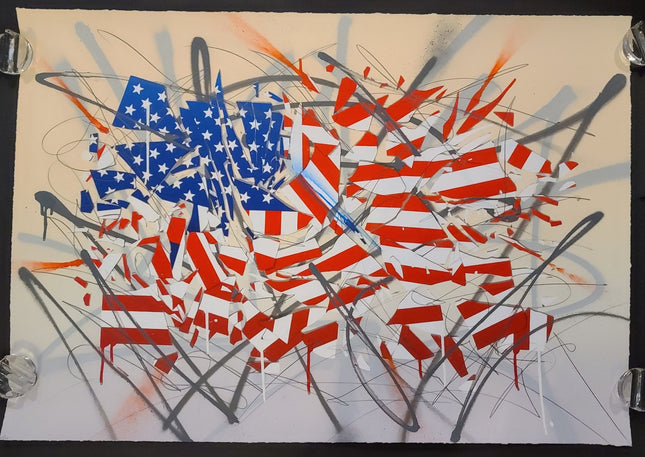
Saber Indivisible HPM Serigraph Print by Saber
Indivisible HPM Limited Edition Hand Pulled 4-Color Serigraph Print on Coventry Rag Archival Paper by Saber Graffiti Street Artist Modern Pop Art. This is a large print. -40"x28" in -Serigraph/ mixed media, spray paint, pencil on Coventry Rag archival paper -Each print is unique with spraypaint and pencil -Hand deckled edges "This print was an experiment from start to finish. This is a multi-dimensional mixed media print in the sense the original was created as a conceptual digital-video piece. From this video experiment I was able to capture the final image to be translated into the print format. This was tricky breaking the American Flag that was printed on glass and capturing the right moments as it shattered, but as this process evolved so did the outcome. I really went all out on these with the hand-touching. Within the print layers are raw spray-paint tags buried under multi-colored split fountains. I also penciled and spray-painted on top of the prints weaving these colors and gestures through the image." -Saber
$803.00